There is a version of film history where Akira quietly disappears. A cartoon costing more than a billion yen, based on a manga most of its own investors hadn't read to the end, arriving in the same summer as a soft-eyed forest spirit called Totoro and a wave of enormous Gundam robots. By any sensible logic, it should have been a footnote. Instead, it became the reason an entire generation of animators, musicians, and Hollywood directors had to rethink what a drawing could do.
Akira did not just tell a good story about a boy on a motorcycle who accidentally becomes a god. It changed how Japanese animation got financed, how it moved, how it sounded, and how the rest of the world was allowed to think about it. Nearly four decades on, its fingerprints are still turning up in places you wouldn't expect, including the middle of a Jordan Peele film.
What makes that staying power a bit strange is how narrow the film's own scope actually was. Katsuhiro Ōtomo's original manga ran past two thousand pages and continued publication for two more years after the film came out, yet the screenplay he co-wrote covers only the front half of that story, compressed into a hundred and twenty-four minutes. A smaller film, made with less conviction, would have felt like a trailer for a story it never finished telling. Instead, it became the template other people kept borrowing from, in industries that had nothing to do with manga at all.
A Billion-Yen Bet in a Crowded Summer
When Katsuhiro Ōtomo's (大友克洋) animated feature Akira premiered in Japanese theatres on 16th July 1988, it walked straight into one of the most competitive release windows in the country's cinema history. Studio Ghibli had just put out its own double bill, pairing Hayao Miyazaki's My Neighbor Totoro with Isao Takahata's Grave of the Fireflies. Sunrise, meanwhile, was riding high on Mobile Suit Gundam: Char's Counterattack. Against that field, Akira looked less like a safe commercial play and more like a dare.
The numbers back that up. Production costs started around five hundred million yen and crept toward seven hundred million yen (roughly $3.3 million to $4.7 million at current exchange rates) before prints, advertising, and reshoots pushed total spending closer to one point one billion yen (about $7.3 million). Toho's theatrical run brought in about seven hundred and fifty million yen (around $5 million) in distributor rental income, from over one million admissions. That is a solid result for most films. For the most expensive animated production Japan had ever attempted, it was closer to breaking even than breaking records.
What actually made Akira a financial success took years to show up. Laserdisc sales, VHS circulation, repeated revival screenings, and later a run of 4K IMAX re-releases stretched the film's cumulative domestic gross toward an estimated six point three billion yen (around $42 million) over subsequent decades. The lesson the industry took away was not that big-budget anime pays off immediately. It was that it can pay off for a very long time, provided someone is patient enough, and organised enough, to keep collecting.
The Committee Nobody Wanted to Need
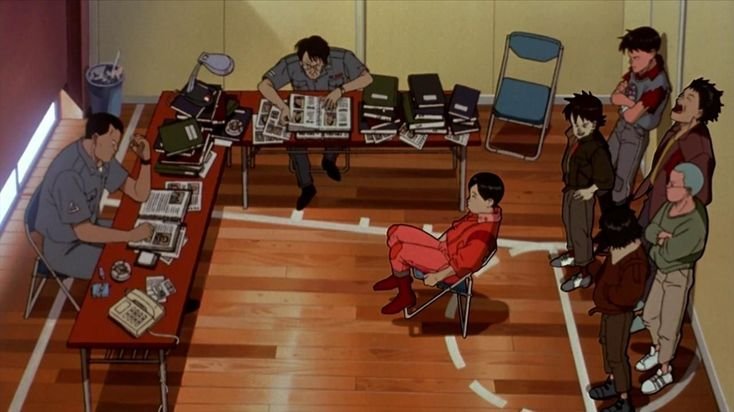
That patience required a structure that did not exist yet. Before Akira, large Japanese animated features were usually bankrolled by a single studio or a broadcaster looking for a promotional tie-in. Neither model could absorb the risk that Ōtomo's ambitions demanded, so Kodansha, the publisher behind the manga, assembled something unusual: an eight-company consortium that became known as the Akira Committee (アキラ製作委員会).
The roster reads like a strange dinner party guest list. Kodansha wanted to protect the intellectual property while building an international export pipeline. Toho wanted guaranteed access to prime theatrical screens. Bandai was applying lessons learned from producing Royal Space Force: The Wings of Honnêamise. Mainichi Broadcasting System wanted long-term domestic broadcast rights. Hakuhodo, an advertising agency, wanted to test whether mature anime could carry corporate sponsorships. Laserdisc Corporation wanted a flagship disc to sell players with. Sumitomo Corporation, a general trading firm with no obvious business being anywhere near an animation studio, wanted to learn the mechanics of film production well enough to build an export arm through its new venture, Asmik Ace. Tokyo Movie Shinsha simply supplied the studio space and staff to make the thing.
Ryōhei Suzuki, who acted as the consortium's executive auditor, later put the logic plainly, if a little diplomatically: producing a feature on this scale carried more financial risk than any single company could reasonably shoulder, and while gathering so many different industries together caused its share of friction, it also meant the project benefited from an unusually wide spread of perspectives. That structure, the production committee, or seisaku iinkai (製作委員会), didn't just get Akira made. It became the default way Japan finances ambitious animation to this day, right down to the anime series airing this season.
Ōtomo's Obsession With Making Cartoons Behave Like Reality
Visually, Akira set out to dismantle the house style of Japanese limited animation, or rimiteddo animēshon (リミテッドアニメーション), which had long relied on expressive stylisation and a light drawing count to keep production manageable. Ōtomo, coming from a background as an illustrator rather than a career animator, pushed for something closer to physical truth: weight, anatomy, and a kind of architectural solidity that Japanese animation simply hadn't attempted at this scale.
The animation critic Ryūsuke Hikawa has described how Ōtomo's approach resolved a divide that had shaped Japanese studios for three decades, caught as they were between Disney-influenced design and the caricature of gekiga-style manga. Ōtomo's characters, in Hikawa's account, looked like actual Japanese people, rendered with a precision where fabric behaved like fabric and muscle behaved like muscle, all governed by a kind of visual cause and effect. Hikawa went further, arguing that quality in animation isn't about pretty drawings at all. It's about weight: whether the density and chaos on screen are enough to make an audience believe the world in front of them is real.
Getting there meant throwing out standard production habits. Most Japanese animation used post-synchronisation, or afureko (アフレコ), where animators sketched rough mouth movements first and voice actors matched their performance to the finished footage afterward. Akira reversed the order across its entire hundred and twenty-four minute runtime, recording dialogue before a single frame of animation was drawn. That forced supervising animation director Takashi Nakamura to develop seven distinct mouth shapes to capture the specific physical mechanics of Japanese speech.
Key animator Toshiyuki Inoue, who worked on several of the film's pivotal sequences, later recalled just how demanding that discipline was in practice. Japanese speakers tend to underarticulate, he pointed out, without the exaggerated mouth movement that lip-syncing to a soundtrack after the fact usually gets away with. Matching that reality frame by frame made the schedule brutal, but it also forced the animation team to rethink how characters physically express emotion at all.

The film's motion held to the same standard. Where Japanese television and most features ran on "three-koma" animation (each drawing held for three frames, at eight drawings per second), Akira was drawn primarily on "two-koma" (twelve drawings per second), stepping up to full "one-koma", or twenty-four frames per second, for its fastest action. Crowds and background characters moved on their own independent cycles rather than freezing in place, adding up to roughly one hundred and fifty thousand hand-drawn cels across the finished film.
Ōtomo also insisted his animators think like camera operators, applying the actual optics of wide and telephoto lenses to hand-drawn layouts rather than the flat, stage-like staging cel animation typically relied on. Inoue described the effect of learning that a figure running toward the camera doesn't simply grow bigger at a constant rate when shot on a telephoto lens, and how building animation around that kind of optical physics reshaped his entire technical vocabulary. A year spent on Akira, he said, told him exactly what his talent was actually built for.
Even the colour palette got the same treatment. Rather than the flat primary blues most productions used to signal "night city," the production developed three hundred and twenty-seven distinct production colours, including fifty custom-mixed pigments, to build a Neo-Tokyo that looked, on Ōtomo's own instruction, like a rundown amusement park: dazzling from a distance, and visibly rusted and grimy the closer you looked.
A Score That Argued With the Rest of Science Fiction
The sound design took an equally deliberate left turn. Producers initially suggested Isao Tomita, the synthesizer composer whose work had defined Japanese science fiction cinema for the better part of two decades. Ōtomo turned the idea down as too predictable and went looking for something more physical, something that could ground Neo-Tokyo's neon sprawl in the human body rather than in electronics.
He found it in Geinoh Yamashirogumi (芸能山城組), a performance collective led by Shōji Yamashiro, the stage name of the composer and scientist Tsutomu Ōhashi (大橋力). Yamashiro initially agreed to the job expecting to write two modular themes. Once he saw the storyboards, he committed the entire collective to a full score instead.
That score borrowed nothing from a conventional Western orchestra. The propulsive drive behind "Kaneda" leans on the jegog, an enormous Balinese bamboo xylophone whose low frequencies give the track its thundering pulse, layered with the interlocking vocal rhythms of Balinese kecak chanting to mirror the frantic energy of the film's motorcycle battles. For Tetsuo's psychic unravelling, the collective reached for Buddhist liturgical chanting, or shōmyō (声明), Noh vocal technique, and the dense microtonal harmonies of Bulgarian polyphonic choirs, aiming for something closer to raw human voice than to a conventional film score's emotional shorthand.
Yamashiro framed the group's method less as composition and more as an experiment in treating a crowd of people as a single acoustic instrument, an attempt, in his words, to line up biological rhythm with social rhythm, on the theory that sound is really just how the brain rebuilds a picture of the world from vibration. That idea wasn't purely artistic flourish. Ōhashi later carried it into his own academic research, proposing what he termed the "hypersonic effect": the claim that inaudible high-frequency sound, present in live gamelan performance but largely absent from standard digital recordings, can measurably affect brain activity even though listeners can't consciously hear it. It's a properly interesting idea, and one that gave Akira's cinema sound mix a physical presence its Hollywood contemporaries didn't have. Worth flagging, though: the hypersonic effect remains disputed within acoustics research, with several follow-up studies failing to reproduce its more specific claims about perceived audio quality.
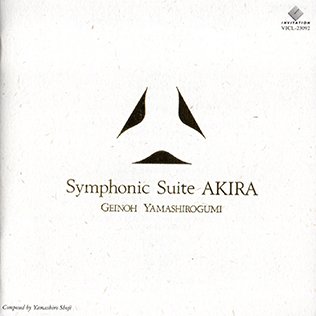
This is the cover art for Symphonic Suite Akira. The cover art copyright is believed to belong to the record label or the graphic artist(s).
Front cover of the album Symphonic Suite Akira by Geinoh Yamashirogumi.
Crossing the Pacific Without Studio Backing
Western audiences in the late 1980s had almost no frame of reference for what Akira was about to do to them. Japanese animation reaching North America and Europe up to that point had come almost entirely through heavily sanitised television exports, shows like Astro Boy, Battle of the Planets, and Robotech, all of it stripped down and marketed squarely at children. The assumption that animation was inherently a kids' medium was not really up for debate in most Western film circles.
Akira didn't get a conventional release to challenge that assumption. Carl Macek's Streamline Pictures, a small distribution outfit built specifically to bring Japanese animation to America with minimal editing, opened the film at the Biograph in Washington DC on 25th December 1989, later expanding into university film societies and midnight screening circuits rather than mainstream cinema chains. That grassroots path turned out to matter more than a wide release might have. Audiences encountered a film openly dealing with state violence, political collapse, and bodily horror, treated with none of the cushioning that Western cartoons usually applied to serious subject matter, at exactly the moment Cold War anxieties gave those themes somewhere to land.
The commercial results were striking for an unsubsidised, subtitled import: over one hundred thousand VHS units sold in the United States alone by the early 1990s, with comparable numbers across European markets. For context, that is a foreign-language cartoon about civic collapse and body horror outselling most mainstream video releases of the period, without a single television advert to its name. It's worth being precise about one detail here that often gets flattened in retrospective writing. The word "Japanimation" did not originate with Akira; it had already been circulating among American fans and distributors since at least the mid-1980s, largely around Robotech. What Akira did was give the term a very different reputation. Before 1989, "Japanimation" mostly meant cheaply dubbed television cartoons. After it, the word increasingly described something an adult critic could take seriously, and that shift in tone is what actually built the commercial foundation for distributors like Manga Entertainment and ADV Films.
The Slide That Wouldn't Stay in One Movie
Akira's second act of influence happened in live-action, largely because filmmakers realised animation had already solved staging problems their cameras couldn't. Lana and Lilly Wachowski have named Akira, alongside Mamoru Oshii's Ghost in the Shell, as a direct influence on The Matrix, pointing to the same interest in telekinetic destruction, institutional conspiracy, and bodies transformed by forces beyond their control.
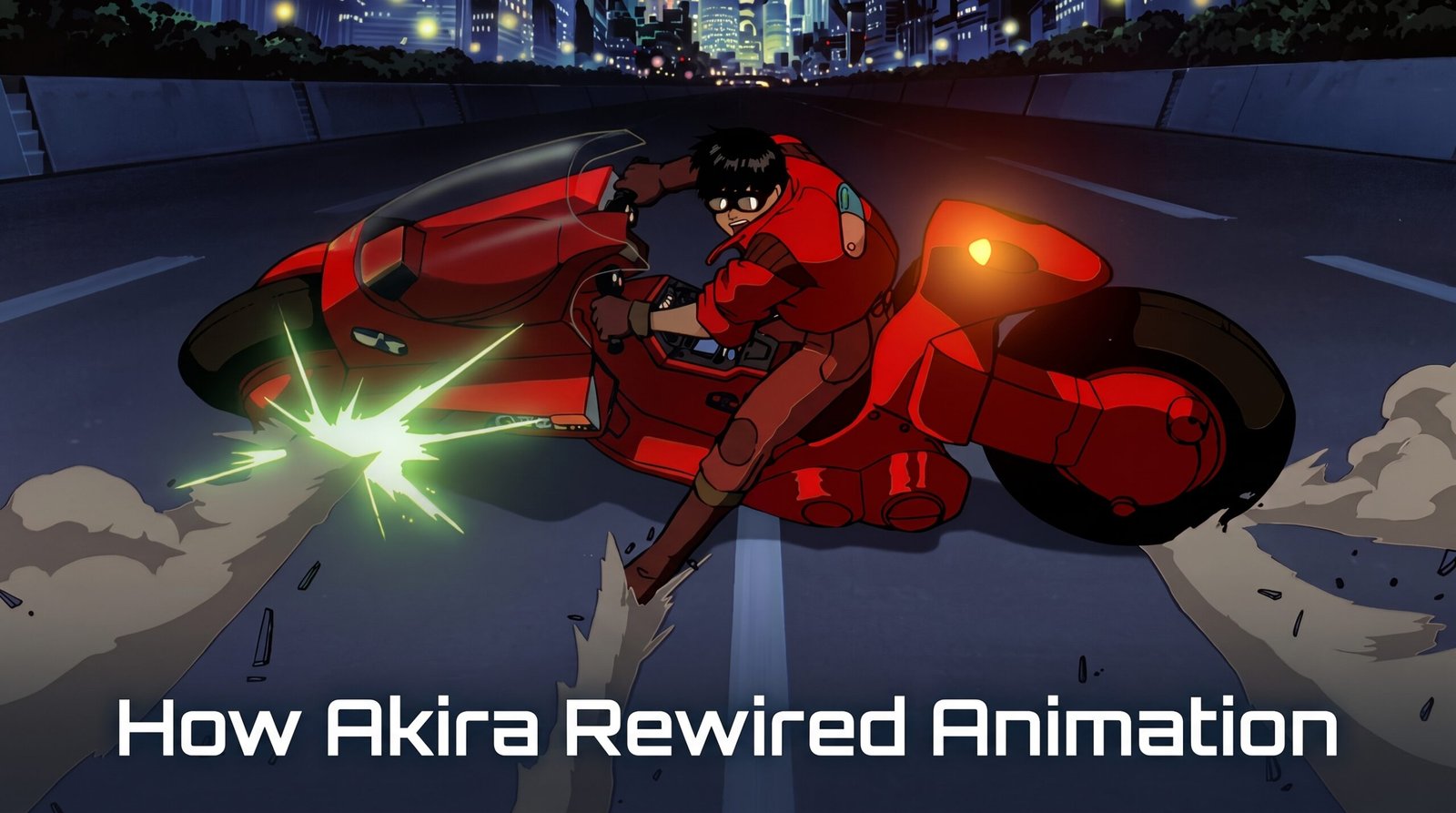
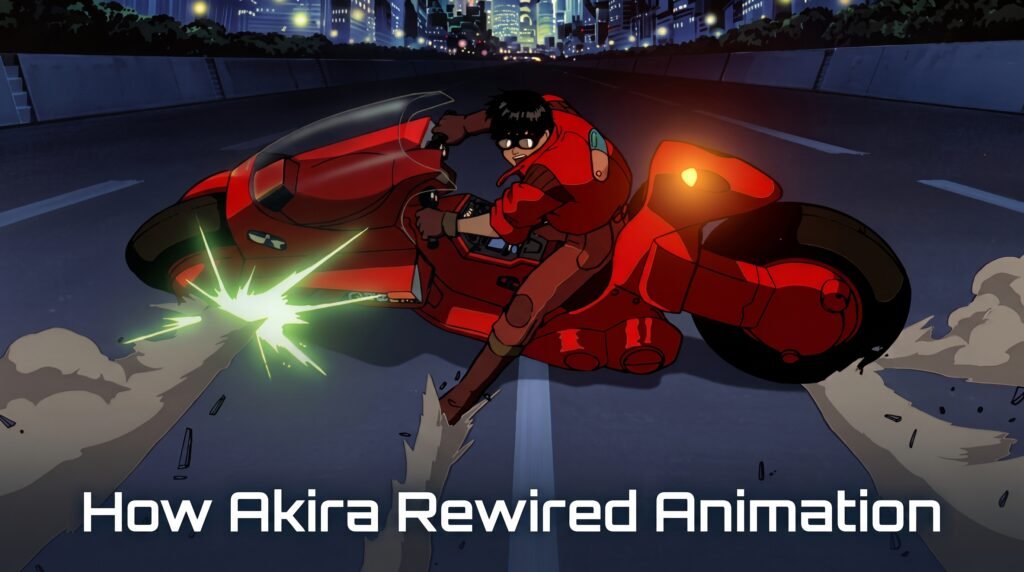
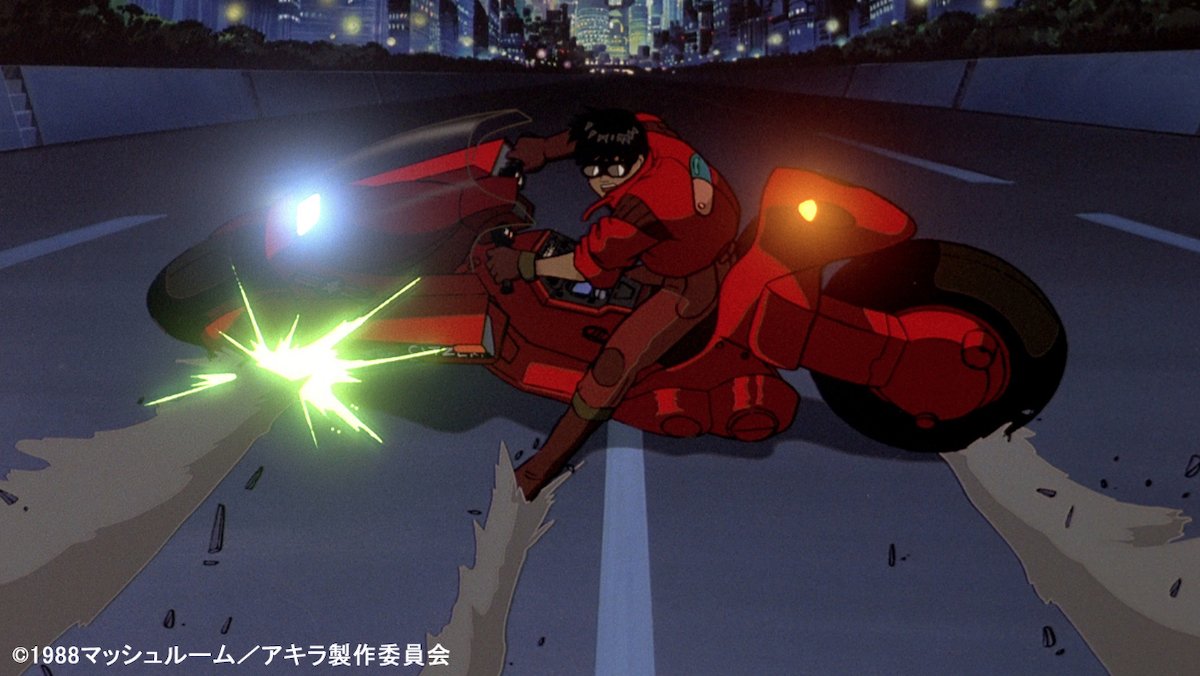
Then there's the shot. Shōtarō Kaneda sliding his red motorcycle sideways to a smoking stop has become one of the most recreated compositions in animation, turning up in Batman: The Animated Series, Star Wars: The Clone Wars, and, in live-action form, Jordan Peele's Nope, where Peele built a purpose-made camera rig specifically to reproduce it. Peele, who had at one point been attached to direct a live-action Akira adaptation before deciding to pursue his own original work instead, has described the shot as deeply personal rather than a passing reference. Tetsuo's climactic transformation inside the Neo-Tokyo Olympic Stadium did something similar for body horror, setting a visual benchmark that Hollywood's own depictions of physical and psychic breakdown kept circling back to for years afterward.
The Studio That Trained the Next Three Decades
Inside Japan, the year-long production schedule effectively ran as an academy for a generation of young animators who went on to define the next two decades of the medium. Hiroyuki Okiura, who worked under Ōtomo and Nakamura, later directed Jin-Roh: The Wolf Brigade. Kōji Morimoto directed the Magnetic Rose segment of Ōtomo's own Memories anthology. Yoshiji Kigami became a foundational technical influence at Kyoto Animation. Toshiyuki Inoue went on to serve as lead animator on Satoshi Kon's Paprika and Oshii's Ghost in the Shell.
Hikawa has traced how directly that lineage runs, describing how the animators in their late twenties on Akira absorbed Ōtomo's realism and carried it straight into Production I.G, where it became the technical backbone of Ghost in the Shell. The through-line from there to Patlabor 2: The Movie and Neon Genesis Evangelion is not really a matter of speculation; it's a documented chain of the same people applying the same standard, film after film.
What Actually Lasted
Akira's legacy splits neatly into two halves, and both matter more than its opening-week box office ever did. At home, it pioneered a financing model the entire industry still runs on, forced a new baseline of anatomical and cinematographic realism onto studios that had never needed one before, and proved that a demanding, expensive anime could pay for itself over decades rather than weeks. Abroad, it broke a fairly stubborn Western assumption that animation belonged exclusively to children, and it did it not through a marketing campaign but through word of mouth in midnight screenings and university film clubs.
Not bad, in the end, for a project that started life as a financial gamble nobody was entirely sure would pay off.
A note on quotations: Quotations from Ryūsuke Hikawa, Ryōhei Suzuki, Toshiyuki Inoue, and Shōji Yamashiro were originally given in Japanese and appear here in translation.
Sources
Wikipedia Japan: AKIRA (1988年の映画)
Wikipedia English: Akira (1988 film)
Anime Eiga: Ryusuke Hikawa on the Visual Legacy of AKIRA
Movie Walker Press: Ryusuke Hikawa on Japanese Animation History
Web Anime Style: Animator Toshiyuki Inoue Interview Archive
Cut Elimination: Critical Breakdown of Animation Mechanics in AKIRA
Slow Innovation: Tsutomu Ohashi (Shoji Yamashiro) on Geinoh Yamashirogumi
Monumental Movement: Shoji Yamashiro's Acoustic Theory
AV Watch: 4K Remaster and Hypersonic Immersion of AKIRA
Ohta Bookstand: How AKIRA Sparked the Global Japanimation Movement
Cinema Today: Production Budgets and Technical Milestones of AKIRA
Natalie Music: The Architecture of the AKIRA Remix Project
SlashFilm: Why Jordan Peele Wanted Nope to Include That Akira Homage
Cartoon Research: Streamline Pictures, Part 1
Wikipedia: Tsutomu Ōhashi
Wikipedia: Hypersonic effect