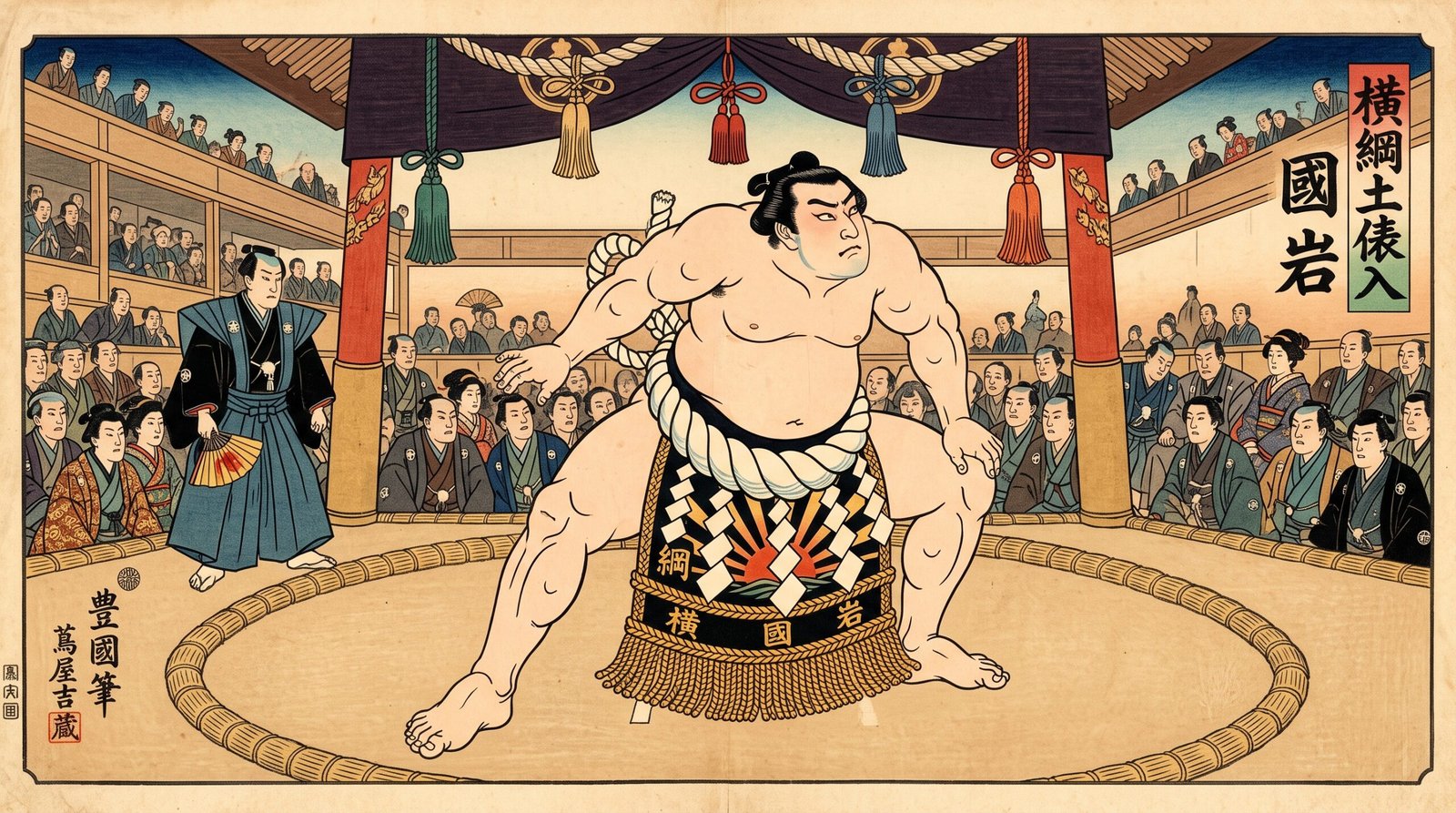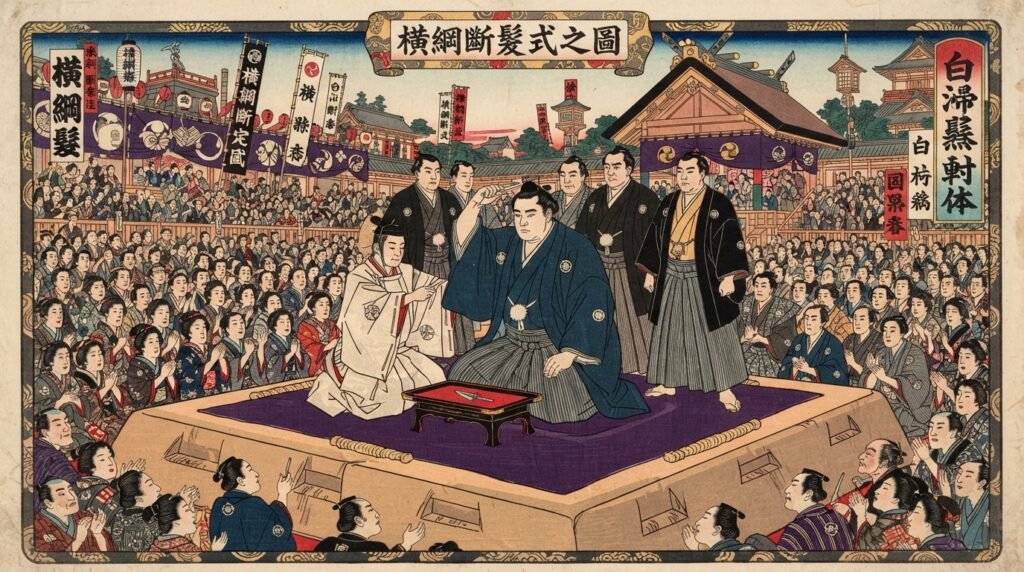
On the last day of September 2001, roughly 11,000 people packed into the Ryōgoku Kokugikan (両国国技館), Tokyo's national sumo arena, to watch a man get his hair cut off.
The man was Akebono (曙), born Chad Rowan in Hawaii, the first foreign-born wrestler ever to reach sumo's top rank of yokozuna. For nearly an hour, some 320 friends, rivals, sponsors, and dignitaries filed past him one at a time, each taking a small ceremonial snip at his topknot with a pair of scissors, until his stablemaster stepped up and made the final cut. It's called danpatsu-shiki (断髪式), the hair-cutting ceremony, and it functions as something between a retirement party and a funeral for a career. The wrestler who walks in wearing the elaborate oichomage topknot walks out looking, for the first time in years, like an ordinary man. Akebono cried through most of it. When he finally spoke, voice cracking, he told the crowd he'd do his best in the next phase of his life.
He would go on to try mixed martial arts and professional wrestling, file for bankruptcy, rebuild, and eventually die of heart failure in 2024 at the age of 54, some 27 years short of the average life expectancy for a Japanese man. We'll come back to that. For now, the point is simpler: as sumo retirements go, Akebono's was a good one. He had a stadium, a stablemaster with the standing to run the show, and hundreds of well-wishers rich enough to pay for the privilege of holding a pair of scissors for ten seconds. Most retiring rikishi (力士) get none of that. Sumo runs on a rigid hierarchy from the day a wrestler walks through the stable door, usually as a fifteen-year-old fresh out of middle school, and it turns out that hierarchy matters most in the one moment it's supposed to end.
The economics of a haircut
Not every retiring wrestler gets a danpatsu-shiki like Akebono's. The Japan Sumo Association (日本相撲協会, JSA) runs three tiers of retirement ceremony, and which one you get depends entirely on how far you climbed.
Reach the salaried sekitori ranks (Jūryō or Makuuchi) for at least thirty tournaments and you qualify for a full retirement tournament, or intai-zumo, in the Kokugikan's main arena, complete with paid tickets and a public dohyō (土俵) hair-cutting. Manage even one tournament as a sekitori and you can still hold the ceremony in the ring, just without the commercial bouts around it. Spend your whole career in the unsalaried lower divisions, and your send-off happens inside your own stable's practice hall or a rented banquet room, with whatever your stablemaster's regular patrons feel like chipping in.
That difference isn't just symbolic. Anyone who steps onto the dohyō to make a snip pays an honorarium, or goshugi (ご祝儀), typically somewhere between ¥100,000 and ¥1,000,000 (roughly $670 to $6,700) a person. Because the wrestler keeps the net proceeds from ticket sales and patron fees after the venue and the JSA take their cut, a big-name retirement tournament effectively works as a private severance fund. When Yokozuna Hakuho (白鵬) held his in 2023, more than 400 people took a turn with the scissors, and the gross receipts reportedly ran into the hundreds of millions of yen (well over a million dollars), enough to bankroll his own new stable. A wrestler who never made it past the unsalaried ranks, meanwhile, gets a much smaller and much more personal moment: a few departure gifts from family and whoever from the neighborhood showed up.

Danpatsu-shiki (Retirement ceremony) from Futabayama Sadaji, 1946 -『大相撲写真画報 昭和の大相撲60年』日本スポーツ出版社、1986年、p.66, Public domain, via Wikimedia Commons
The 105 names
The most obvious way to have a soft landing in sumo is to never really leave it. Wrestlers can stay on as coaching and voting members of the JSA, known as toshiyori or oyakata (親方), and it's the outcome most fans probably picture when they think about what happens to a retired wrestler. It's also the least available.
To become an elder, a wrestler has to acquire one of exactly 105 hereditary elder names, or toshiyori myōseki (年寄名跡). The bar to qualify isn't outrageous on its face: roughly one tournament at the sanyaku level (komusubi or sekiwake), or twenty tournaments in the top division, or thirty in the combined salaried ranks. Japanese citizenship is non-negotiable, which is why foreign-born wrestlers who want to stay on as coaches, Akebono among them, have to naturalize before they retire.
Meeting the performance bar, though, doesn't get you a name. It gets you the right to try to buy one. Because the number is fixed at 105 and has been for decades, elder names trade privately between wrestlers for sums that have run into the hundreds of millions of yen, whether through outright purchase, adoption into a stablemaster's family, marriage, or a temporary lease known as karikabu (借株). Even legends aren't guaranteed an exception: for years, a handful of yokozuna who won twenty or more championships were allowed to keep their own ring name as a personal "one-generation elder," a privilege extended to Taiho, Kitanoumi, and Takanohana. The JSA's own advisory panels eventually decided the practice had no legal footing under the association's modern corporate charter, so it was quietly shelved, and even Hakuho, one of the greatest wrestlers who ever lived, had to go out and buy a conventional elder share like everyone else.
The wrestlers who lose out are the ones who did everything right by the numbers and still couldn't find a name to buy. Former komusubi Shohozan, Chiyotairyu, and Ounsho, and former sekiwake Ichinojo, all technically qualified for elder status at retirement and all left the JSA anyway because no share was available to them at the right price, at the right time, from the right person.
For everyone else who wants to stay close to the sport without a name, the JSA keeps a tiny number of salaried support jobs: eight wakamonogashira (若者頭), who shepherd young wrestlers and help the injured off the dohyō, and thirteen sewanin (世話人), who handle the physical logistics of regional tours. Combined, that's 21 positions nationwide, and a vacancy generally only opens up when the person holding it retires or dies. It's not a real option for most people leaving the sport. It's closer to a lottery with very good odds of not winning.
Falling off the cliff
For the sekitori who do retire without a coaching path, the JSA at least cuts a real check. A former yokozuna's base retirement allowance runs around ¥15,000,000 (about $100,000), plus roughly ¥500,000 (about $3,300) for every tournament wrestled at that rank; former ōzeki Kaio reportedly accumulated ¥36,700,000 (about $245,000) in longevity pay alone, and former yokozuna Harumafuji's total package has been put at around ¥44,000,000 (about $293,000). Even a career Jūryō wrestler is entitled to a base allowance near ¥4,750,000 (about $32,000). None of these figures are published with perfect precision, since the JSA doesn't release them and most reporting comes from wrestlers or their associates after the fact, but the broad shape is consistent across sources: it's real money, and it scales sharply with rank.
Below the salaried line, there's no floor at all. Wrestlers in Makushita and the divisions beneath it draw no base salary while active, just a modest bimonthly stipend that tops out around ¥150,000 (about $1,000) and shrinks the lower you go, down to roughly ¥70,000 (about $470) in the bottom division. Retire from those ranks and there's no yoro-kin (養老金), no severance in any real sense, just a nominal farewell gift, or sembetsu (餞別), that caps around ¥200,000 (about $1,300) for a Makushita wrestler and bottoms out near ¥70,000 for the lowest tiers. The JSA does pay into these wrestlers' national pension throughout their careers, but that money is locked up until age 65, which does nothing for a 26-year-old walking out of the only home he's had since he was fifteen.
So a wrestler can spend a decade of his life inside a sumo stable, eating, training, and living entirely on the association's terms, and walk away from it with less money than most people make in a couple of months at a part-time job. That's the reality for the majority of the roughly 600 professional wrestlers active at any given time. Only a small fraction ever reach Jūryō.

What sumo actually teaches you
Keisuke Kamikawa (上河啓介) joined a stable the same year he finished middle school, in 1993, right as Japan was in the grip of a sumo boom. He fought under the ring name Wakatenro (若天狼), reached Jūryō, and stayed there on and off for eighteen years, bouncing back down to Makushita more than once, with a record of 136–170 at that level. Not a spectacular career. A long one, though, and a stable one, right up until it wasn't.
"During my active years, sumo was one hundred percent of my life, twenty-four hours a day, three hundred and sixty-five days a year," he said later. "So when I retired and it came time to find the next job, I didn't even know what I could do, let alone what I wanted to do."
He retired at 33 and, against every instinct of a culture that prizes immediate usefulness, did nothing for a while. Not because he didn't care, but because he'd worked out that the smartest move was to stop and take stock. His formal education had ended at fifteen. "In terms of schooling, I'm a middle school graduate," he said. "I figured that would put me at a real disadvantage for the rest of my life, so I decided to study for the high school equivalency exam." He spent months at a prep school for the test, passed it, and picked up a basic caregiving certification on the side, mostly on a whim. Of that whole stretch, broke and studying full time in his thirties, he's fairly blunt: "I wasn't earning any money, so it was basically like I was just goofing off."
A conversation with a friend who ran a daycare facility for the elderly changed the direction of all that studying. Kamikawa had never wanted to work for someone else; he'd always wanted to run his own business. Between that ambition and a caregiving license he'd gotten almost as an afterthought, the idea clicked. In July 2012, he opened Day Service Hanasaki in Tokyo's Sumida Ward, hired a few other retired wrestlers to help him run it, and became locally known as the sumo guy who does elder care.
The obvious assumption is that a former wrestler thrives in caregiving because of sheer strength: lifting people, moving them safely between beds and wheelchairs and baths. Ask Kamikawa directly and he pushes back on it. "Actually, situations that call for real strength are pretty rare," he said. "Caregiving is essential work, which means it has to be something anyone can do regardless of physical strength. The whole point is to use systems and technique so it doesn't turn into a strength contest." What sumo did give him, he says, was something less obvious: the instinct of a junior wrestler assigned to attend a senior. Before a bout, a top-ranked wrestler is deep in concentration, not in the mood to be asked questions, so an attendant has to read the room from posture and expression alone. "That's been enormously useful in caregiving," he said. "You catch the smallest change in a resident's expression or movement, and you adjust how you respond." It's the same skill, pointed at a different kind of silence.
Thirteen years in, the business has become the thing he always wanted, on its own terms rather than sumo's. "Just being able to do the thing I always wanted to do, running my own company, is the reward in itself," he said. "It's hard when we're in the red, obviously, but when I put my own thinking into turning that around and it actually shows up in the numbers, that's satisfying. And on the floor, when I move away from a one-size-fits-all approach and tailor things to the resident in front of me, and I get a good reaction back, that's when I'm happiest." It's a small, specific kind of satisfaction, and by his own account, an unfamiliar one. Competitive sumo earns you cheers from a crowd that came to watch someone win. Caregiving, for the first time in his adult life, gave him people thanking him directly for something he did for them.
He didn't stop at his own second act. Kamikawa now runs a nonprofit aimed at exactly the problem he lived through, counseling active and retiring wrestlers on what comes next, sometimes fielding questions from parents of boys who haven't even joined a stable yet. The requests he gets rarely sound like a normal job search. "Most people who come to a career agency already have some idea of the job they want," he said. "But former wrestlers who come to us are mostly starting from 'what jobs are even out there?' You don't know what you're suited for until you actually try it, so we try to be able to point people toward pretty much any industry. People assume it's all physical labor, but I've placed guys in office jobs at taxi companies and security firms." It's a small operation solving a problem the JSA's own math guarantees will keep recurring: with only 105 elder names and 21 support jobs to go around, the overwhelming majority of the roughly forty or so wrestlers who retire in any given year are, sooner or later, going to need exactly this kind of help.
The other exits
Not every retiring wrestler becomes a caregiver, obviously, and the paths that don't involve Kamikawa's particular combination of luck and timing tend to run through the same handful of trades.
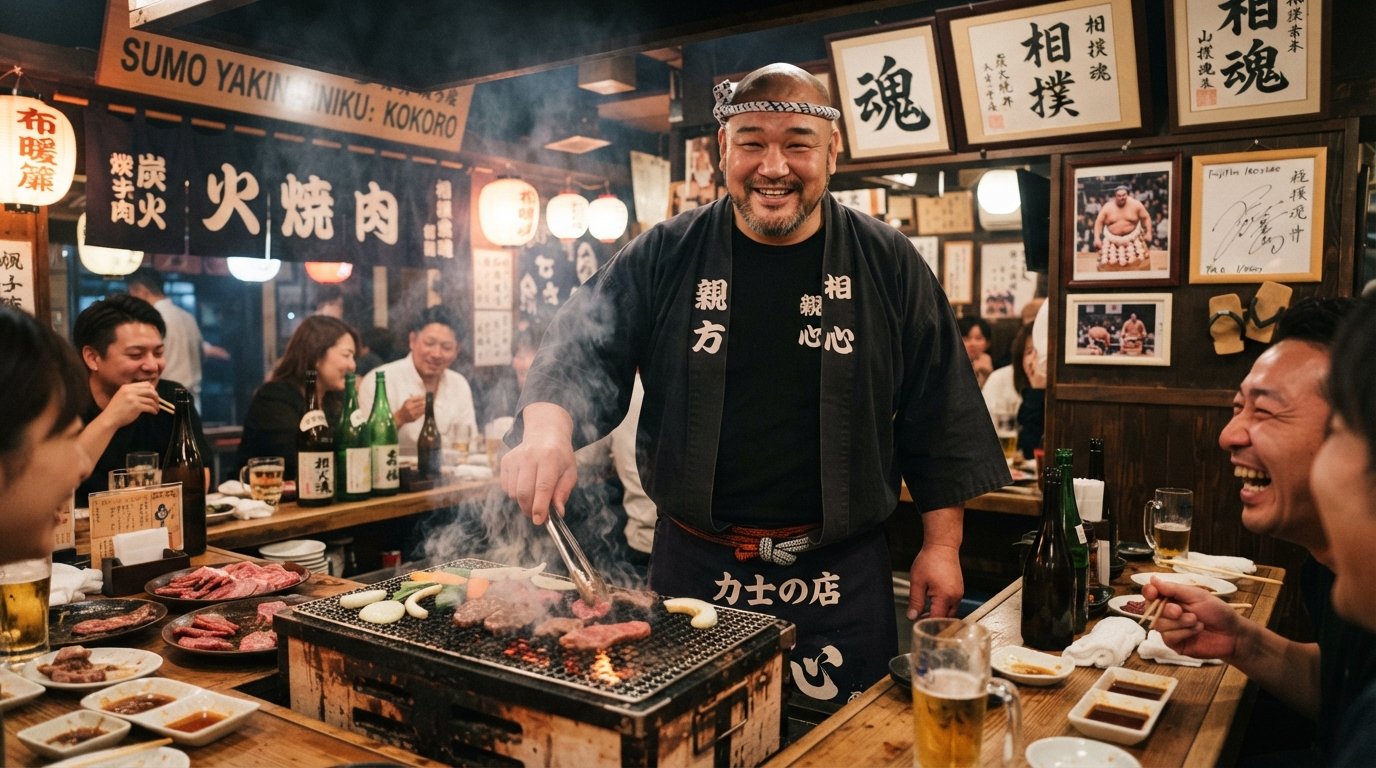
Opening a chankonabe or yakiniku restaurant is the most culturally recognizable one, and for good reason: junior wrestlers spend years on rotating kitchen duty, or chanko-ban (ちゃんこ番), cooking in bulk for the whole stable, and it's real commercial training. Retirees frequently trade on their old ring name for the restaurant's brand and lean on stable patrons, or tanimachi (谷町), for their first regulars. It's also a rough business. Cash flow, leases, and supply costs sink a lot of first-time restaurateurs regardless of background, and standing on a concrete kitchen floor for ten or twelve hours a day is a brutal ask for knees and hips that have already spent a decade absorbing collisions at 150-plus kilograms.
A steadier, if less romantic, path runs through licensed bodywork: judo seifukushi (a form of orthopedic bonesetting), acupuncture, and moxibustion. Wrestlers spend their careers managing their own dislocations and torn ligaments, which gives them a practical head start on the material, and at least one vocational school, Kinki Medical College, has built a direct pipeline to help retired rikishi sit the national licensing exams. A former Makushita wrestler named Raiho lost 40 kilograms after knee surgery and became a certified personal trainer and competitive bodybuilder; a former Jūryō wrestler called Tanzou dropped from 155 kilograms to 80, roughly half his fighting weight, on his way to becoming a licensed manipulative therapist. Security and long-haul logistics round out the list, trading on the one asset that never really goes away: a physical presence most people instinctively don't want to argue with.
The body's bill
None of this addresses the part of retirement that isn't about money or hierarchy at all: what decades of competitive sumo actually does to a body, and what happens when the training that was managing the damage suddenly stops.
A top-division wrestler eats an estimated 5,000–8,000 calories a day, heavy on carbohydrates, protein, and salt, and burns through a meaningful share of it in four to five hours of brutal morning training. That combination builds the sport's signature frame: enormous muscle mass under an equally enormous layer of fat. Retirement usually ends the training overnight while leaving the appetite and the drinking habits fully intact. According to Eiroku Hayashi, formerly the JSA clinic's medical director, that mismatch triggers a rapid buildup of visceral fat and, often, a fairly swift metabolic collapse.
Type 2 diabetes is close to an occupational hazard in professional sumo. While a wrestler is active, sheer muscle mass can mask a fair amount of underlying insulin resistance; once training stops, that resistance tends to catch up fast, sometimes into lifelong insulin dependence, neuropathy, or worse. Chronic hypertension and sleep apnea, driven partly by neck size and partly by diet, take their own toll on the heart and kidneys, and end-stage renal failure requiring dialysis or a transplant shows up disproportionately often among retired heavyweight wrestlers, including, at different points, Akebono, Konishiki, and Musashimaru. The average top-division wrestler's weight climbed from about 135 kilograms in 1980 to over 160 kilograms by 2024, with an average body mass index above 47, and joints that carried that kind of mass through thousands of high-impact collisions tend not to age gracefully. Degenerative knee arthritis and chronic lower-back damage are closer to the rule than the exception among retirees.
The actuarial numbers are stark enough to make the point on their own. A 2024 analysis of the 36 top-division wrestlers active in the May 1980 tournament found that 21 of them, 58 percent, had already died, at an average age of 57. A comparable cohort of Japanese professional baseball players from the same year had lost just 13.6 percent, and the survivors were, on average, in their mid-seventies. Older studies of historical yokozuna and of elite Japanese athletes born before 1939 tell roughly the same story: sumo wrestlers as a group have consistently ranked at or near the bottom of life expectancy for any athletic discipline studied, well behind even amateur sumo competitors, who train similarly but never carry the extreme weight.
Former ōzeki Konishiki, who has lost close to 100 kilograms since retiring in 1997, has talked about how that reality shapes wrestlers while they're still active, not just after. "There is no life after sumo," he's said of the mindset among younger wrestlers he trained alongside, describing men who stay in the sport past the point of enjoying it purely out of fear of what comes next. His own break with that fear was deliberate: "I told myself I'm not going to lead my life like this," he has said of the decision to start losing weight seriously as he aged, eventually with the help of gastric bypass surgery. He's not alone in that choice. Contemporary rikishi increasingly work with the JSA clinic or private sports doctors on structured, medically supervised weight loss immediately after retiring, often targeting 30–50 kilograms in the first year alone; one former Makuuchi wrestler, Takuya Ogushi, reportedly cut his weight from 153 to 110 kilograms in six months through diet and targeted training.
Akebono never really got that chance. By the time he died in 2024, he'd spent seven years in a wheelchair after a 2017 hospitalization for heart failure, his body finally presenting the bill for a wrestling career and everything that came after it. In 2001, standing in the ring where he'd just had his topknot cut off, he'd promised to do his best in the next phase of his life. He kept that promise in every way he could. It just wasn't enough to buy him more time.

The reset, and what comes after it
Every retiring wrestler goes through some version of the same ceremony: the topknot comes off, the silk apron goes back to the stable, and a life that has been managed down to the hour since age fifteen suddenly has no schedule at all. What happens next has almost nothing to do with that ceremony and almost everything to do with a rank achieved years or decades earlier, a number of tournaments, a nationality, and, frankly, luck in when an elder name happened to come up for sale.
For a wrestler like Kamikawa, thirteen years and counting into a business he built from a caregiving license he almost didn't bother getting, that reset turned into a second career he actually chose, with its own satisfactions that sumo, for all its cheering crowds, never quite offered him. For plenty of others, it's meant a restaurant that didn't make it, a job in security or on a delivery route, or a body that started collecting diagnoses the moment the morning training stopped. Sumo is unusually good at teaching young men how to be extraordinary inside a very narrow set of rules. What it has never quite figured out is how to help most of them once those rules stop applying.
A note on translation
Quotes from Japanese-language interviews and reporting in this piece have been translated into English by the author. Akebono's retirement remarks and Konishiki's comments on weight loss and life after sumo were originally given in English and appear here as reported by English-language outlets.
Sources
Gendai Business: 33歳で引退した元力士が、未経験から「デイサービスの経営者」になるまで
Gendai Business: 入門前に「引退後」の相談も…大相撲元若天狼が、力士の【セカンドキャリア】を支援する理由
PRESIDENT Online: 元横綱・曙の「54歳で死去」はまったく不思議ではない
Tokyo American Club In Touch: The Ringmaster (Konishiki interview)
Honolulu Star-Bulletin archive: Akebono officially retired (2001)
Money Post Web: 力士の退職金事情と横綱・大関の格差
Victory Sports News: 引退した横綱が手にする退職金と養老金
大相撲ガイド: 力士の退職金・養老金・加算金と除名処分の実態
週刊女性PRIME: 十両以上の力士に支給される養老金制度
大相撲ガイド: 年寄名跡の取得条件と部屋新設基準
Japaaan Magazine: 年寄名跡を得るための資格と国籍要件
じんじ部: 年寄名跡と相撲協会の内部事情
Smart FLASH: 照ノ富士と力士の糖尿病・日本相撲協会診療所の実態
Wikipedia: 大相撲力士の健康問題
大相撲ガイド: 引退相撲と断髪式の開催条件・興行収入の仕組み
日刊ゲンダイDIGITAL: 横綱白鵬の引退相撲と断髪式参加費の相場
Wikipedia: 若者頭
WORK MILL: 元十両若天狼によるデイサービス花咲の起業
Tarzan Web: 元幕内力士・大串拓也の内臓にやさしい43kg減量術
Number Web: 元幕下雷鵬の40kg肉体改造とパーソナルトレーナー転身
東海医療科学専門学校: 元十両丹蔵の減量と整体師セカンドキャリア