One afternoon in the early 1980s, a Sony engineer named Ken Kutaragi (久夛良木健) sat down next to his young daughter to watch her play. She wasn't watching television. She was hunched over a small grey box wired into the family set, working a joypad with the total concentration that only children and professional athletes ever really manage. The box was a Nintendo Famicom (ファミコン), and what struck Kutaragi wasn't the game itself so much as his daughter's face. She wasn't a passive viewer anymore. She was inside the thing.
That was a strange thought to be having inside Sony in 1983. This was a company built on the Walkman and the Trinitron, staffed by engineers who thought of themselves as serious people making serious machines, and video games were filed under omocha (おもちゃ), toys, a word with a faint sneer built into it. Founders Masaru Ibuka and Akio Morita had spent three decades building Sony's name on precision audio and broadcast-grade engineering, and to the men who ran the place, dedicated game consoles were a fad being milked by a playing-card company from Kyoto that had wandered into electronics almost by accident. Sony's own foray into home computing, the HiTBiT-branded MSX machines it built with ASCII and Microsoft from 1983 under the slogan "People's HiTBiT" (ひとびとの、ヒットビット), with pop idol Seiko Matsuda fronting the adverts, was aimed at spreadsheets and word processing, not entertainment, and the HB-55 and HB-101 never troubled NEC's grip on the Japanese PC market. The Famicom, released that same July, quietly took over the living room instead.
Kutaragi thought the board had the argument backwards. Television, he believed, was on its way to becoming something people did rather than something they watched, and the silicon that would make that possible was already visible if you knew where to look. Almost nobody with any power at Sony agreed with him. It would take more than a decade, one act of corporate betrayal, a screamed order from the company president, and no small amount of stubbornness for Kutaragi to be proven right.
The Secret Sound Chip
By the late 1980s, Nintendo was designing a successor to the Famicom, the Super Famicom, and its hardware architect, Masayuki Uemura, wanted something the era's chiptune synthesizers couldn't manage: real sampled sound, with the texture of an actual instrument rather than the buzz of a square wave. Kutaragi saw his opening. Working out of Sony's Information Research Laboratories rather than its consumer electronics mainstream, he began designing a custom audio processor for Nintendo's new console, using Sony's own semiconductor fabrication lines without asking anyone's permission.
The result, the SPC700, paired an 8-bit processing core with a 16-bit digital signal processor and 64 kilobytes of dedicated memory, and could decode eight simultaneous channels of sampled 16-bit audio. It gave the Super Famicom a sound nothing else in the industry could match. It also, once Sony's senior management found out about it, very nearly got Kutaragi fired. Moonlighting for a toy manufacturer, on company equipment, without a signed-off project, looked to the executive board like a straightforward breach of loyalty, and they wanted him gone.
Kutaragi appealed to the one person in the building with the standing to overrule them: Norio Ohga (大賀典雄), Sony's president. Ohga was an unlikely audience for a loyalty case. He had trained as an opera singer at the Tokyo National University of Fine Arts and Music, studied further in Munich and Berlin, and only joined Sony after firing off a furious letter about the sound quality of its tape recorders. He held a pilot's licence and sometimes flew the Sony corporate jet himself. He had, in other words, built a career on ignoring what he was supposed to want, and something about Kutaragi's chip appealed to that same instinct. Ohga overruled the board, let the SPC700 ship to Nintendo, and in doing so protected the one engineer at Sony who actually wanted to make games, while building the first real bridge between Tokyo's biggest electronics maker and Kyoto's biggest game maker. That bridge was about to be tested far more severely than either side expected.

The Deal That Fell Apart in Public
By 1989, that bridge looked like the future for both companies. Cartridges built on semiconductor mask ROM were running out of room for the games publishers wanted to make, and Sony, which had co-invented the compact disc alongside Philips, had exactly the manufacturing capability the industry needed next. In early 1990, Sony and Nintendo signed a formal joint development agreement to build a Super Famicom with a CD-ROM drive attached, alongside a standalone hybrid machine that Sony would sell under its own name: the "Play Station," a two-word working title for a deck that could read Super Famicom cartridges and a new Sony optical format called Super Disc, intended for games, educational software, and home karaoke alike.
The contract Kutaragi negotiated gave Nintendo control of cartridge licensing, the profitable part of its existing business, and gave Sony control of the CD-ROM format, which both companies assumed would be the profitable part of the next one. When Nintendo's president, Hiroshi Yamauchi, and Nintendo of America's Minoru Arakawa, read that agreement properly, they worked out what it actually meant: if games moved from cartridges to discs, as everyone expected, Sony would end up owning the format Nintendo's whole business depended on, reducing Nintendo to a hardware supplier inside its own supply chain.
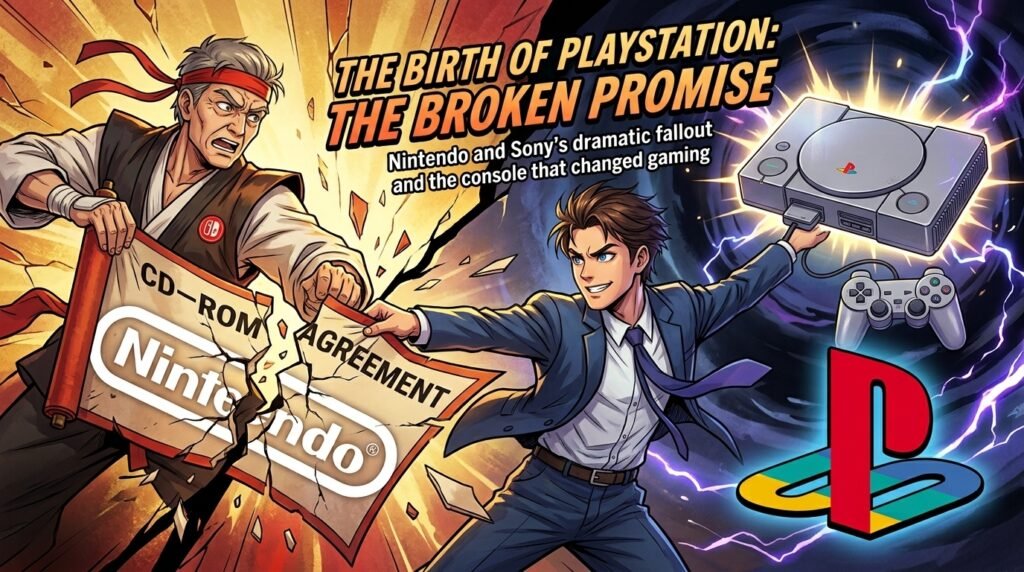
So Nintendo broke the deal, in the most publicly humiliating way available. In June 1991, at the Summer Consumer Electronics Show in Chicago, Sony stood on stage and announced the "Play Station" to the world's trade press. The following morning, Nintendo held its own press conference to announce it was building a rival CD-ROM add-on with Philips instead, instantly voiding Sony's licensing rights over the format it thought it had secured. Sony's leadership learned its own project was dead by reading about it in the trade papers, alongside everyone else.
"Do It"
Inside Sony, the instinct after the Chicago humiliation was to cut losses fast. Senior consumer electronics executives told Ohga to shut the whole games project down; Sony's dignity, the argument went, could survive losing to a fellow industrial giant like Matsushita, but not to what one director is said to have dismissed as "a Kyoto hanafuda maker" (京都の花札屋), a jab at Nintendo's origins as a maker of playing cards.
Kutaragi refused to let it go. He had already decided that CD-ROM add-ons were a dead end regardless, a stopgap built for a world of flat, two-dimensional games. What he had actually been studying, in arcades and on Silicon Graphics workstations far too expensive for anyone's living room, was real-time three-dimensional polygon rendering, and he was convinced the chips needed to bring it into people's houses were only a few years away.
The confrontation came to a head on 24th June 1992, at a Sony board meeting still remembered inside the company, half fondly and half warily, as the "Do It Conference" (Do it会議). With most of the room arguing to leave the games business entirely, Kutaragi turned on Ohga directly: "Are you simply going to pull out and accept this humiliation after Nintendo trampled on the contract signed with your own presidential seal? If we retreat now, Sony will become a laughingstock across the international industrial landscape."
Then he showed the board what he had actually been building in the meantime: a proprietary 32-bit architecture, designed from the ground up for real-time 3D graphics, with no dependence on Nintendo hardware whatsoever. Furious at Nintendo and evidently persuaded by the pitch, Ohga slammed his hand on the desk and delivered the order that gave the meeting its name: "If you are so certain, then prove it. Do it!" (「そんなに言うなら証明してみろ!Do it!」)
With that, Sony abandoned any hope of salvaging something with Nintendo and committed to building its own console, keeping the PlayStation name it had already trademarked internationally, this time run together as one word, a small permanent souvenir of where the whole idea had started.

Building an Island Inside Sony
Keeping the project alive meant keeping it away from the rest of the company. A games division sitting inside Sony's mainstream electronics arm, surrounded by executives who had just spent a year arguing to kill it, was never going to survive a quarterly budget review. So Ohga moved Kutaragi's team physically out of headquarters to offices in Aoyama and folded them into Sony Music Entertainment Japan, an entertainment business with none of the electronics division's caution and considerably more appetite for risk. Sony had a name for this kind of arrangement: Dejima (出島), after the small artificial island in Nagasaki harbour where, for two centuries, Japan had allowed a handful of Dutch traders to operate while keeping the rest of the country closed to the outside world. The plan amounted to much the same thing: contain the strange new thing, let it work at arm's length, and don't let it near the rest of the empire.
Shigeo Maruyama (丸山茂雄), president of Sony Music Entertainment Japan and founder of Epic/Sony Records, became Kutaragi's minder in practice, managing internal politics and outside relationships that Kutaragi had neither the patience nor, by most accounts, the diplomacy for. Maruyama later described the arrangement in blunter terms than most corporate histories allow themselves: "My role was like the parent of a playground bully. When he was running around making everyone cry, I had to follow behind him, bowing my head and saying, 'Please forgive him, he's really not a bad child at heart.' Nobody inside Sony was brave enough to stand up to Kutaragi because above him was only Mr. Ohga, who completely adored him. We were all effectively slaves to Ken's ambitions, but I was willing to do it because being around Kutaragi was simply the most interesting thing happening."
Alongside Maruyama, corporate planner Teruhisa Tokunaka built the financial and administrative machinery the project needed to function as an actual business rather than a passion project with a budget code. Sony announced it was spinning the effort out on 27th October 1993, and on 16th November 1993, Sony Computer Entertainment Inc. was formally incorporated as an equal fifty-fifty venture between Sony Corporation and Sony Music Entertainment Japan. Toshio Ozawa took the first presidency, with Tokunaka as senior managing director, Kutaragi running engineering, and Maruyama running software and strategy.
Convincing the Room
The console Kutaragi's team built was no modest piece of engineering. Where its rivals treated 3D as an occasional trick, the PlayStation was designed around it: a 32-bit RISC processor paired with two purpose-built coprocessors, one for the matrix arithmetic behind 3D coordinates, the other dedicated to shading and texture mapping. On paper it could push out up to 360,000 flat polygons a second, or 180,000 with textures applied, figures that belonged to graphics workstations costing many times the price, not a box meant to sit under a television.
Numbers on paper convince nobody in a boardroom, so on 28th October 1993, Sony Computer Entertainment gathered the industry to show them instead. Ohga opened the event with a line that, from a company which had spent a decade calling games toys, amounted to a small formal apology: "We intend to leverage all our accumulated technology to lead the video game field, and we ask for your cooperation." The room then watched a demonstration visibly modelled on Jurassic Park: an animated, fully textured Tyrannosaurus rex head tracking a controller in real time, rendered without a single dropped frame. It was the kind of thing developers had only seen on machines they couldn't afford, running now on hardware they could build for, helped along by ordinary C-language tools that meant a studio no longer needed an assembly-code specialist just to get a sprite moving on screen.
The demo won engineers over. Winning the executives who signed the cheques took a different pitch, and it came from Maruyama's side of the operation. Nintendo's cartridge business ran through a closed wholesale network called Shoshinkai (初心会), and it was expensive at every step that mattered to a publisher: a mask ROM cartridge cost roughly ¥1,500 to ¥3,000 (something like US$10 to US$19 today) to manufacture, took up to three months to produce, and had to be ordered in enormous batches with no right of return, meaning a publisher who guessed wrong on demand simply absorbed the loss. A CD-ROM cost Sony Computer Entertainment ¥150 to ¥200 a disc (a little over a dollar), could be pressed and delivered within a week and a half through the same domestic plants that pressed music CDs, and could be reordered in small batches against daily sales figures rather than a single upfront gamble. Traditional toy wholesalers, used to publishers committing half a million units at a time, dismissed this small-batch approach as チマチマした商売, "petty business." Sony Music's distribution arm simply connected retailers to its own automated warehouses instead, cutting the Shoshinkai syndicate out entirely and letting publishers restock within days rather than months, at a fraction of the financial risk.
That model closed the deal with the console's most important early partner. Namco founder Masaya Nakamura carried his own grudge against Nintendo, which had stripped the arcade pioneer of its preferential licensing terms years earlier and put it under the same restrictive cartridge quotas as everyone else. Nakamura saw in Sony the only company with the scale to break Nintendo's grip on the industry, and said so without much subtlety: "Team up with Sony and give Nintendo a proper taste of defeat" (「ソニーと組んで任天堂に一泡吹かせてやる」). Namco aligned its own arcade board architecture with the PlayStation's, which let it port 3D arcade hits almost directly to the console, and committed two of them, the racer Ridge Racer and the fighting game Tekken, as showcase titles. Sony's low manufacturing costs and open licensing also opened the door to developers who had never been able to afford cartridge production, among them a business software house called FromSoftware, which used the opportunity to make its first game, the dungeon-crawling King's Field. By launch, more than one hundred software houses had signed on to make games for the console.

July 1977 trade advertisement by Namco featured in an issue of Play Meter featuring Masaya Nakamura announcing their name change. - Namco Limited, Public domain, via Wikimedia Commons
The First of December
Sony wasn't first to market. Sega's 32-bit Saturn launched in Japan on 22nd November 1994, priced at ¥44,800 (roughly US$290 today) and built around an arcade conversion of Virtua Fighter. Sony undercut it by ¥5,000, pricing the PlayStation at ¥39,800 (about US$255), and ran a television campaign built around a countdown mnemonic, Ichi, Ni, San, one-two-three, timed to land squarely on the release date: Saturday, 3rd December, 12/3.
The PlayStation went on sale across Japan that day, backed by a launch lineup running from Namco's Ridge Racer, holding a steady thirty frames a second with full texture mapping and streaming CD audio that sounded, for once on a home console, like an actual arcade, down to smaller titles like the railway simulator A-Train IV Evolution and a table-game compilation from Sunsoft. The first production run, one hundred thousand units, sold out on day one; within a month, cumulative shipments had passed three hundred thousand, and the CD-ROM supply chain SCE had built kept pace without the shortages that were already dogging its cartridge-bound rivals.
Somewhere underneath the sales figures is the part of the story that's easy to lose: an engineer who couldn't stop thinking about his daughter's face in front of a Famicom he wasn't supposed to be paying attention to, inside a company that had spent thirty years deciding it was above the entire category of toys. What actually got the PlayStation onto shop shelves wasn't only Sony's engineering, formidable as it was. It was an opera singer with a pilot's licence willing to back an engineer nobody else would vouch for, and a record executive willing to spend two years playing minder to a man he half-jokingly compared to a playground bully. Nintendo built the machine Sony would spend the next decade trying to beat. In breaking a contract in the worst possible way, in front of the world's press, it also handed Sony its reason to try.

A note on quotations
Quotations originally given in Japanese have been translated into English by the author for clarity and flow. Quotations originally given in English are reproduced as spoken. Several accounts of the "Do It Conference" retell Ohga's closing order with minor variations in wording; the substance is consistent across every source consulted.
Sources
Sony Group Corporation: Sony History, Chapter 9 — Game Business Launch and Norio Ohga's "Do it!" Decision
Denfaminicogamer: Historical Interview with Shigeo Maruyama and Nobuo Kawakami on the Birth of PlayStation and Ken Kutaragi
Denfaminicogamer: Special Industry Report by Keiichi Tanaka — Shigeo Maruyama and Sony's Software Revolution
Denfaminicogamer: Comparative Seminar Report — Masayuki Uemura and Ken Kutaragi on Platform Architecture
Denfaminicogamer: Distribution Channels, CD-ROM Supply Chains, and the Namco Alliance (Part 3)
Intrastar Case Studies: Ken Kutaragi, the Dejima Strategy, and the Creation of PlayStation
Game Gyokai Historical Archives: Ken Kutaragi and the Behind-the-Scenes Development of the PlayStation
ASCII.jp: Sony's Early MSX and HiTBiT Personal Computer Initiatives
Akiba PC Watch: Retro Hardware Review — Sony MSX HiTBiT HB-55 and 1980s Computing
Bandai Namco Holdings Inc.: Corporate History, Namco Arcade Development, and Ridge Racer Launch
Automaton Media: Retrospective Analysis of the 1991 CES Nintendo-Sony-Philips CD-ROM Rupture
G-Search / Mikke News Archives: The Historic June 24, 1992 "Do It" Boardroom Meeting
Weblio Technical Reference: Sony SPC700 Audio Processing Unit Architecture for Super Famicom
Wikipedia (English): PlayStation (console)
Wikipedia (English): Norio Ohga
Wikipedia (Japanese Edition): Chronological Software Lineup of PlayStation Launch (1994–1995)
Wikipedia (Japanese Edition): Sony Computer Entertainment Inc. Historical Corporate Records