Fifty-three thousand, two hundred and eighty-seven people came to Saitama Stadium 2002 on the night of 22nd October 2008, and almost none of them wanted Gamba Osaka to leave happy. The noise started before kickoff and never really stopped: a low, rolling roar that the reporter covering the match for Gamba would later compare to a Corinthians-Palmeiras derby in São Paulo, or the atmosphere inside Boca Juniors' Bombonera in Buenos Aires. From his seat in the press box, he said, it felt like a complete away game, even for him. It was two Japanese clubs playing an away leg of an Asian semi-final on Japanese soil, and it felt like a different country.
Gamba had good reason to be nervous. For most of the decade, whenever it had really mattered, Urawa Red Diamonds had been the team standing between Gamba Osaka and something they wanted. This particular night would decide whether that pattern held one more time, or whether it finally, properly broke.
The answer Gamba gave that night turned out to be one of the more unusual title runs in Asian club football. It started back in March, in a much emptier stadium in Osaka, with a manager who had spent years building a team that refused to defend.
Seven Years of Saying No to Caution
By the start of 2008, Akira Nishino (西野朗) had been in charge of Gamba Osaka for six seasons, and his team had a fairly settled idea of what it was for. Nishino had won the J1 League title in 2005 and the J.League Cup in 2007, and he had done it by building his side around a rotating midfield engine rather than a defensive spine. At the base of it sat Yasuhito Endō (遠藤保仁), a deep-lying playmaker who dictated tempo rather than chasing the ball, flanked by the industry of Tomokazu Myōjin (明神智和) and Hideo Hashimoto (橋本英郎). On the left, Takahiro Futagawa dribbled at defenders and threaded passes through them; on the flanks, full-backs Akira Kaji and a twenty-one-year-old named Michihiro Yasuda (安田理大) pushed forward relentlessly to overload the wings. Up front, Brazilian target man Lucas Severino held the ball up for runners like Masato Yamazaki and Ryuji Bando.
The whole structure had a name in the Japanese press: chō-kōgekiteki (超攻撃的), roughly "ultra-offensive." It described a temperament as much as a tactic. Gamba conceded chances because their full-backs were forty metres upfield, and nobody at the club seemed keen to fix that.
Endō kept all of this from falling apart. Nishino once called his playmaker "a bit like a mole: he can look exhausted but he finds a way through." It's an odd compliment to pay your best player, but watch Endō amble around a pitch, apparently bored, then slip a pass through a gap nobody else had noticed, and you see what Nishino meant.
Drawn into a continental group alongside Chonburi FC of Thailand, Chunnam Dragons of South Korea, and Australian champions Melbourne Victory, Gamba ran straight into the oldest problem in Japanese continental football: away games in Asia are hostile, tiring, and unforgiving of a high defensive line. Their opening match, at home against Chonburi on 12th March, exposed exactly that vulnerability. Chonburi sat deep, soaked up pressure, and very nearly stole a win before Lucas equalised in the fourth minute of stoppage time to salvage a 1–1 draw.
Not, on the face of it, the start of a team about to go twelve matches unbeaten.

Akira Nishino managing Gamba during a 3-2 away win at Omiya Ardija in 2007 - TAKA@P.P.R.S, CC BY-SA 2.0, via Wikimedia Commons
Refusing to Play It Safe
What happened next set the tone for the rest of the year. Rather than tightening up on the road, the way most Japanese clubs traditionally had, Nishino did the opposite. On 19th March in Gwangyang, South Korea, Gamba fell behind Chunnam Dragons twice and simply outscored them anyway, winning a chaotic 4–3 with goals from Futagawa, Yasuda, and a brace from Bando. Three weeks later in Melbourne, in front of a loud home crowd at the Telstra Dome, the same pattern repeated itself: Gamba went behind early, traded punches for the better part of ninety minutes, and won 4–3 again, Lucas settling it in the eighty-ninth minute.
Two away matches, six goals conceded, eight scored, two wins. It looked reckless, and it worked. Gamba's high line kept leaking chances on the break, but their passing created more than they gave away, and tired opponents in hot, hostile stadiums struggled to keep up. Nishino consolidated the group at home, beating Melbourne Victory 2–0 and then Chonburi 2–0 away in Bangkok behind two Yamazaki finishes, before a flat 1–1 draw against Chunnam back in Osaka closed things out. Gamba topped Group G with fourteen points, and had done it playing like a team that had never heard the phrase "park the bus."
Those were the first two of six away trips in the tournament. Gamba won all six.
The Heat in Homs
After a four-month break, during which lead striker Bare was sold to a club in the UAE, Gamba returned to continental duty in September against Syrian champions Al-Karamah, one of West Asia's most battle-hardened outfits and a side that had reached the ACL final only two years earlier. Their home ground, the Khalid ibn al-Walid Stadium in Homs, had a reputation that preceded it: intense heat, an aggressive crowd, and opponents who rarely left with anything.
Al-Karamah scored in the seventh minute through defender Abduldaim and then did exactly what a well-drilled home side is supposed to do: dropped deep, packed the box, and dared Gamba to find a way through. Nishino told his players not to bother lumping long balls forward. Instead, Endō and Hashimoto kept the ball moving patiently, forcing Al-Karamah to keep running in conditions built for standing still. It worked, slowly. Team captain Satoshi Yamaguchi (山口智) rose to head in an equaliser in the seventieth minute, and seven minutes after that, Yamazaki scored the winner. Gamba left Homs with a 2–1 victory, and finished the job at home a week later, winning 2–0 through Yamazaki and new signing Roni to seal a 4–1 aggregate.
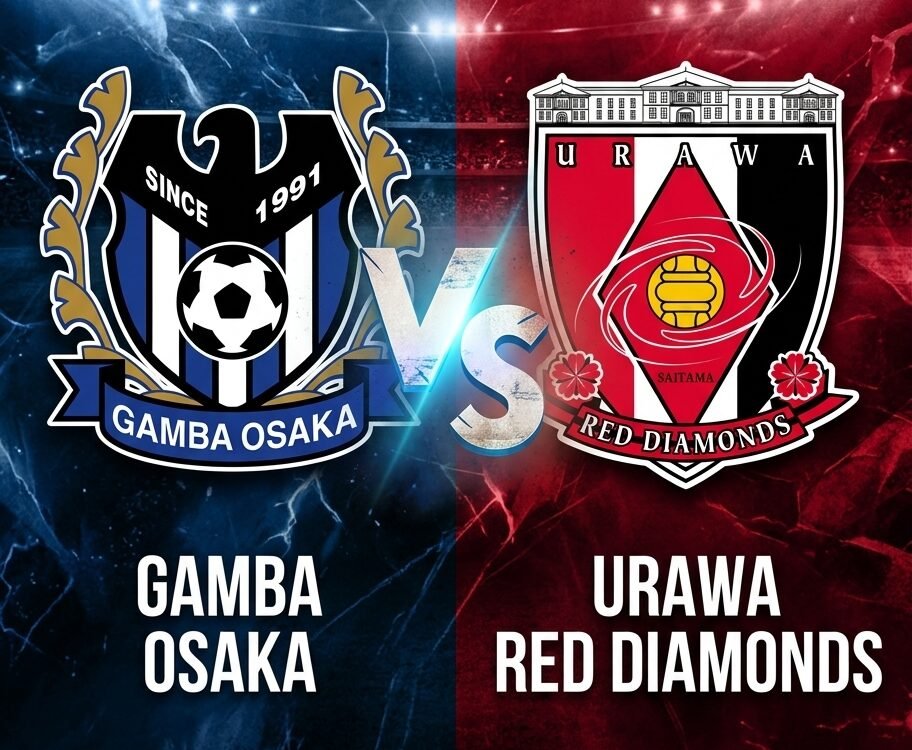
The prize for surviving Syria was a semi-final against the one club Gamba least wanted to see: Urawa Red Diamonds, the defending Asian champions and, for most of the decade, Gamba's tormentor of choice.
The Wall of Urawa
Inside Gamba's dressing room, this fixture carried a lot of baggage. In 2006, Urawa had beaten Gamba in the Xerox Super Cup, then denied them the J1 League title on the final day of the season with a 3–2 win at Saitama Stadium. On New Year's Day 2007, Urawa beat them again, 1–0, in the Emperor's Cup (天皇杯) final. Nishino himself had bitterly called his squad Urawa's perpetual hikitateyaku (引き立て役), the supporting cast, there to make someone else's glory look good.
Midfielder Tomokazu Myōjin put it more plainly than any manager could, ahead of the tie: "There was always the wall of Urawa standing in our way, and we desperately wanted to overcome it."
The first leg, in Osaka on 8th October, ended 1–1. Hajime Hosogai gave Urawa an early lead; Endō levelled from the penalty spot in the eighty-first minute. Because away goals counted double, the return leg at Saitama meant Gamba needed to win outright, or draw at least 2–2, to go through. On 22nd October, they walked out into that wall of noise.
For the first half, Urawa looked every bit like the team that had spent two years making Gamba's life miserable. Gamba froze under their pressing. In the thirty-sixth minute, a sloppy clearance fell straight to Naohiro Takahara, who finished past goalkeeper Yōsuke Fujigaya. Six minutes later, Takahara hit the crossbar from long range. Gamba spent the rest of the half pinned in their own territory, and the noise from the stands only grew.
At half-time, with his team's continental campaign forty-five minutes from ending in exactly the way it always had, Nishino stayed calm. His instruction was short: "If we make it 1–1, we can turn this whole thing around."
He backed the words with a change of shape, switching from a flat 4-4-2 to a more fluid 4-5-1, taking off striker Ryuji Bando for winger Hayato Sasaki. Sasaki's directness immediately caused Urawa's left-back problems, dragging him out of position and winning a string of corners. In the fifty-first minute, one of those corners, swung in by Endō, was met by a towering header from captain Satoshi Yamaguchi. 1–1. Twenty-one minutes later, another Endō delivery found Myōjin cutting in at the near post to flick a header past the goalkeeper. 2–1, and now it was Urawa's turn to feel the aggregate pressure. Five minutes after that, Endō himself finished the job, collecting the ball at the top of the box and side-footing it into the corner for a 3–1 win on the night.
Three unanswered goals, all of them Gamba's, in the noisiest stadium either club had ever played in. The wall, as Myōjin had called it, was down. Whatever Gamba Osaka had spent the better part of the decade being to Urawa Red Diamonds, they were not that thing anymore.

Michihiro Yasuda pictured in 2010 against Kawasaki Frontale - TAKA@P.P.R.S, CC BY-SA 2.0, via Wikimedia Commons
Ninety Minutes, No Apologies
Compared to Syria and Saitama, the final felt almost gentle. Adelaide United were the first Australian club ever to reach an Asian final, and they had knocked out Kashima Antlers, the most successful side in Japan, along the way. They had got there on physical defending and set-piece goals, but their back line was built to deal with crosses, not with a team that kept the ball on the ground and moved it in triangles. In the first leg at home on 5th November, Gamba simply took the game apart. Lucas opened the scoring in the thirty-seventh minute with a close-range finish; six minutes later, Endō curled a shot into the far corner to make it 2–0. In the sixty-eighth minute, Michihiro Yasuda drove into the box, beat his marker, and rifled the ball into the roof of the net for 3–0.
Yasuda, still only twenty-one and about to be named the tournament's Best Young Player, could barely find the words for it afterwards. "In my whole life up to now, there has never been a better day," he said. "To score a goal myself, and having fought together as a team since the group stage, it feels absolutely incredible."
Endō, typically, was less interested in the scoreline than in the chances Gamba hadn't taken. "We should have scored four or five," he said after the match, having also seen a stoppage-time free-kick ruled out for offside. It was the complaint of a man who had just won 3–0 and still felt slightly cheated.
The second leg, at Hindmarsh Stadium in Adelaide a week later, was barely a contest. Gamba broke down an early Adelaide press within four minutes, an error at the back gifting Lucas a tap-in, and doubled the aggregate lead to 5–0 by the quarter-hour mark when Endō slid another one through for him. With the tie essentially decided before half-time, most managers would have sent a message: shut up shop, protect the clean sheet, go home. Nishino sent on more attackers instead.
Afterwards, in the mixed zone in Adelaide, he explained why. "It's simply one word: joy," he said. "Just winning is not satisfying to me. While the final outcome was clear as time passed, it was essential to play Gamba Osaka's football for the full ninety minutes. When offensive players aren't scoring, we substitute and continue pursuing goals; that is our identity. I would not have been satisfied with our game today had we done anything less."
He was equally direct about what the win meant relative to Urawa's title the year before. "Because our rivals Urawa took the Asian title last year, naturally we felt Gamba had to take it this year," he said. "Winning through a different style from Urawa gives it a different kind of value. Imposing our style across all twelve matches from the qualifiers, and particularly performing so well away from home, makes this a championship of a different and profound significance."
The two title runs could hardly have been more different. Urawa had won the 2007 tournament under Holger Osieck playing a compact 3-5-2, drawing tough away fixtures and leaning on home advantage; they finished with fourteen goals in eight matches. Gamba won theirs playing an open 4-4-2, won every away match they played, and scored twenty-seven goals in twelve matches, at a rate of 2.25 per game. Two Japanese clubs, back-to-back continental titles, built on almost opposite ideas about how to be good at football.
The Price of the Title
The mood among Gamba's players afterwards was more mixed than you might expect. Endō, who was named the tournament's Most Valuable Player, put it simply: "We proved the true strength and quality of Gamba Osaka." Yamaguchi, who had marshalled the defence through all twelve matches, sounded almost more relieved than proud: "I am truly relieved."
Hideo Hashimoto was the one who said the thing nobody else wanted to. Continental football takes a physical toll that a domestic schedule has no room for, and Gamba, worn down by travel and fixture congestion, had slumped to eighth place in the 2008 J1 League, a startling finish for a club that had just conquered Asia. "I can't rejoice purely and simply," he admitted. "We haven't achieved results in the J.League, given our position in the table."
The Japanese press had a phrase for this particular flavour of success: naiyū-gaiki (内憂外喜), internal distress alongside external glory. The J.League had yet to build scheduling allowances into its calendar for clubs playing in Asia, so a continental run could eat into a team's own league season. Gamba's players knew that better than anyone.

Yasuhito Endo pictured during a match in 2017 against Vissel Kobe - TAKA@P.P.R.S, CC BY-SA 2.0, via Wikimedia Commons
Yokohama, and One Match Short
The continental title bought Gamba a place at the FIFA Club World Cup in Japan that December, and a third meeting that year with Adelaide United, this time in the quarter-final at Toyota Stadium on 14th December. In front of a crowd of roughly thirty-eight thousand, and against an Adelaide side that had clearly learned something from being battered 5–0 in the final, the game was tight. Yasuhito Endō settled it inside the first half, meeting a headed knockdown from substitute Ryuji Bando to score the only goal in the twenty-third minute. It was Gamba's third straight win over the Australians that year, and their narrowest.
That earned them a semi-final against Manchester United, full-strength and freshly crowned European champions, featuring Cristiano Ronaldo, Wayne Rooney, Carlos Tevez, and Ryan Giggs. Nishino, unsurprisingly, refused to set his team up defensively against them either. At International Stadium Yokohama, in front of nearly sixty-eight thousand people, Nemanja Vidić put United ahead in the twenty-seventh minute and Ronaldo doubled the lead just before half-time. Yamazaki pulled one back in the seventy-fourth minute, and Gamba's brief hope was answered by three United goals in four minutes, two from Rooney and one from Fletcher. Gamba got two more back, through a penalty from Endō and a late finish from Hashimoto, but the damage was done: 5–3 to United, six goals crammed into the last sixteen minutes of the match. Sir Alex Ferguson praised the pace and technical quality of Gamba's play afterwards, which is the sort of compliment that tastes better in hindsight than it does on the night of a semi-final defeat. Gamba salvaged third place a few days later, beating CONCACAF champions Pachuca 1–0.
The Last Whistle of the Year
Gamba's year still had one match left. Back in domestic knockout football for the Emperor's Cup, they advanced through the winter rounds and met Kashiwa Reysol in the final at the National Stadium in Tokyo on 1st January 2009. The match went to extra time scoreless, until a substitute forward found the winner: Ryuji Bando, the same player Nishino had withdrawn at half-time in Saitama three months earlier to change the shape of a football match, scored the goal that gave Gamba a 1–0 win and the club's second Emperor's Cup.
More than a decade later, when the AFC asked Endō to look back on the whole campaign, he didn't reach for anything grand. "It was really enjoyable," he said.
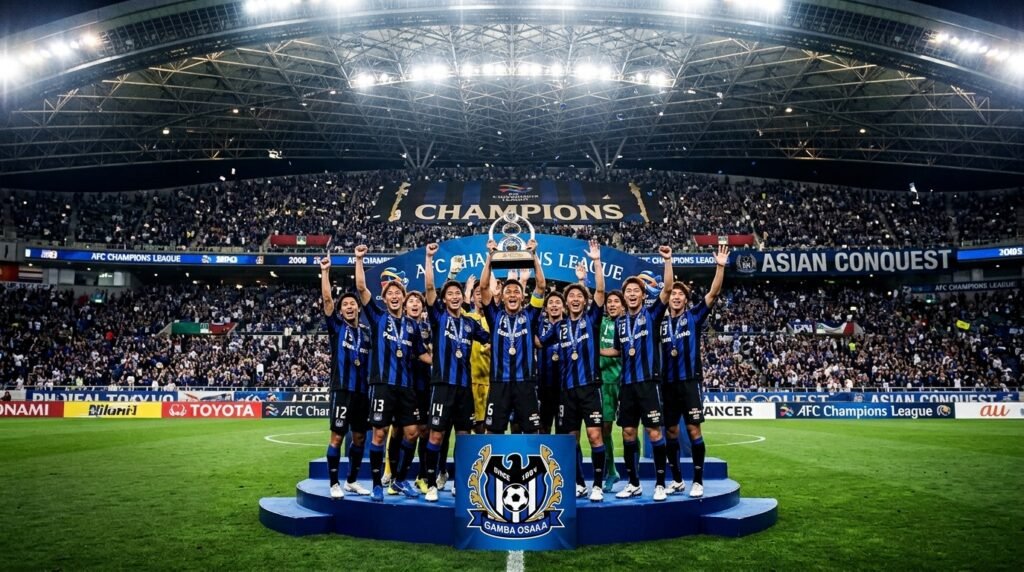
Gamba won Asia without getting more careful. They attacked as freely on the road as they did at home, twelve matches in a row, against opponents who expected Japanese clubs to blink eventually. Gamba never did. The club that had spent years cast as Urawa's supporting act ended 2008 as the champions of Asia, and Urawa were the ones watching.
A note on quotes
Direct quotes from Japanese-language sources in this piece, including comments from Akira Nishino, Yasuhito Endō, Tomokazu Myōjin, Michihiro Yasuda, Satoshi Yamaguchi, and Hideo Hashimoto, have been translated into English from Japanese-language match reports and press coverage. Yasuhito Endō's 2020 reflection on the campaign was originally given in English to the AFC.
Sources
2008 AFC Champions League Final – Wikipedia
2008 AFC Champions League Knockout Stage – Wikipedia
2008 AFC Champions League – Wikipedia
Yasuhito Endō – Wikipedia
Akira Nishino (footballer) – Wikipedia
2008 Emperor's Cup Final – Wikipedia
2008 FIFA Club World Cup – Wikipedia
2008 Gamba Osaka Season – Wikipedia
AFC Champions League – MVP Memories: Yasuhito Endo – the-AFC.com
Sports Graphic Number (Masaki Shimozono): "浦和の『引き立て役』はもう御免だ。ガンバACL雪辱劇と勝負師・西野朗"
Sports Navi (Masaki Shimozono): "浦和とは違う意味で意義があるチャンピオン" (2008/11/13)
Sports Navi Feature Column: "内憂外喜のG大阪、アジア制覇の裏にあった葛藤" (2008/12/03)
J.League News Vol. 142 Official Documentation
Urawa Red Diamonds Official Match Archive: ACL Semifinal 2nd Leg vs Gamba Osaka (2008/10/22)
Gamba Osaka Historical Match Database (2008 Season)
Gamba bank on Endo the 'mole' – The National
Gamba outclass Adelaide in the first leg – The National
Gamba Osaka 3-5 Man Utd – Sky Sports match report
Gamba Osaka 3-5 Man United – ESPN
Gamba reach semis, Ahli to face Adelaide – filgoal.com
FIFA Club World Cup Japan 2008 – Adelaide Regroup for Ahly Clash – Oceania Football Confederation
Kashiwa pips Osaka to reach top competition – Hürriyet Daily News