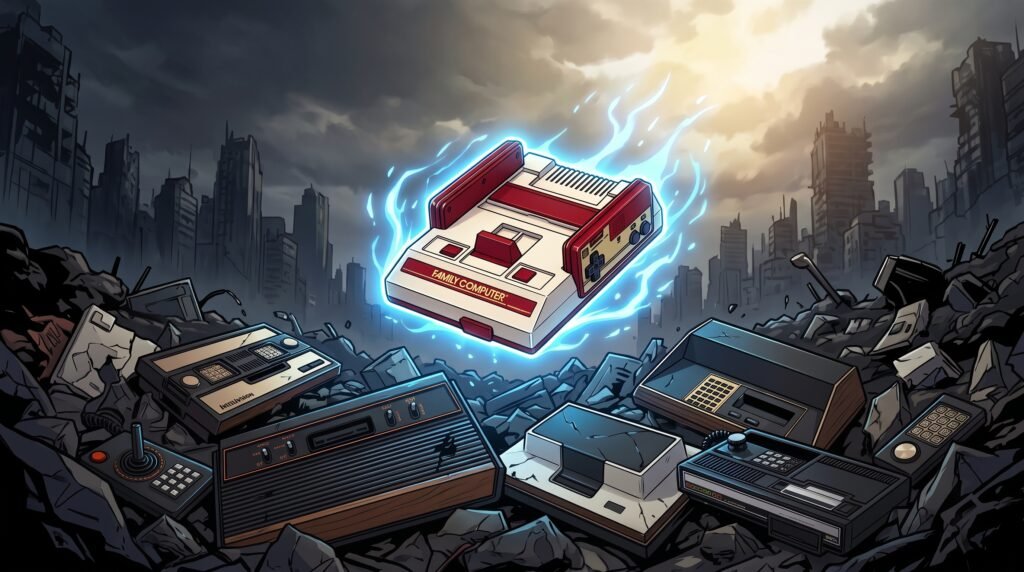
Masayuki Uemura (上村雅之) had a habit of not taking his boss too seriously after hours. Hiroshi Yamauchi (山内溥), the famously severe president of Nintendo, liked to call his engineers late at night once he'd had a few drinks, and Uemura had learned to treat those calls the way you'd treat a fortune cookie: politely, and without much follow-through. So when Yamauchi phoned in 1981 and told him to build a video game system that ran on cartridges, Uemura said "Sure thing, boss," and went back to bed. It wasn't until the next morning, when a stone-sober Yamauchi cornered him at the office and asked if he was actually on the project, that Uemura understood the old man had meant every word.
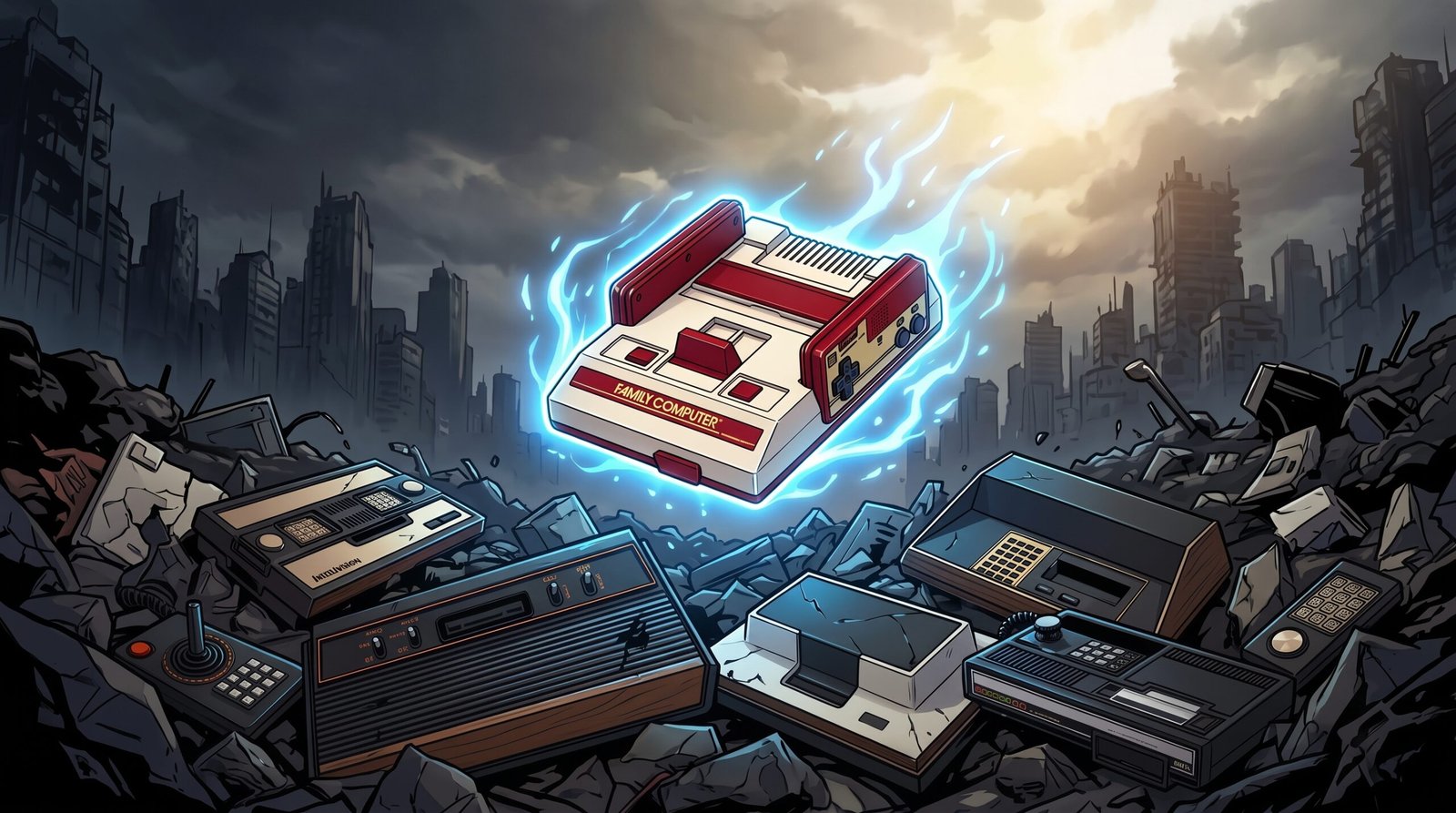
That machine became the Family Computer, and within a couple of years it had done something that looked, at the time, close to impossible: it convinced an industry that had just watched itself die that people still wanted to play games at home. The Famicom, and its Western twin the Nintendo Entertainment System, went on to sell nearly 62 million units, gave the world Mario and Zelda, and quietly rewrote the economics of an entire business. None of that was obvious on the night Yamauchi made his drunken phone call. To understand why he made it at all, it helps to look at what the games business looked like just before Nintendo decided to build a console of its own.
A Toy Company Watches an Industry Burn
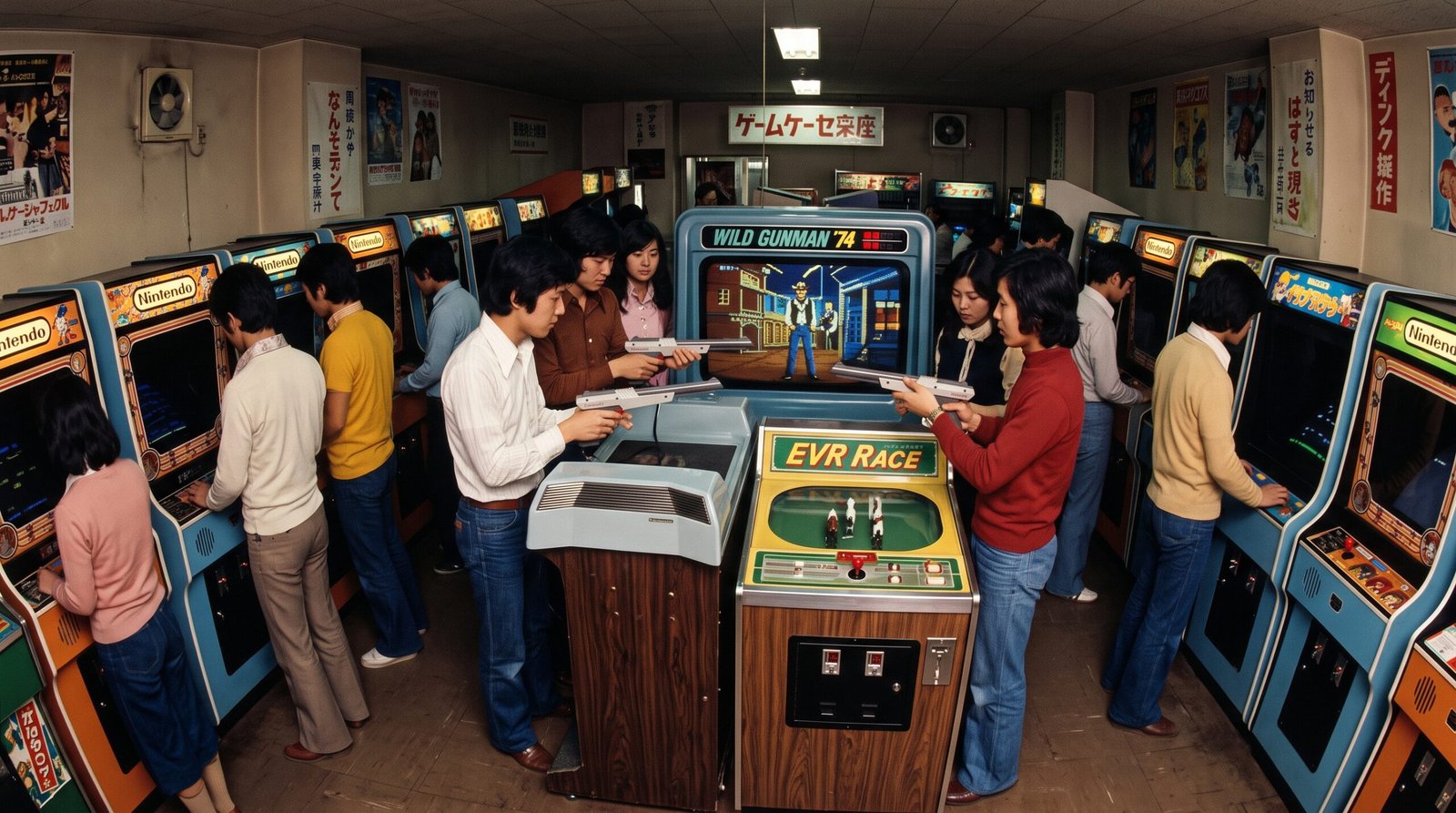
Nintendo, in 1981, was not a video game company in any way we'd recognise now. It was a card and toy manufacturer from Kyoto that had spent the previous decade dabbling, with mixed results, in arcade cabinets, light guns, and Gunpei Yokoi's line of handheld Game & Watch units. Its most recent arcade bet, a space shooter called Radar Scope, had flopped so badly in the United States that Nintendo of America was left sitting on warehouses of unsold machines. The company's rescue came from an unlikely source: a young designer named Shigeru Miyamoto (宮本茂) was handed the job of turning those dead cabinets into something sellable, and the result, Donkey Kong, became an arcade sensation in 1981 despite operators reportedly mangling its name into things like "Konkey Dong." It was Donkey Kong's American success, oddly enough, that gave Nintendo the confidence, and the cash, to think bigger.
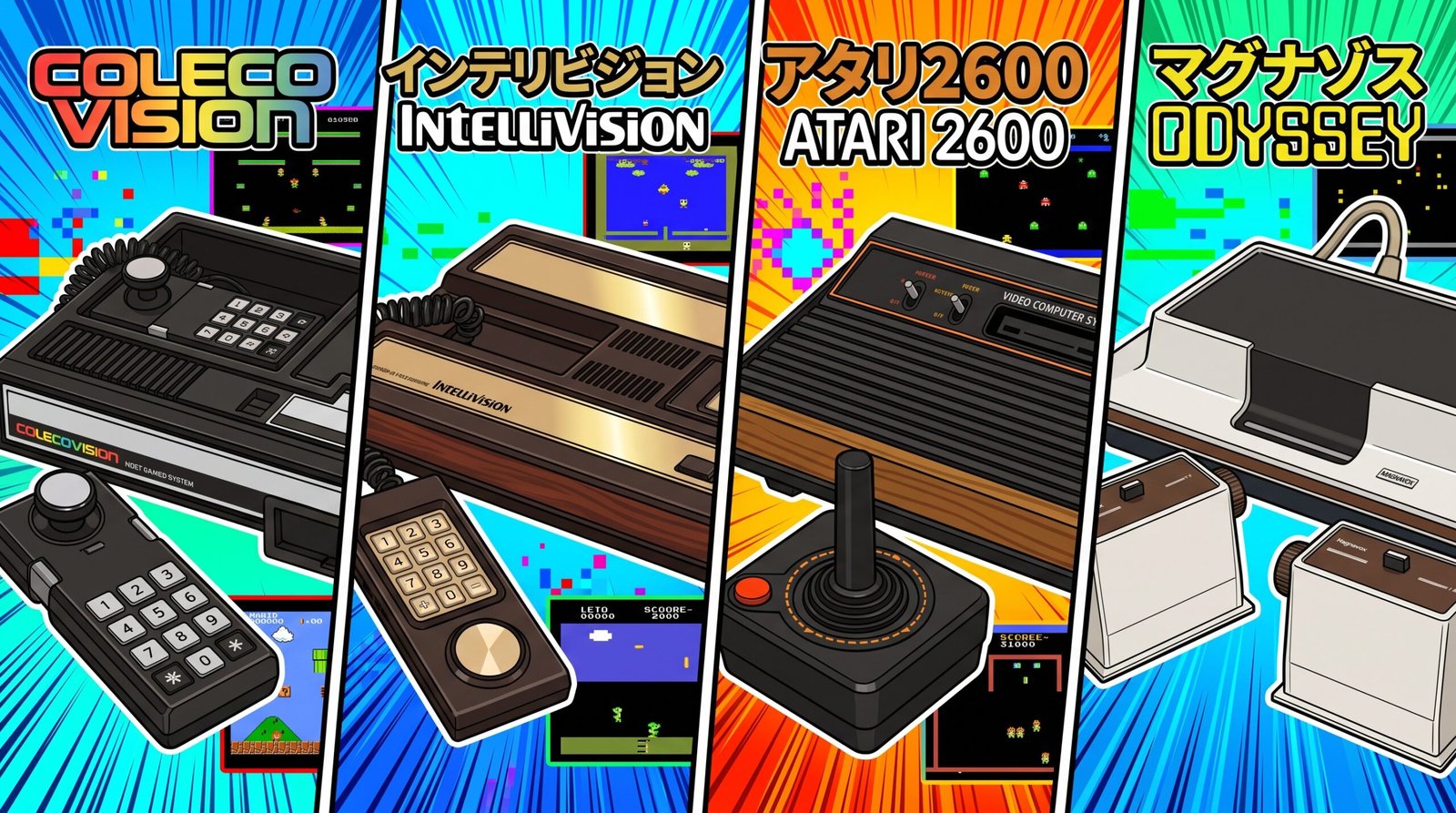
Bigger, at that moment, meant looking at what everyone else in the industry was doing and deciding it wasn't good enough. Home video games had existed since Magnavox put the Odyssey on shelves in 1972, and Atari had turned the idea into a genuine mass-market business with the 2600 in 1977. By the early 1980s, though, the American console market had become a pile-up: Atari, Mattel's Intellivision, Coleco's ColecoVision, the Magnavox Odyssey², the Bally Astrocade, and a scattering of also-rans were all fighting for the same shelf space, while anyone with a soldering iron could publish a cartridge for the Atari 2600 without Atari's approval or involvement. The predictable result was a flood of rushed, forgettable software, and in 1983 the market simply seized up. Revenue collapsed from roughly $3 billion in 1982 to under $100 million by 1985, Magnavox and Coleco walked away from games entirely, and Atari's parent company posted losses in the hundreds of millions. American retailers, burned once, wanted nothing more to do with the category. In Japan the same collapse became known as the Atari Shock, and it happened to arrive in the same year Nintendo was readying its own machine for launch.
That timing was either extraordinarily lucky or extraordinarily well judged, depending on how much credit you're willing to give Yamauchi. He wanted a home machine that could approximate arcade-quality graphics, sold at a price so low that ordinary households wouldn't think twice, and he wanted it built by people who understood cost discipline down to the component. Uemura got the call precisely because he'd spent years wringing performance out of cheap parts for Nintendo's toys and Game & Watch line. The brief he was handed had nothing to do with matching Atari or Coleco on features. It was about building something so inexpensive that Nintendo could survive a crash the rest of the industry hadn't seen coming yet.
Building It Cheap, and Then Fixing It
Yamauchi's original target was a retail price under ¥10,000. Uemura and his team at Nintendo's Research & Development 2 division found that number impossible to hit once they'd built in anything worth playing. "Development began with the goal of getting the sale price to be 10,000 yen or below, but that was just too hard," Uemura admitted years later, and the team eventually pared the design down to what he called the barest of features before settling on a launch price of ¥14,800, still roughly $62 at 1983 exchange rates and dramatically cheaper than the ¥30,000 to ¥50,000 that rival home computers and consoles commanded.
Getting there meant leaning hard on Ricoh, which built a custom 8-bit processor, the 2A03, around a licensed core of the MOS 6502, the same chip family powering the Apple II and Commodore 64. To sidestep a patent dispute with MOS Technology, Ricoh disabled the chip's decimal arithmetic mode entirely, a quiet workaround that nobody playing Super Mario Bros. would ever notice. Alongside it sat a dedicated graphics chip, the Ricoh 2C02, which handled sprites and background tiles so the CPU didn't have to, and a five-channel sound unit built into the same die as the processor, giving the Famicom its two melodic pulse-wave channels, a buzzy bass-heavy triangle wave, a noise channel for percussion, and a crude sample channel for digitised sound effects. None of it was cutting-edge even in 1983. All of it was cheap enough to hit Yamauchi's price, which was the entire point.
The controllers tell the same story from a different angle. Rather than the fragile joysticks most Western consoles used, Uemura and Miyamoto borrowed the cross-shaped D-pad they'd developed for Game & Watch, a piece of design so effective it's still the default on nearly every controller made today. Nintendo's second controller went a step further, swapping out the Start and Select buttons for a tiny built-in microphone that a handful of games, most famously The Legend of Zelda, used to register voice input as a crude on-off signal.
None of this cost-cutting came without consequences. Early Famicom units suffered genuine hardware crashes, a side effect of instability in the graphics chip, and the console's original square rubber buttons had an unfortunate habit of sticking inside their housing. Rather than patch the problem quietly, Yamauchi ordered a full recall of every affected unit, replacing motherboards and swapping the buttons for durable round plastic ones. It was an expensive decision for a young platform to make, and it worked: the recall became part of the case Nintendo could later make to sceptical parents and retailers that its hardware, unlike some of what had just crashed the American market, was built to last.
Cartridges That Refused to Stay Small
Nintendo's original cartridge design allowed for a maximum of 40 kilobytes of program and graphics data, which sounds absurdly small until you remember that early Famicom games were built to fit inside it. As ambitions grew, that ceiling became a problem, and the fix was a small industry of its own: custom chips, known as mappers, embedded inside the cartridges themselves, that could swap banks of memory in and out of the console's addressable space on the fly. Nintendo's own MMC1 chip, introduced in 1987, added enough extra memory and battery-backed save support to make The Legend of Zelda and Metroid possible; the follow-up MMC3 added a scanline counter that let Super Mario Bros. 3 pull off split-screen effects the base hardware was never designed to produce.
Third-party publishers went further still, because the Japanese Famicom's cartridge connector happened to route the console's audio signal straight through the cartridge slot, something the Western NES connector quietly dropped. Konami used that quirk to build entirely new sound channels into its cartridges, most memorably for Akumajō Densetsu, the Japanese original of Castlevania III, whose extra synthesiser gave its soundtrack a richness the American version simply couldn't reproduce once the audio pins were gone. Namco and Sunsoft built their own variations on the same trick. It's a strange little detail, but it says something about how far developers were willing to push a machine that was never meant to be powerful in the first place.
Nintendo tried one more expansion in 1986 with the Famicom Disk System, a peripheral that swapped ROM cartridges for cheap, rewritable magnetic disks sold and even rewritten at kiosks in electronics stores for a fraction of a cartridge's price. It briefly offered more storage than cartridges could match, but reliability problems, slow load times, and the arrival of ever-larger mapper chips left it obsolete within a few years, and Nintendo shifted its energy back to cartridges for good.

The Famicon Disc System attachment launched in 1986 - Evan-Amos, Public domain, via Wikimedia Commons
Selling Trust, Not Cartridges
The crash Nintendo had watched unfold in America had one clear cause in Yamauchi's reading of it: nobody controlled who could publish a game, or how many, or how good it had to be. His fix, once Hudson Soft and Namco had proven in 1984 that outside developers could make real money on Famicom hardware, was to make Nintendo the gatekeeper for everyone who followed. Publishers couldn't manufacture their own cartridges. They had to pay Nintendo the full cost of production upfront, taking on all the financial risk themselves, and in North America they were capped at five titles a year, a limit Konami got around by inventing a shell company, Ultra Games, purely to double its own quota.
It was, by any modern standard, an aggressively one-sided arrangement, and Nintendo of America's leadership never pretended otherwise. Howard Lincoln, the company's chairman at the time, defended the release cap in blunt terms: forcing publishers to work within a limited number of slots meant it would eventually dawn on them that they had better make a good game. Every licensed cartridge carried Nintendo's circular Seal of Quality, a mark that told nervous parents and retailers this particular product had been checked, and Nintendo of America backed it up by censoring anything it judged too violent, too political, or too suggestive for its target audience, a policy that stood until the ratings board known as the ESRB arrived in 1994.
Some of Nintendo's rivals decided the arrangement wasn't worth honouring. Atari's software arm, Tengen, obtained the schematics for Nintendo's lockout chip through improper means and manufactured its own unlicensed cartridges, triggering years of litigation. Regulators took an interest too: both the US Federal Trade Commission and the European Commission opened antitrust investigations into Nintendo's contracts, and by the early 1990s the pressure had forced Nintendo to drop its exclusivity clauses and loosen its release quotas. The model still worked well enough, in its original harsh form, to convince every console maker that followed, Sega, Sony, and Microsoft among them, that selling hardware cheap while controlling the software that ran on it was simply how the business worked.
A Country Falls for a Plastic Box
What made all of that licensing machinery worth building was the sheer size of the audience the Famicom created almost overnight. Before 1983, coverage of home and arcade games in Japan lived inside general computing magazines like ASCII's LOGin. That changed fast: Tokuma Shoten launched Family Computer Magazine (ファミリーコンピュータMagazine), quickly nicknamed Famimaga, in July 1985 as the first publication devoted entirely to the console, and ASCII followed in June 1986 by spinning its own Famicom column off into a standalone title, Famicom Tsūshin (ファミコン通信), which would later shorten its name to the one most players know today, Famitsu. Famitsu's four-critic, forty-point review scale became the reference standard for Japanese game journalism, and its fox mascot, Necky, became a recurring in-joke on its covers for decades afterward.
The Famicom also created its own celebrities. Masaya "Takahashi Meijin" Takahashi, a Hudson Soft executive famous for being able to tap a button roughly sixteen times a second, turned that party trick into a starring role in his own game series, Takahashi Meijin no Bōken Jima, better known abroad as Adventure Island. Children's manga magazines like CoroCoro Comic (コロコロコミック) ran serialised stories set inside Famicom game worlds, and Nintendo itself packaged instruction manuals as comics rather than dry technical documents. By the time Super Mario Bros. landed in 1985, the console had stopped being a children's toy and become something closer to a shared national obsession; one Japanese securities analyst later observed that the game's crossover success into mainstream gossip magazines significantly widened the age range of people who considered themselves players.
Western critics took longer to come around, and their scepticism is worth remembering precisely because it didn't age well. When the NES launched in America, reviewer Edward Semrad wrote in the Milwaukee Journal that its cross-shaped controller made it virtually impossible to get an on-screen character to move diagonally, and recommended against buying the system outright. He nonetheless carved out an exception for the pack-in game, admitting that Super Mario Bros. was, in his own words, a super game. That contrast, a hostile review of the hardware paired with grudging respect for what Nintendo had managed to build on top of it, turned out to be a fairly accurate preview of how the Famicom's legacy would settle. The hardware got mocked, tinkered with, and eventually forgotten. The games it enabled did not. Super Mario Bros. alone pioneered fluid multi-screen scrolling and secret warp zones on a machine with two kilobytes of working memory; The Legend of Zelda, a year later, gave players a world they could wander in almost any order and a save file that actually remembered where they'd been; and Enix's Dragon Quest and Square's Final Fantasy, both released within the following two years, took the sprawling ambitions of computer role-playing games and made them fit on a console controller for the first time.

The camouflaged NES (left) next to it's Japanese counterpart, the Famicom (right) - A7N8X, CC0, via Wikimedia Commons
Crossing the Pacific in Disguise
Bringing that success to North America meant hiding almost everything that made the Famicom recognisably a game console. Minoru Arakawa (荒川実), running Nintendo's American operation, understood that retailers who'd just been burned by Atari wanted nothing described as a "video game system" anywhere near their shelves. Nintendo's answer was to rename the machine the Nintendo Entertainment System, repaint its cheerful red-and-white shell in muted grey and black, and redesign the cartridge slot to open like the front-loading door of a VCR rather than the simple top-loading tray Japanese buyers already knew. The company even built a toy robot, R.O.B., largely so retailers would have a reason to shelve the whole package in the toy aisle rather than an electronics section nobody trusted.
The disguise came at a real technical cost. The Famicom's 60-pin cartridge connector, which had carried that useful analogue audio signal straight through to the console's own output stage, was replaced on the NES by a 72-pin connector that dropped those audio pins entirely, along with four new pins dedicated to a cryptographic lockout chip designed to keep unlicensed cartridges from running at all. It also introduced a problem nobody had asked for: the front-loading, spring-loaded slot that made the NES look reassuringly VCR-like turned out to bend its internal pins with repeated use, producing the blinking grey screen that an entire generation of American children learned to fix by blowing into their cartridges, a superstition that did approximately nothing except occasionally corrode the contacts further.
Underneath the redesign, the two machines were close cousins running the same processor at the same speed. What changed was everything aimed at a retailer's or a parent's first impression: the vaguer, more corporate name, the muted colour scheme, the detachable controllers with their microphone quietly removed, and a marketing rollout so cautious that Nintendo test-launched the whole system in New York with a full buy-back guarantee before risking a wider release.
The Long Tail of a Cheap Little Machine
By the time Japanese production finally stopped, on 25th September 2003, the Famicom had been on sale in some form for two full decades, and Nintendo kept repairing units in Japan for another four years after that, until it simply ran out of the parts to do it. Across its life, the platform sold close to 62 million units worldwide, split roughly between 34 million NES consoles in North America, 19.35 million Famicoms in Japan, and 8.56 million more across the rest of the world. Super Mario Bros. alone moved north of 40 million copies as a pack-in title, a figure that stood as the best-selling game of all time for over two decades, while Super Mario Bros. 3 became the best-selling standalone cartridge ever released for the system.
The bigger legacy is harder to put a number on. Yamauchi is widely remembered for arguing that hardware was never really the product, that a console was simply the box people were forced to buy so they could get to the software they actually wanted, and the Famicom's entire business model was built to prove that idea profitable: sell the machine cheap, control the games tightly, and let licensing revenue do the rest. Every major platform holder since has run some version of that same playbook. Culturally, the Famicom did something harder to plan for at all: it turned characters born on a machine with a handful of kilobytes of memory into figures recognisable well beyond gaming, closer, as one historian of Japanese pop culture put it, to Mickey Mouse's kind of fame than anything a Kyoto card company could plausibly have predicted when Yamauchi picked up that phone in 1981.
Uemura, in his later years, liked to point out that the Famicom's limitations weren't really a flaw in retrospect. With so little detail on screen, he argued, players had to fill in the gaps with their own imagination in a way that today's more literal, more polished consoles don't ask of anyone. It's a generous way of describing a machine his own team built under brutal cost constraints and a boss who once handed him the whole assignment over the phone, half-drunk, on a random weeknight. Whether or not Nintendo ever meant for the Famicom to work quite that well, it's hard to argue with the results.
Sources
Masayuki Uemura – The Creator of the Famicom (Shmuplations)
NES Creator Masayuki Uemura On Building The Console That Made Nintendo A Household Name (Nintendo Life)
The Famicom Design Was Based On A Scarf, And Other Fun Facts (GameSpot)
Masayuki Uemura and the Family Computer project (Magweasel)
The Designer Of The NES Dishes The Dirt On Nintendo's Early Days (Kotaku)
Masayuki Uemura (Wikipedia)
Nintendo Entertainment System models (Wikipedia)
Hiroshi Yamauchi (Wikiquote)
The Equality of Entertainment Born from Soup, a Plate, and Coins (SUPERJUMP)
Video game crash of 1983 (Wikipedia)
The Video Game Crash of 1983: How the Industry Nearly Died (VGCL)
NES and Famicom — Release Date, Models & History (Video Game Console Library)
Minoru Arakawa (Wikipedia)
R.O.B. (Wikipedia)
This scathing NES review reminds us that first impressions aren't everything (TechRadar)
It's-a hit: the 'Super Mario' phenomenon in numbers (Malay Mail/AFP)
Super Mario Bros: Still super after 30 years (Gulf News)
How Nintendo Conquered the Gaming World (Mental Floss)
ファミリーコンピュータMagazine (Japanese Wikipedia)
ファミ通 (Japanese Wikipedia)
Famitsu (Wikipedia)
What Does The Nintendo Seal Of Quality Mean In 2019? (Nintendo Life)
The Nintendo Seal of Quality: How Nintendo Established a Monopoly (Medium)
Note on translated material: several quotations attributed to Japanese Nintendo staff (Uemura, Yamauchi, Miyamoto) originate from interviews conducted in Japanese and rendered into English by the outlets cited above. Ed Semrad's 1986 NES review and Howard Lincoln's remarks on licensing were originally given in English.