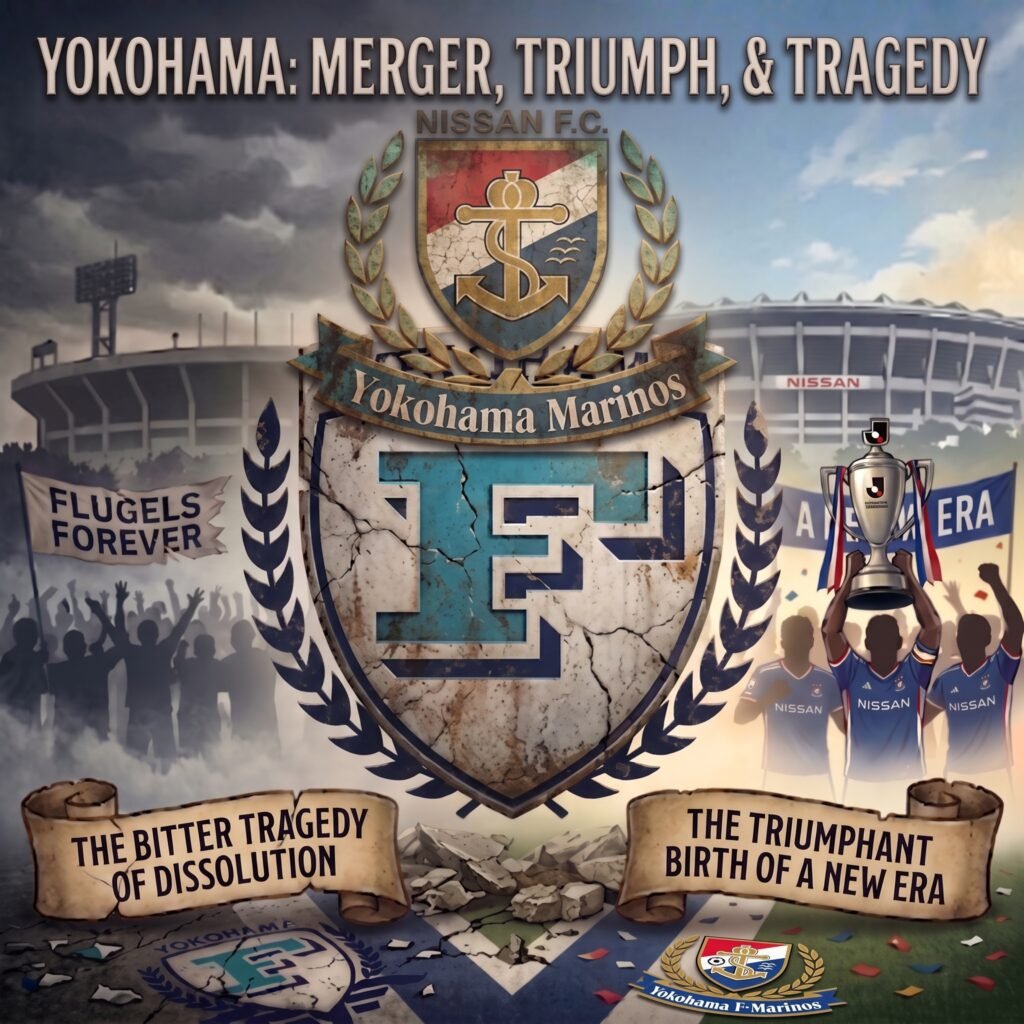
How a boardroom deal, a fan uprising, and a fairy tale cup run collided in the winter of 1998
Picture an ordinary Thursday morning in late October, 1998. Coffee, a folded newspaper, the usual scan of headlines before the commute. For an All Nippon Airways Sports administrator named Mr. Omatsu, that routine ended somewhere in the sports pages, when he read that the company he’d spent years helping to build no longer existed. Not metaphorically. It had been dissolved and absorbed into a rival, and nobody inside it had thought to warn him first. He found out the same way most of the country did, over breakfast, from a leak, before the two clubs involved had even finished coordinating their own announcement.
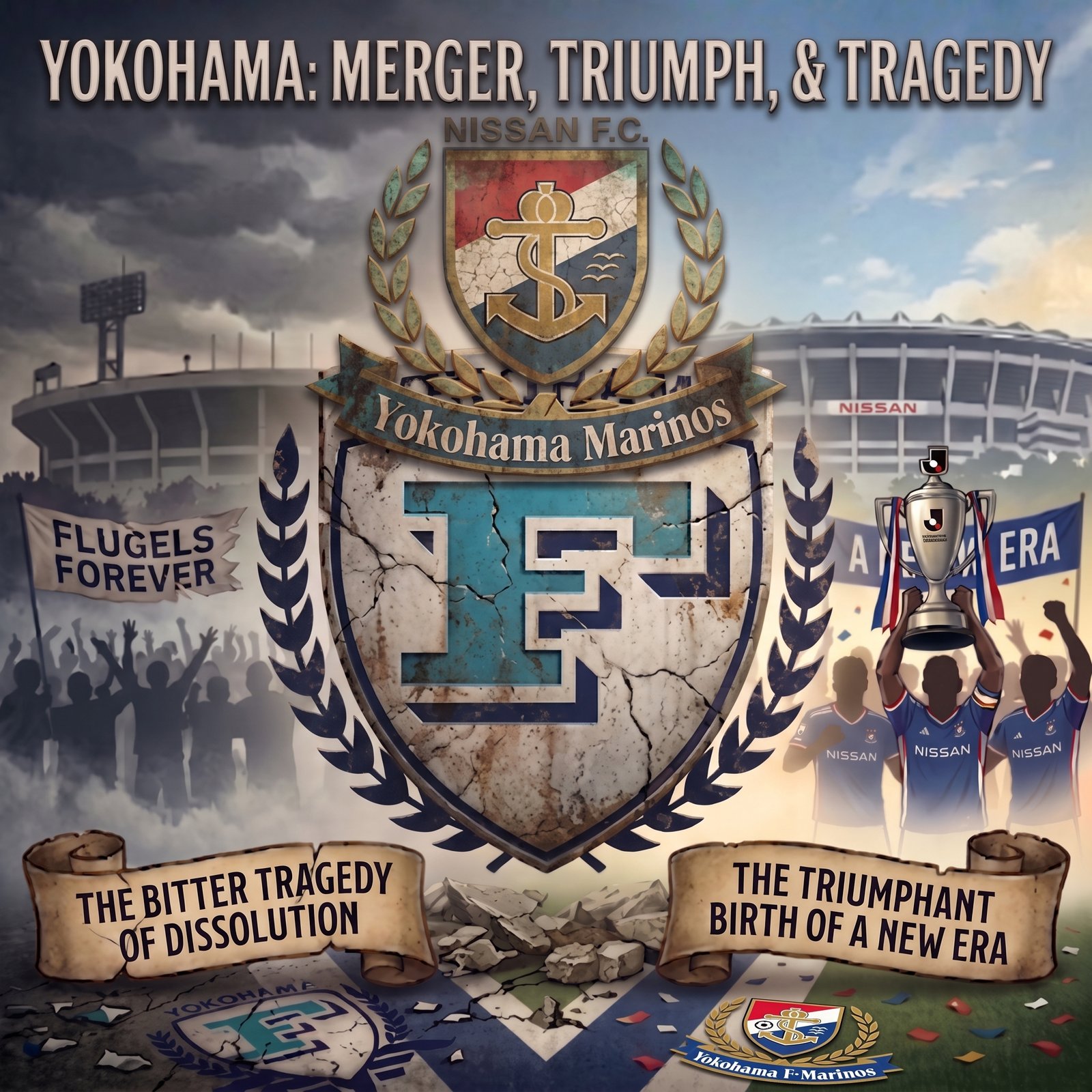
That’s the level of chaos that greeted the end of Yokohama Flügels, a founding member of Japan’s J.League and, until that morning, one half of the country’s most evenly matched football rivalry. What followed was corporate farce and genuine heartbreak. It also somehow produced one of the greatest send-offs any dying club has ever managed.
A rivalry built to last
Every derby needs an origin story, and Flügels’ is a slow-motion identity crisis. The club’s roots go back to 1964 and a company side called Yokohama Chuku Sports Shonendan, which spent three decades changing names each time ownership shifted: first Yokohama Tristar, then the All Nippon Airways Yokohama Soccer Club, then simply ANA Soccer Club. When the J.League launched in 1993, the club finally landed on the name that stuck. The arrangement behind it would later prove to be its undoing: All Nippon Airways held 60%, and a construction firm called Sato Kogyo held the other 40%.

Marinos, by contrast, never had an identity crisis. They descended directly from the Nissan Motor Company Football Club, a legitimate powerhouse of the old semi-professional Japan Soccer League, carrying the kind of institutional weight and cash reserves that come from being owned outright by one of the country’s biggest manufacturers rather than split awkwardly between an airline and a builder.
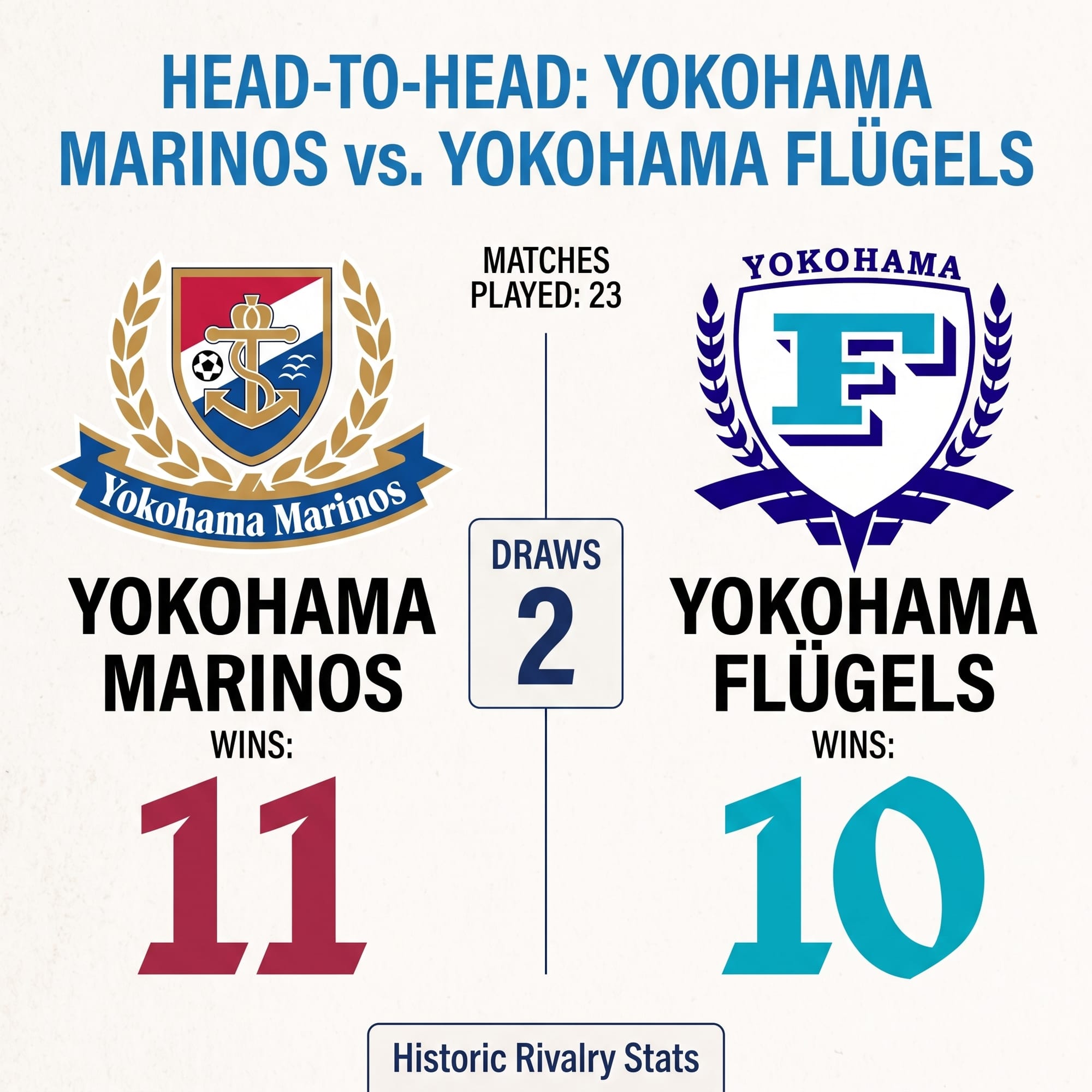
You’d expect that imbalance to show up in the results. It never really did. Between 1992 and 1998, the two sides met 23 times across all competitions: Marinos won 11, Flügels won 10, and two were drawn, close enough that neither club could claim Mitsuzawa Stadium, where the derby was played, as home turf in anything but the literal sense.
A lot of that competitiveness traces back to Flügels’ first manager, Shu Kamo, who built the team around a zone press, a coordinated, suffocating defensive scheme that was still fairly novel in Japanese football at the time. Matches against Flügels became a real test of composure. He paired the system with real quality: Brazilian internationals Cesar Sampaio, Zinho, and Evair gave the side technical class, while homegrown players like Masakiyo Maezono, Motohiro Yamaguchi, and a young goalkeeper named Seigo Narazaki gave it a spine that would matter later, when everything else fell apart. Marinos, under Hidehiko Shimizu, played a more methodical, star-studded game. Two very different clubs ran neck and neck in the same city for six full seasons. It’s the exact kind of rivalry a league quietly builds its whole identity around, right up until one half of it turns out to be running on borrowed time.
The math doesn’t add up
The J.League’s founding model rested on an assumption that looks almost quaint from any distance: that large corporations would happily absorb whatever losses a club’s ticket and merchandise revenue couldn’t cover, indefinitely, as a kind of civic goodwill exercise. It worked well enough while Japan’s economy was booming. It stopped working the instant the asset price bubble burst and every corporate marketing department in the country started hunting for things to cut, and a football club that didn’t sell anything the parent company actually made was an obvious candidate.
Flügels felt it earliest and hardest. Under the original ownership agreement, ANA and Sato Kogyo jointly covered the club’s net losses through a combined annual subsidy of around 1.5 billion yen, already a serious sum, and one that only worked because it was split two ways. Late in 1997, Sato Kogyo walked away from that arrangement entirely. The company was reeling from the collapsing property market and going through an internal restructuring that pushed the founding family out of active management; two years later it would slide into a formal court-led reorganization of its own. Whatever appetite it had for propping up a football club had evaporated well before then.
That left ANA holding an operating budget that had swollen to roughly 3 billion yen a year, alone, at precisely the moment its own finances were under pressure. The airline simply couldn’t absorb a shortfall that size by itself. And the uncomfortable truth is the club had been badly run even when the money was flowing. Executives dispatched from ANA’s corporate offices had backgrounds in aviation, not sports administration, and the gaps showed everywhere: payroll drifting upward without much discipline, merchandising inventory nobody was tracking properly (a kit redesign reportedly left the club sitting on unsold stock and an outright write-down), and, worst of all for anyone who actually followed the team, letting Cesar Sampaio walk back to Palmeiras on a free transfer instead of selling a Brazilian international for what should have been real money. It’s the kind of decision that looks careless in isolation and considerably worse once you know how the story ends.
Rather than air any of this in public, ANA quietly opened talks with Nissan about folding Flügels into Marinos, and set about preparing to present the whole thing as a rescue rather than what it actually was: one struggling parent company handing its liability to a stronger one and calling it teamwork.

The morning everything changed
The deal leaked to sports newspapers before either club’s press teams could get their story straight, which is how players and staff ended up learning about their own club’s dissolution from the very same papers everyone else was reading that morning. When ANA Sports staff were finally gathered into a conference room to hear the news made official, the mood was reportedly closer to a wake than a briefing: the kind of silence that follows news you already suspect is coming and still can’t quite absorb once it arrives.
Captain Motohiro Yamaguchi’s response, when asked whether the players agreed with the decision, was blunt to the point of bleak:
Agree or not, the decision had already been made.
There wasn’t really a question left to answer. Younger players had it worse in a different way. Forward Shunsuke Nagai, who had only just completed a full transfer to the club that same year, was suddenly staring down the possibility of losing a contract he’d barely had time to unpack his bags for.
The paperwork, once it caught up with the headlines, confirmed exactly how one-sided the arrangement was. Under an official press release from All Nippon Airways, the corporate entity behind the Flügels, All Nippon Airways Sports Co., Ltd., was formally dissolved and folded into Yokohama Marinos K.K. on February 3, 1999. The merged club kept the Marinos name and simply appended a single letter: Yokohama F. Marinos, the “F” a small, mostly symbolic nod to the club that no longer technically existed. Ownership of the new entity split 70% Nissan, 30% ANA. It was hardly a merger of equals beyond the branding exercise.
There’s a detail that makes the timing feel almost unkind. On the very day the merger broke, Japan’s national team was in Osaka preparing for a friendly against Egypt at Nagai Stadium, marking new manager Philippe Troussier’s first match in charge. Ordinarily, that’s a significant story in its own right. That week, it barely got a mention.
The league says yes, the fans say no
The J.League’s board convened an emergency meeting that same afternoon and rubber-stamped the merger before the day was even out. Chairman Saburo Kawabuchi later described the decision using a phrase that has followed the episode ever since:
超法規的措置 — a “super-constitutional measure.”
In practice, it meant the league tore up its own rulebook to make the timeline work. Under normal J.League regulations, a club intending to withdraw or dissolve was required to give a full year’s notice. That requirement simply vanished to fit a schedule Nissan and ANA had already agreed between themselves.
The Flügels’ supporters weren’t willing to let it go quietly. A fan group called Asa Azul (Portuguese for “Blue Wings”) organized a nationwide petition and gathered over 620,000 signatures trying to reverse the decision, a startling number for a club that had never once won a league title. On the night the merger was announced, roughly 80 supporters gathered in Shin-Yokohama and simply stayed there until dawn, less protesting than grieving, unable to think of anywhere better to be.
Asa Azul’s leader, a supporter named Tamaki Kawamura, later led a delegation to confront the chairman, Saburo Kawabuchi, in person at J.League headquarters. Kawamura recalled one young supporter putting on a suit and tie for what he said was the first time in his life, out of respect for the meeting, before asking Kawabuchi how the league could spend years preaching community-built clubs and then simply take one away. By most accounts the chairman was visibly shaken, reportedly moved to tears, but held the line that the decision was final, a matter of corporate insolvency rather than sentiment, however much the two might have felt indistinguishable in that room.
He did offer two concessions to soften the landing. Clubs across the league were allowed to expand their top-tier roster by one extra slot specifically to absorb displaced Flügels players, and every transfer fee ordinarily owed on those moves was waived outright, letting them negotiate freely with whoever would take them. Small mercies, but real ones, for a squad about to be scattered across the league whether it wanted to be or not.
Going out as champions
Knowing the club had, at most, a couple of months left to exist, the Flügels squad, managed by German coach Gert Engels, put together a nine-match unbeaten run to close out its history, playing with a defiance that bordered on spite. What follows reads less like a corporate footnote and more like a script.
They opened just two days after the merger broke, taking Cerezo Osaka apart 7–0 at the Yokohama International Stadium, a scoreline that still stands as a club record. It was the football equivalent of slamming a door on the way out. A 2–1 win away at Sanfrecce Hiroshima followed, then a 2–1 win over Avispa Fukuoka back at Mitsuzawa Stadium, a match that carried the particular weight of being the club’s final home fixture ever. A 4–1 win over Consadole Sapporo on the road closed out the league campaign completely unbeaten across the whole stretch.
Then came the Emperor’s Cup, Japan’s national knockout competition, and somehow the run got even better. A 4–2 win over Otsuka Pharmaceutical and a comfortable 3–0 victory over Ventforet Kofu set up a quarterfinal against Jubilo Iwata, the reigning league champions and not remotely the opponent anyone expected a club in Flügels’ position to beat. They won 2–1 anyway, goals from Yoshinori Kuboyama in the 6th minute and Takayuki Yoshida in the 77th sandwiching a Masashi Nakayama equalizer for Iwata. A tense, low-scoring 1–0 semifinal win over Kashima Antlers, played in Osaka, put them into the final with nothing left to lose and, for once, everything still to prove.
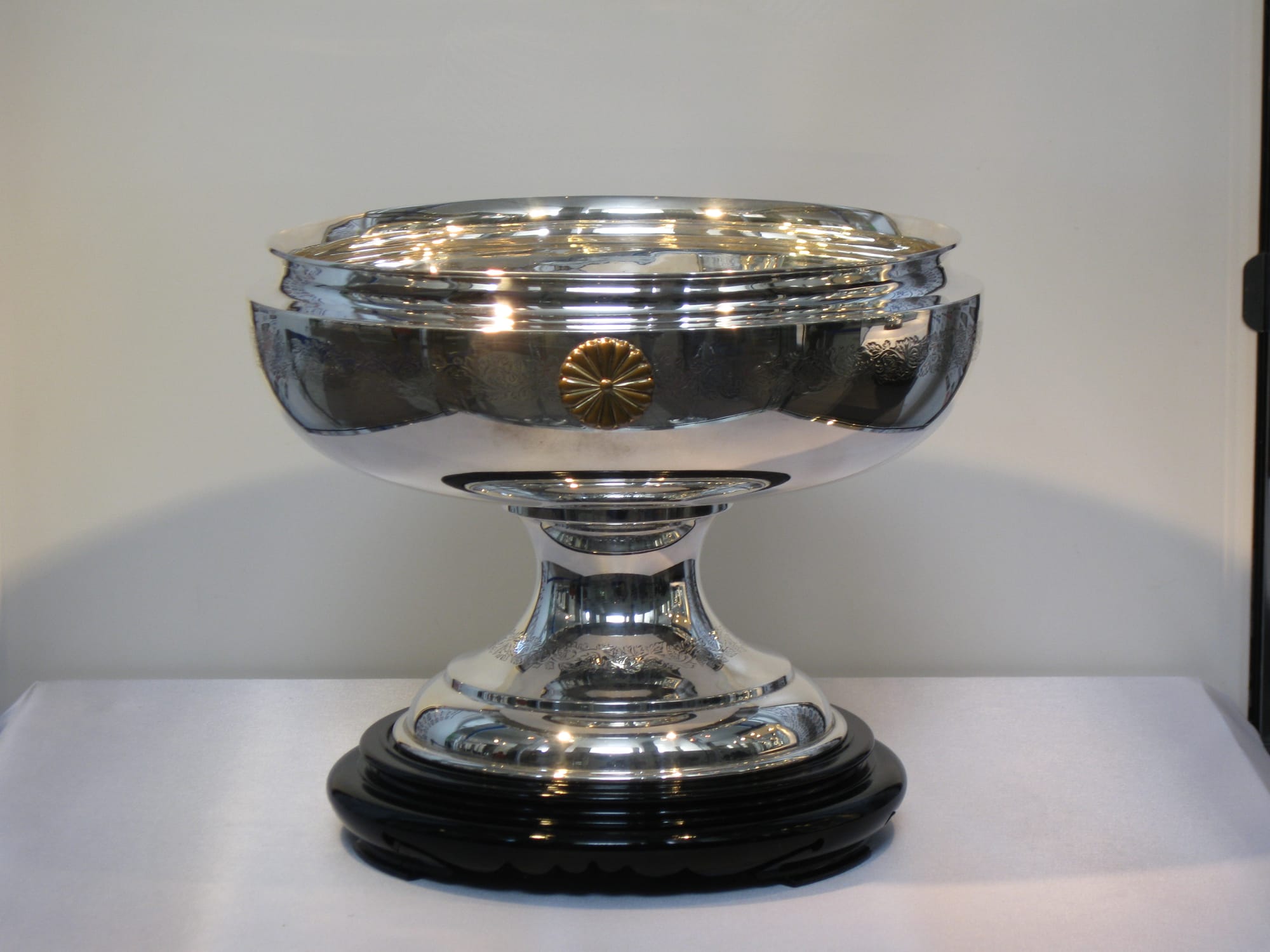
They won that too. On New Year’s Day 1999, at the National Stadium in Tokyo, Flügels beat Shimizu S-Pulse 2–1, Takayuki Yoshida scoring what turned out to be the winning goal in the 72nd minute. It was the final kick of a match that was, in every sense, the final act of the club’s existence. Reporters who were there described the atmosphere as something like a festive banquet held on the day of a funeral, which might be the single most precise sentence anyone has ever written about a football match. Outside the stadium, Kawamura and her fellow Asa Azul members had spent the previous night hand-painting a banner adapting a line from a well-known poem, roughly “let us meet by your side,” and unveiled it as the final whistle sounded. Yamaguchi kept the match ball. It’s still, presumably, somewhere in his house.
The celebration didn’t survive contact with reality. At the post-match press session in Shin-Yokohama that should have been a victory party, player after player took the microphone not to talk about the trophy but to announce which club they’d be joining for the following season. The team that had just won the country’s oldest cup competition dissolved, on camera, within the same hour it had been crowned.
Where everyone landed
Some of the squad did cross the divide to Marinos (midfielder Atsuhiro Miura, forward Takayuki Yoshida, and defender Yasuhiro Hato among them), and the extra quality helped the newly merged club win the J.League’s First Stage title the following year. It’s an odd kind of vindication for the executives who engineered the whole thing: the on-pitch results arrived almost immediately, even as the goodwill cost never really got repaid.
The club’s two biggest names refused outright, for reasons that had nothing to do with money. Yamaguchi said he simply couldn’t picture himself in a Marinos shirt after years of derby rivalry; to him, crossing over would have meant betraying the fans who’d stood behind Flügels through everything, right up to that last cup final. Narazaki had a sharper reason to walk: Marinos executives had publicly suggested the club already had enough goalkeepers in Yoshikatsu Kawaguchi, a comment that left little doubt about where he stood. Both signed with Nagoya Grampus instead, and both actually played there. But before his transfer paperwork went through, Narazaki insisted on one specific detail: that his registered club immediately prior to Nagoya be listed as “Yokohama Flügels,” not Marinos, even though the merger meant his contract had technically passed to the new entity. It’s a small, purely administrative act of loyalty, but a deliberate one, making sure that, on paper as much as anywhere else, his last club was the one he actually played for.
What actually changed
The lasting damage from the merger was never really about either club individually. It was about what it exposed in the league itself. Kawabuchi later called the whole episode the “greatest stain” on his career running the J.League. The league already had a guiding philosophy on paper by this point: the “百年構想,” or 100-Year Vision, a community-first slogan Kawabuchi had adopted back in 1996 after a public dispute with a newspaper executive over whether J.League clubs should be run as commercial ventures or as local institutions. The Flügels collapse is what forced the league to actually live up to it. By Kawabuchi’s own later account, watching a founding club disappear pushed him to push harder on “living within your means” financial management and meaningful community roots, rather than leaving the Vision as a slogan on a brochure. Clubs were pushed to build broad networks of local sponsors, municipal partnerships, and small and mid-sized businesses, spreading financial risk across dozens of stakeholders instead of leaving it resting on one or two corporate patrons who could walk away the moment their own numbers turned bad.
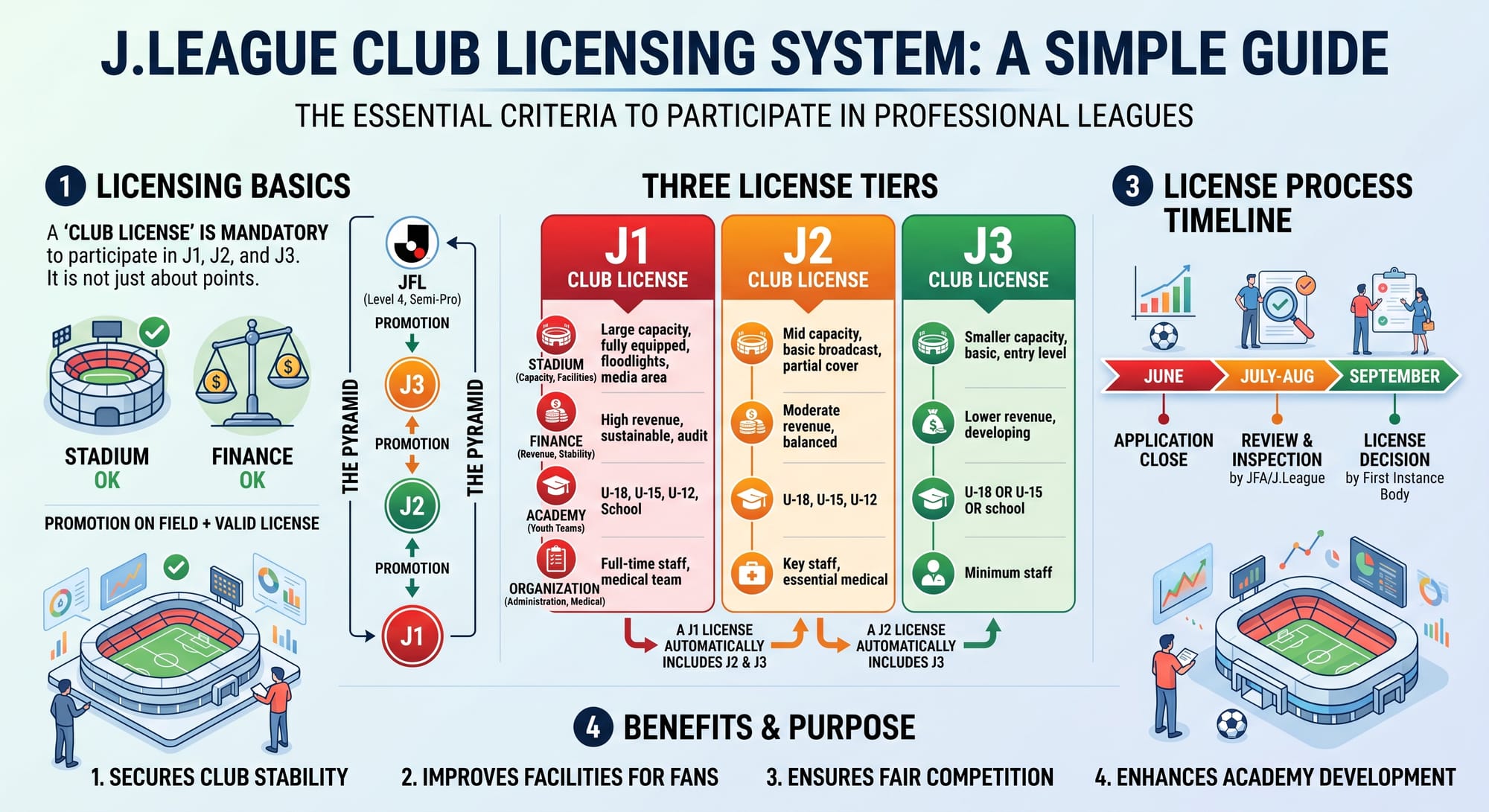
That philosophy eventually hardened into an actual rule. The J.League Club License System, introduced in 2012 and fully in force by the 2013 season, strips any club of its professional license if it posts a net financial loss for three consecutive years or falls into outright insolvency. It reads like a dry piece of financial regulation, and mostly it is. But it exists directly because of what happened to Flügels: a structural guarantee, in theory, that no club could ever again implode quite this quietly, with a captain finding out his job was gone from a headline and a club’s own staff learning the news from the morning paper, the same way Mr. Omatsu did.
One door closes…
There’s one more thread in this story that deserves more room than a closing paragraph can give it. Within weeks of the merger, a group of Flügels supporters who refused to simply transfer their loyalty to Marinos set out to build something that had never existed in Japanese football before: a club owned outright by its own fans, with no corporate parent standing behind it at all.
They called it Yokohama FC. What they were attempting, an unusual experiment in supporter ownership borrowed from a model more familiar in European football, would either prove that a club could survive without a Nissan or an ANA propping it up, or demonstrate exactly why nobody had tried it in Japan before. That’s a story with its own boardroom drama, its own leap of faith, and its own hard lesson about what “fan-owned” actually costs to run. It’s one worth telling properly, on its own terms, another time.
At a Glance
- Merger announced: October 29, 1998 (leaked before official confirmation)
- Legal dissolution of ANA Sports / merger effective: February 3, 1999
- New entity: Yokohama F. Marinos — Nissan 70%, ANA 30%
- Yokohama Derby head-to-head (1992–1998): Marinos 11 wins, Flügels 10 wins, 2 draws
- Anti-merger petition: over 620,000 signatures, organized by supporter group Asa Azul
- Flügels’ closing run: 9 matches unbeaten, capped by a 2–1 win over Shimizu S-Pulse in the 78th Emperor’s Cup Final, January 1, 1999
- Resulting reform: J.League Club License System, introduced 2012, fully in force from the 2013 season
Sources & Further Reading
This piece draws on primary press material, official club histories, and Japanese sports journalism covering the merger and its aftermath. Most sources are Japanese-language; readers without Japanese should find them workable through machine translation.
Primary and official
- All Nippon Airways — official press release announcing the merger, October 29, 1998
- Yokohama FC — official club history
- Yokohama FC — 25th-anniversary interview with Yasuhiko Okudera, “Aiming for a Club That Lasts 100 Years”
Reference
- Wikipedia (Japanese) — Yokohama Flügels
- Wikipedia (Japanese) — Yokohama FC
- Wikipedia (Japanese) — 78th Emperor’s Cup
- Wikipedia (Japanese) — Saburo Kawabuchi
Journalism and firsthand testimony
- Sportiva (Shueisha) — “20 Years Since Japan’s Biggest J.League Tragedy: What Happened to the ‘F’ Players”
- PRESIDENT Online — player testimony on the day the merger was announced
- Football Channel — interview with former Asa Azul leader Tamaki Kawamura, twenty years on
- Yahoo! Sports Navi — J.League 25th-anniversary testimony series on the 1998 “F Tragedy”