

Part one of a three-part series on the making of Japan's most successful national team manager
Hajime Moriyasu (森保一) has spent the better part of a decade being praised for what he does not do. He does not chase headlines. He does not build his teams around a single tactical idea and defend it to the death. He does not, by most accounts, need to be the smartest person in the room, only the one who has arranged the room correctly. Long before any of that was a coaching philosophy, it was a survival strategy for a teenager from Nagasaki who was good at football but not obviously destined for it, and who worked out, slowly and without much fanfare, that the way to matter on a football pitch was to make other people better at mattering.
This is the first of three articles tracing that career. Here, we look at the player: a boy who wanted to throw a baseball, a midfielder nobody outside Hiroshima had heard of, and the string of coaches, family members, and one catastrophic night in Qatar that turned him into the anchor of a national team. Parts two and three will follow him into the dugout, first at Sanfrecce Hiroshima and then with the Japan national team itself.
A Family on the Move
Moriyasu was born on 23rd August 1968 in Kakegawa, a city in Shizuoka Prefecture, to a family with no particular football pedigree. His father worked in shipbuilding, including a stint on the Koyagi construction dock for Mitsubishi Heavy Industries, and the job moved the family around: Nagoya, then Yokosuka, then Karatsu in Saga Prefecture, where young Moriyasu briefly enrolled at Karatsu Municipal Kagamiyama Elementary School before the family settled for good in Nagasaki City at the start of first grade. He has since described his own identity in a neat, slightly wry shorthand: born in Nagasaki, raised in Hiroshima. It's a line that carries more weight than it first appears. His father was a second-generation hibakusha (被爆者, atomic bomb survivor), having been exposed as a child to the blast wave from the Nagasaki bombing, and Moriyasu would go on to spend most of his adult life in the only two cities on Earth to have suffered a nuclear attack. He rarely dwells on it publicly, but it sits quietly underneath the biography.
Before any of that, there was baseball. The Moriyasu household was a baseball household, and Hajime played catch constantly with his younger brother, Hiroshi, pitching as a fifth grader to Hiroshi's second-grade catcher. For a while he wanted to go pro. His mother, by all accounts a direct and plain-spoken woman, ran a tight ship at home, and the discipline she instilled would resurface later, once corporate Japan and professional sport got hold of him and asked for a great deal more of it.

Football arrived almost by accident. His elementary school had no team, so in third and fourth grade he and his classmates simply kicked a ball around the schoolyard before class, the way kids do when there's no formal outlet for something they enjoy. The turning point came in fifth grade, when a teacher who had previously coached a youth football club at a neighbouring school transferred in, noticed the boys running around at lunchtime, and organised them into something resembling a team. Moriyasu took to it immediately. He liked that football, unlike baseball, asked you to make your own decisions constantly, in real time, without anyone in the dugout to consult.
By sixth grade he had joined Doinokubi Soccer Sports Shōnen-dan (土井首サッカースポーツ少年団, Doinokubi SSS), based in the reclaimed southern districts of Nagasaki City that also produced neighbouring rival club Koyagi SSS. It was a fiercely competitive youth footballing pocket for the region, and Moriyasu, playing in goal, represented it at the 4th All Japan Boys Soccer Tournament. It's an odd footnote given what came later: the man who would spend his career as the last line of a midfield started out as the actual last line of defence.
The Team His Father Built
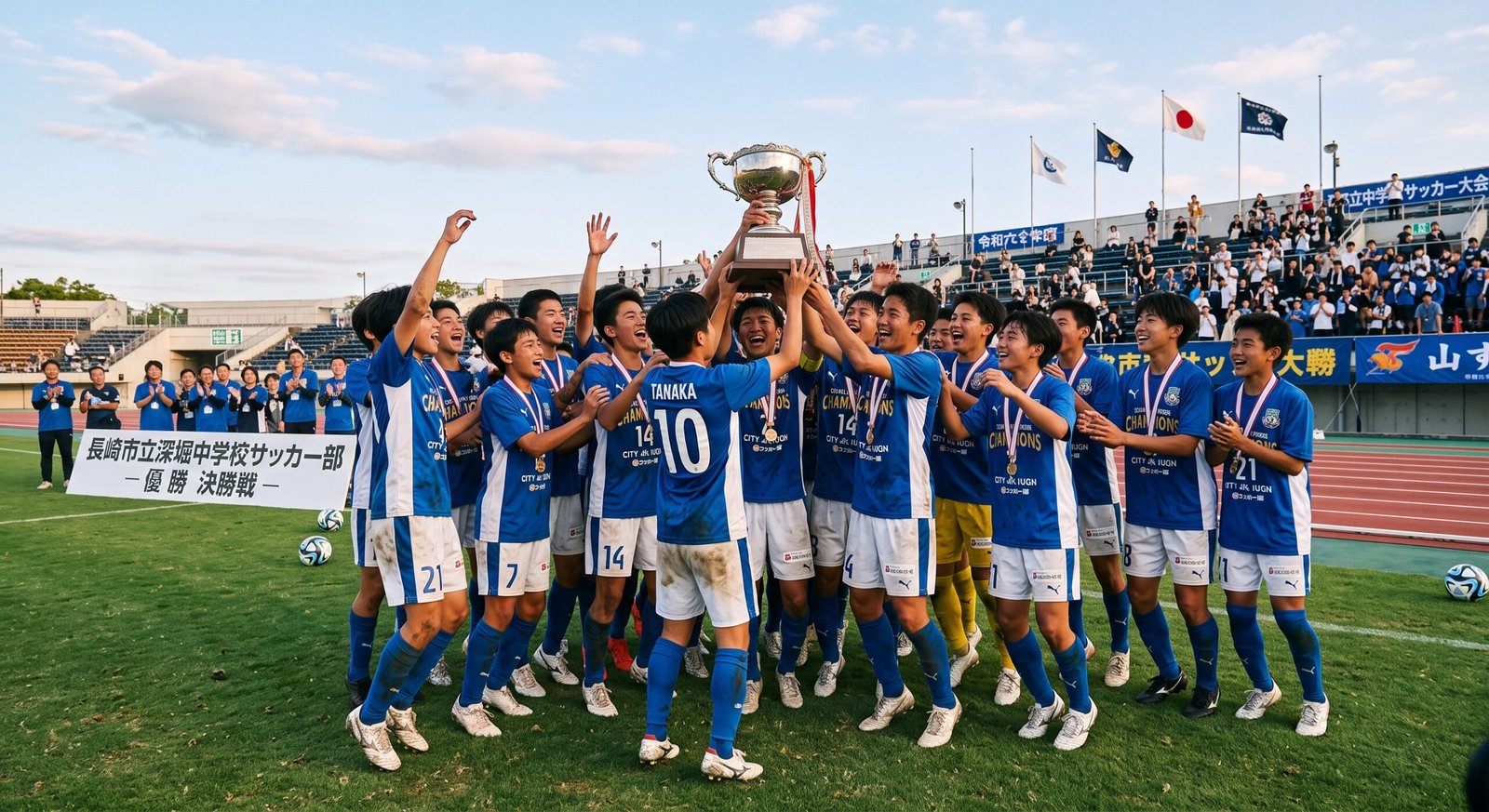
Junior high brought a setback. Nagasaki Municipal Fukahori Junior High School (長崎市立深堀中学校), where Moriyasu enrolled next, had no football team at all, so he joined the handball club instead. When his father asked why he'd walked away from the sport, Moriyasu told him plainly: there was nowhere to play it. That answer was apparently the wrong one to give a man who liked solving problems. Moriyasu's father set about mobilising the local community to build a football programme from scratch, recruiting a player from the Mitsubishi Heavy Industries Nagasaki club to coach it, while parents drove the minibus to away games, found training grounds, and took turns refereeing. Moriyasu's father filmed matches on an 8mm camera so the team could review them afterwards, which was either wonderfully advanced or a little terrifying, depending on how well you'd played that week.
In the gap before Fukahori had its own team up and running, Moriyasu trained for a spell at nearby Doinokubi Junior High School, where he was bullied by some of the other students, who at one point hid his boots. He stuck with it. Within less than a year of Fukahori's team being founded, and with Moriyasu captaining the side, they won the Nagasaki City championship and qualified for the prefectural tournament. It's a small story, but it's the first time in his biography that you see the shape of something he'd return to again and again: an institution built out of very little, by people who simply refused to accept that the thing they wanted didn't exist yet. He would spend a good part of his coaching career doing exactly that at a national level.
Choosing the Smaller School
By the time he reached high school age, Moriyasu had a decision to make. Nagasaki Prefectural Kunimi High School (長崎県立国見高等学校) was the region's football factory, a school about to become thoroughly dominant under a young, ferociously driven coach who had just taken over the programme, and Moriyasu's close friend Teruo Iwamoto was headed there. Moriyasu very nearly went too. His father talked him out of it, worried about his grades and about a teenager who thought of little besides football. Moriyasu himself wasn't sure he'd break into a squad that deep. And there was a plainer obstacle: Kunimi's boarding fees ran to roughly 100,000 yen a month, something in the region of 650 US dollars at today's exchange rates, and he didn't want to put his parents under that kind of strain for his sake, not with younger siblings to think about. His junior high coach, as it happened, had gone to Nagasaki Nihon University High School (長崎日本大学高等学校, Nagasaki Nichidai) himself, and recommended Moriyasu there instead. A scholarship covering part of his tuition sealed it.
At Nichidai he played as an attacking midfielder, all forward instinct, a world away from the deep-lying enforcer he'd later become. He also acquired the nickname that would follow him for the rest of his playing career: a clerical mix-up in a match programme rendered his name oddly on the page, a classmate misread it, and "Poichi" (ポイチ) stuck. It is, for the record, still what a lot of people who played alongside him call him. It was also at Nichidai that he met Yuko, the woman he'd go on to marry, whose maiden surname happened, coincidentally, to already be Moriyasu.
Nationally, none of this registered. Nagasaki high school football in the mid-1980s belonged to Kunimi and to Shimabara Commercial, and Nichidai was knocked out of prefectural qualifying by one or the other most years, so Moriyasu never played at the Inter-High tournament or the national high school championship. Iwamoto, meanwhile, won the Inter-High with Kunimi and reached the championship final. It would have been easy to read the gap between the two friends' schedules as a verdict on Moriyasu's talent. What actually got him noticed was a call-up to the Nagasaki prefectural squad for the Kokutai (国民体育大会, National Sports Festival), held that year in Yamanashi. It was a small stage by national standards, but corporate scouts were watching it, and one of them liked what he saw.
Learning to Be Useful
That scout was Kazuo Imanishi (今西和男), general manager of Mazda Football Club in the old Japan Soccer League (日本サッカーリーグ, JSL), and he had a habit of spotting things other people missed. Moriyasu joined Mazda SC in 1987 with no elite university pedigree and no national high school title to his name, and was parked, unglamorously, in the club's reserve squad. It did not go smoothly at first. He has since admitted, with the kind of candour that would become something of a trademark, that he spent a fair amount of that early frustration in pachinko parlours rather than on the training pitch. What steadied him was partly his own stubbornness and partly Yuko, who was by then his fiancée and who made the trip from Osaka to Hiroshima regularly to support him through it.
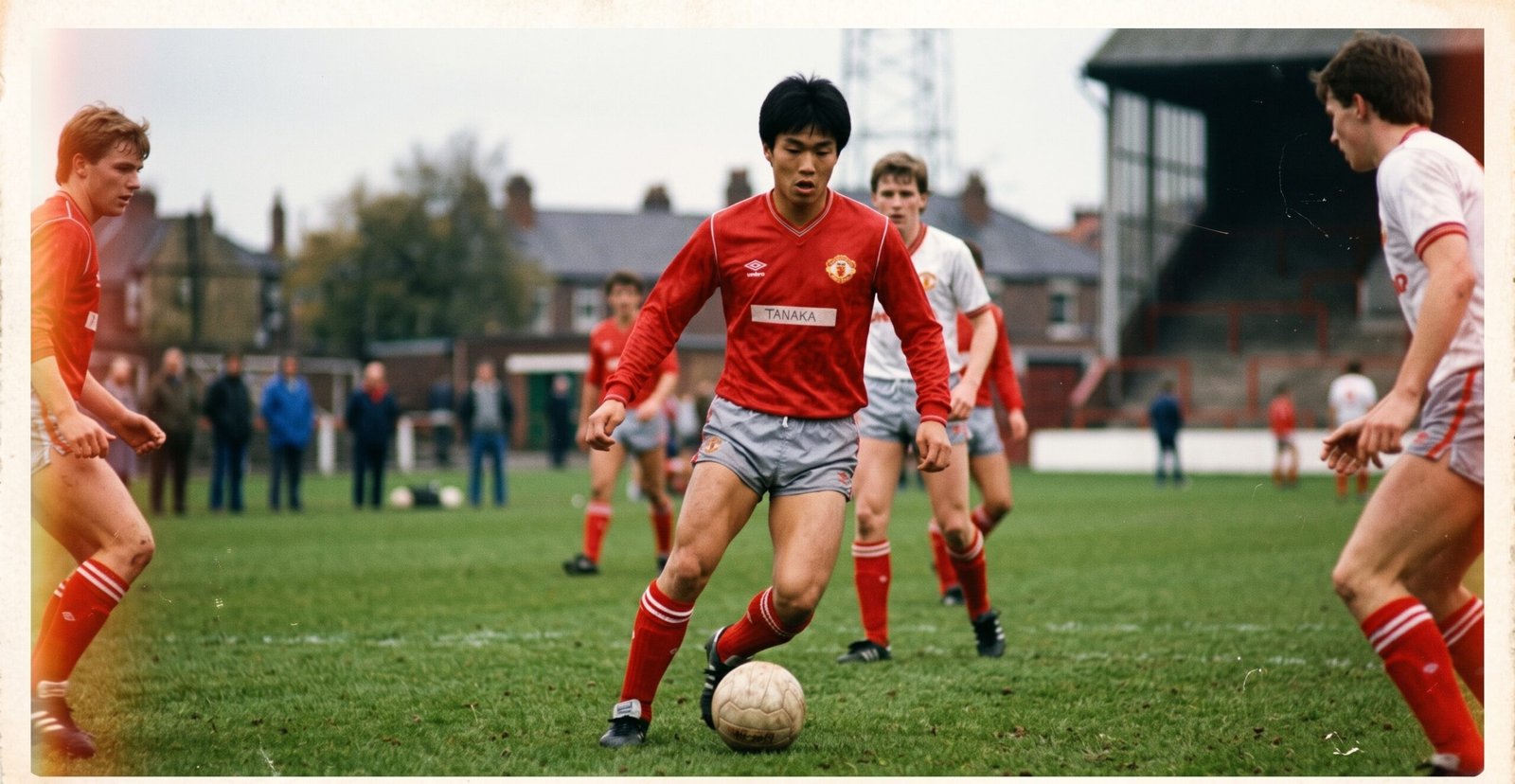
The more useful realisation, though, was tactical, and it was his own. Moriyasu didn't have the acceleration or the technical flair of the era's showcase playmakers, and rather than fight that fact, he built a game around it: positional discipline, quick defensive transitions, spatial coverage, an instinct for making the team around him function better. Imanishi, for his part, kept betting on internationalism ahead of most of his Japanese League counterparts, bringing in Dutch coach Hans Ooft and former Manchester United defender Bill Foulkes to import European ideas, and arranging a month-long training trip to Manchester United for a handful of promising young players. In the spring of 1990, a 21-year-old Moriyasu was one of four sent. It was reserve-team access rather than a trial with Alex Ferguson's actual first XI, but it put him in the same building as Bryan Robson and Mark Hughes, training under a manager who'd go on to define an era, at a time when Japan didn't yet have a professional league of its own to speak of. Some of the United players he trained alongside weren't sure a Japanese footballer belonged there at all. He answered that the only way he knew how, by playing well enough that the question stopped coming up. Tellingly, it's not an episode Moriyasu tends to bring up himself. He came home, kept his head down, and let the football speak.
Ooft, Behind the Ball, and the Making of a Volante
It was Ooft who made Moriyasu the player he'd be remembered as. Watching him at Mazda, Ooft saw the tactical awareness and the stamina and converted him, deliberately, from an attacking midfielder into a deep-lying defensive one, sitting in front of the back line rather than ahead of it. Ooft's guiding principle for the team was a phrase he used constantly and that Japanese football media eventually just adopted wholesale, rendered in katakana as ビハインド・ザ・ボール: "Behind the Ball." Get bodies behind the ball. Cover the space. Don't get caught upfield when possession turns over. Moriyasu absorbed it so completely that he became known, only half-jokingly, as the child of Behind the Ball, and later, the child of Hans Ooft himself.
In practice, the role meant closing down opposition playmakers before they could deliver a forward pass, tracking back to cover the space an advancing full-back or centre-back left behind, holding defensive shape while more gifted teammates such as Ruy Ramos (ラモス瑠偉) and Kazuyoshi Miura (三浦知良) went and did the creative work further up the pitch, and recycling the ball forward the instant he won it. He described his own mental arithmetic on the pitch in blunt terms: something like seventy or eighty percent containment, twenty or thirty percent distribution. It's not a glamorous job description, and it wasn't meant to be. Photographers covering matches at the time noticed that Moriyasu turned up constantly in the frame during defensive phases and almost never while lingering on the ball, because he didn't linger on the ball, and the press started calling him the Shadow MVP, a nickname that manages to be a compliment and a joke about how little credit the role usually gets, all at once.
Mazda became Sanfrecce Hiroshima when the J.League launched in 1993, and Moriyasu, by then established, made the step up with it. He'd actually opened his account for the club the previous year, scoring in a Yamazaki Nabisco Cup tie against Yomiuri Verdy on 6th September 1992, well ahead of the league's official kick-off. His first goal in the top flight of the old Japan Soccer League had come on 26th October 1991, against Yamaha at Okayama Prefectural Athletics Stadium. He started Sanfrecce's official J.League debut on 16th May 1993, a 2–1 win over JEF United Ichihara at Hiroshima Stadium, and scored his first J.League goal on 2nd June 1993, against Nagoya Grampus Eight at Mizuho Athletic Stadium. By 1994, playing under Stewart Baxter, he and midfield partner Yahiro Kazama were driving Hiroshima's engine room well enough to help the club to a stage title that season.

The Volante Word Gets Its Moment
The specific word Japanese football media reached for to describe what Moriyasu did, volante, borrowed from Portuguese and meaning something like "steering wheel," wasn't really in wide circulation in Japan before he arrived on the national scene. There's a fairly specific reason it caught on when it did. When Ooft took the national team job in 1992, becoming the first foreign head coach in the side's history, he called Moriyasu up despite his being almost entirely unknown to the national press, and some journalists, not unreasonably, assumed it was cronyism dressed up as selection. Moriyasu made his senior international debut on 31st May 1992 against Argentina at the National Stadium in Tokyo, in the Kirin Cup, a match Japan lost 0–1. Argentina's own coaching staff and their star forward were reportedly impressed enough by what they'd seen from the unheralded number seven that they remarked, more or less, that Japan did have a decent volante after all. The word stuck, and a role that Japanese football hadn't previously had a name for suddenly had one, borrowed from South America and attached, from then on, to Moriyasu.
His real breakthrough came that November, in the semi-final of the 1992 AFC Asian Cup against China, a match Japan led and then nearly threw away before winning 3–2. Moriyasu covered vast amounts of ground after a teammate went down, and picked up a second yellow card of the tournament in the process, which ruled him out of the final win over Saudi Arabia. He watched Japan lift the trophy from the sidelines, having done a fair amount of the unglamorous work required to get them there.
Doha
Moriyasu started every minute of Japan's 1994 World Cup qualifying campaign in Doha that October, and he was on the pitch on 28th October 1993 for the match against Iraq that decided it all. Japan led 2–1 deep into stoppage time, seconds from a first World Cup finals appearance, when Iraq worked a short corner and Jaffar Omran headed home the equaliser. The match finished 2–2. Japan finished third in their qualifying group on goal difference, South Korea went through instead, and the country still refers to that night as the Tragedy of Doha (ドーハの悲劇, Dōha no higeki).
Moriyasu has talked since about what went wrong in those final minutes, and it reads less like an excuse and more like a coaching manual in embryo. The emotional intensity of the game, he's said, made it hard for the team to properly reset at halftime, and that carried through into late fatigue and fraying decision-making. Rather than pressing forward to protect the lead, the side instinctively dropped deep into its own box, which is precisely the kind of passivity that hands the opposition the room to work a short corner in the first place. And in the chaos of those final seconds, nobody quite organised the marking against a set piece Iraq hadn't shown before. Composure under pressure, proactive rather than defensive risk management, and clear communication in the moments that matter most: these become, almost note for note, the pillars of the way Moriyasu would go on to manage. It's rare to be able to point at one ninety-minute stretch of a person's career and say, with a straight face, that's where the philosophy came from. This is close to being one of those cases.
He won 35 senior caps for Japan between 1992 and 1996, scoring precisely once, a goal in a 4–1 friendly win over Australia in Wollongong on 10th February 1996, under manager Shu Kamo.

Endings, and a Loan Nobody Wanted
Financial trouble at Sanfrecce Hiroshima after the 1997 season forced the club to start moving on its senior earners, and Hans Ooft, by then managing Kyoto Purple Sanga, wanted Moriyasu. Hiroshima initially agreed a permanent sale. Sanfrecce's supporters, who evidently didn't see it that way, organised a petition against the move, and the club backed down far enough to convert the deal into a season-long loan instead. Moriyasu played the 1998 season in Kyoto, then returned to Hiroshima for 1999 and stayed through 2001, before a final chapter at newly promoted Vegalta Sendai from 2002 to 2003 gave a young J1 side some veteran ballast in midfield. He announced his retirement at the end of that 2003 season, seventeen years after he'd joined Mazda's reserves as an unheralded eighteen-year-old, crediting the coaches, teammates, and supporters who'd carried him through a career he was fairly clear-eyed about not having built on natural gifts alone.
The numbers, by the Japan Football Association's own tally: 293 J1 League appearances and 15 goals, 49 J.League Cup appearances and six goals, 35 senior international caps and a single goal, all layered on top of whatever he'd contributed in the old Japan Soccer League before the professional era began in 1993.

None of what Moriyasu did as a player photographs especially well. He isn't in many highlight reels. What he did instead, repeatedly, across a Nagasaki schoolyard, a self-built junior high team, a Manchester reserve pitch, and a World Cup qualifier that ended in the worst possible way, was work out how to make the people and structures around him hold together. That turns out to be a reasonably useful skill to bring into a dugout. Part two picks up in 2012, when Sanfrecce Hiroshima, in some financial disarray of its own, decided the man for the job was one of their own former players, and gave Hajime Moriyasu his first head coaching role.
Sources
Japan Football Association, official announcement of Hajime Moriyasu's appointment as national team manager
Hajime Moriyasu, Wikipedia (English)
森保一, Wikipedia (Japanese)
1993 Japan v Iraq football match, Wikipedia (English)
Hans Ooft, Wikipedia (English)
"A Look at Moriyasu Hajime," Nippon.com
"21-Year-Old Hajime Moriyasu Silenced the Englishmen Who Doubted Him," Number Web"
The World of the Japanese Volante," Number Web
1992 Japan national football team, Wikipedia (English)
"1992 Asian Cup," Inside World Football
*Translated and paraphrased material in this piece has been rendered into English from Japanese-language sources rather than quoted from official English translations, with the exception of remarks originally made in English.

Pingback: Furukawa Electric's 1986 Asian Club Championship Win