
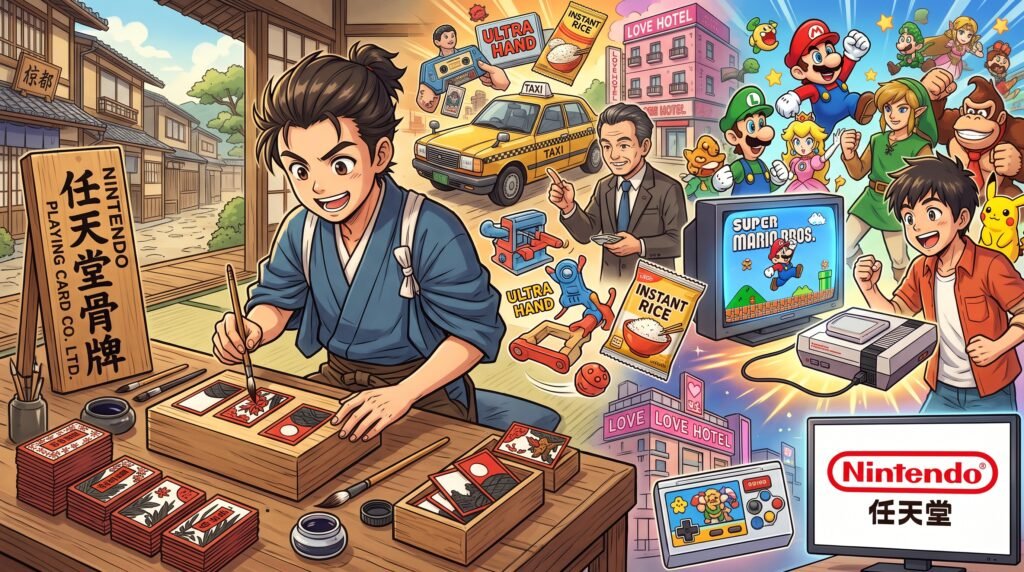
Nintendo (任天堂) did not set out to build the Nintendo Entertainment System, Super Mario Bros, or the Switch. For eighty-eight years, in fact, it primarily did one thing: it made cards for a country that used to arrest people for playing them.
The company that eventually taught the world what "1-Up" meant began life in 1889 in a workshop in Kyoto, hand-painting decks for a customer base its founder's descendants would later prefer not to discuss too loudly. The route from that workshop to home consoles runs through a legal loophole, an adoption, a stroke, a trip to Ohio, a Disney licensing deal, an oil crisis, a bankrupt calculator company, and a folding wooden hand invented by a bored maintenance worker. None of it was inevitable. Most of it was improvised.

A loophole with a flower on it
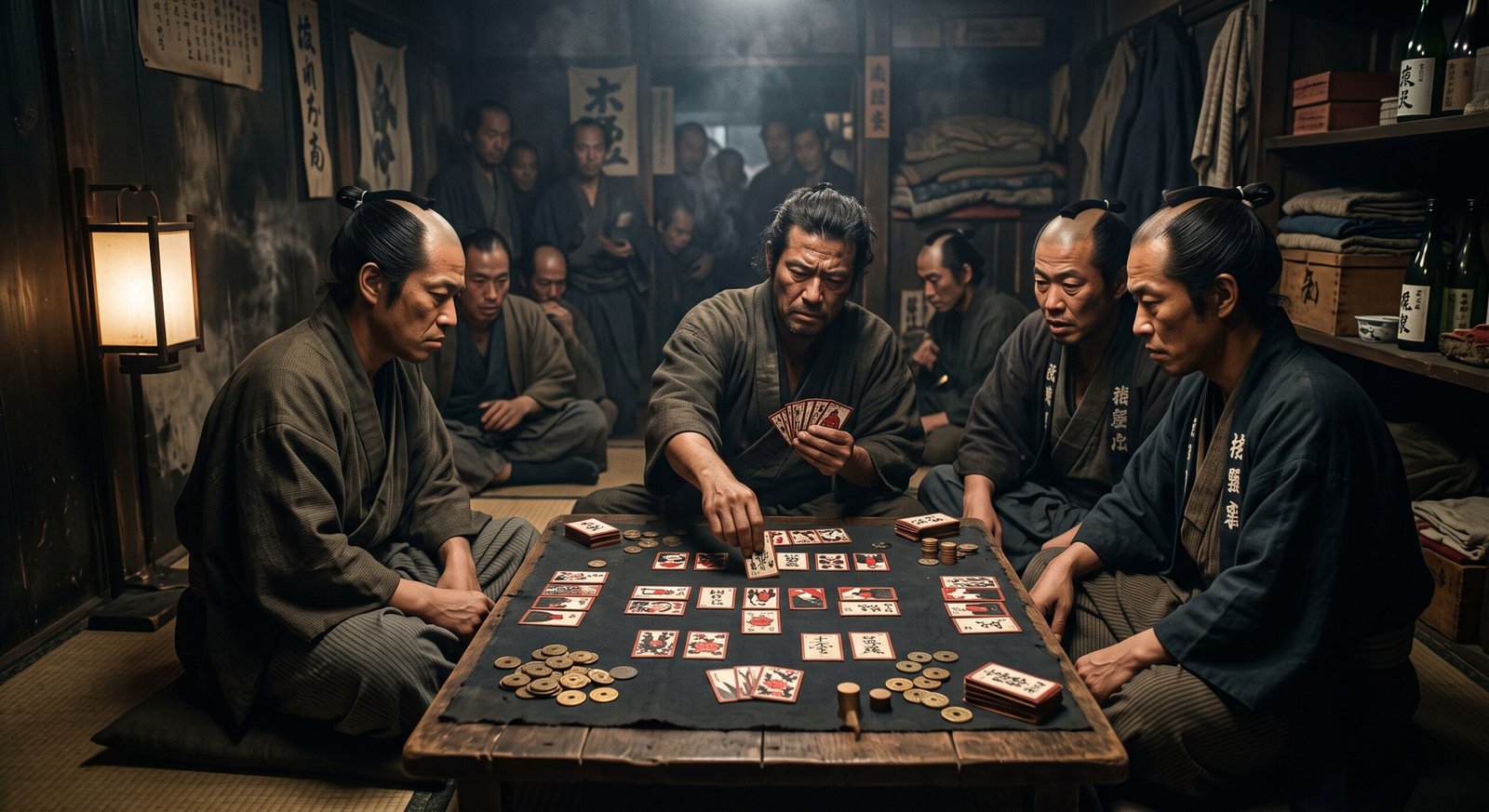
Under the Tokugawa shogunate, playing cards were periodically banned outright because of their obvious use in gambling. When the Meiji government reorganized the legal system in the 1880s, cards stayed heavily restricted, with one carve-out: hanafuda (花札), "flower cards," escaped the tightest scrutiny because their forty-eight cards were organized around twelve months of seasonal flowers rather than numerical suits. On paper, that made them look more like a matching game than a betting instrument. In Kyoto's gambling houses, nobody was fooled, and nobody much minded.
Fusajiro Yamauchi (山内房治郎), a craftsman running a small Kyoto business, saw the opening. On 23rd September 1889, he opened a workshop under the name Nintendo Koppai to hand-produce hanafuda from mulberry bark. That date is the one Nintendo itself has used for well over a century, and it appears in effectively every corporate history written about the company. It also happens to be disputed by at least one specialist. A playing-card historian who has spent years working through Japan's National Diet Library archives has pointed out that pre-war business directories consistently list the company's founding as 1892, three years later than the official version, and that the earliest confirmed paper trail for Fusajiro dates only to 1895. Nobody has definitively settled the question, and Nintendo's own account is the one that has stuck, but it's a useful reminder that even a company this famous has gaps in its own record that historians are still poking at.
Whatever the exact year, the business model was clear enough. Hanafuda decks wore out fast in the hands that actually used them, because high-stakes gambling houses discarded packs constantly to stop players marking or memorising them. A single parlour might burn through hundreds of decks a week. Fusajiro built an apprentice workshop to keep pace, and Nintendo became one of the more reliable card suppliers in a corner of the economy that officially didn't exist.
The gambling connection ran deeper than the customer list. Hanafuda hand-rankings gave the Japanese language one of its more colourful pieces of slang: a losing combination of the eight, nine, and three of the related game oicho-kabu adds up to twenty, a worthless score, and that losing hand is the likely root of the word yakuza. Nintendo's flower-and-bird motifs, meanwhile, ended up inked onto the arms and backs of the gangsters who played with them, a decorative afterlife the company's later, more wholesome marketing would rather not have dwelt on. Around the turn of the century Nintendo also became the first Japanese manufacturer to produce Western-style playing cards, initially aimed at export but quickly popular at home too, and when the Meiji government introduced a new tax on playing cards in 1902 to help fund state coffers, Nintendo simply absorbed the cost and kept growing.
Flowers, noses, and a name nobody can quite pin down
Nintendo sold to different tiers of that market with different products. There was Daitōryō (大統領, "President"), a premium line hand-painted on mulberry bark and stamped with an illustration of Napoleon, aimed at wealthy collectors and upscale gambling houses. And there was Tengu (天狗), a cheaper, high-turnover line named for the long-nosed creature of Japanese mountain folklore, sold into rougher parlours that needed volume over craftsmanship. Both product lines still turn up in collectors' listings today, which says something about how seriously Nintendo took its card business even in its least reputable decades.
The company's own name resists a tidy explanation. "Nintendo" is usually translated as "leave luck to heaven," a phrase that fits nicely with a company built on games of chance. Nintendo has never confirmed that reading, and no document has surfaced that settles the matter either way. A separate, less flattering theory ties the name to gambling-den slang of the era; the specifics of that etymology are folk explanation rather than documented fact, and it's worth treating them as exactly that. What isn't in dispute is the customer base: hanafuda's biggest buyers throughout the Meiji and Taishō periods were organised gambling operations, and Nintendo built its first fortune supplying them.
No son, an adopted heir, and a tobacco deal
Fusajiro had no son to inherit the business, so he followed the common Japanese practice of mukoyōshi (婿養子), adopting his son-in-law as heir. Sekiryō Kaneda (金田積良) married into the family, took the Yamauchi name, and became Sekiryō Yamauchi when Fusajiro retired in 1929.
Sekiryō modernised what had been a craft workshop. In 1933 he reorganised the business as Yamauchi Nintendo & Co., installed assembly-line production, and built the company's first dedicated sales force. To get cards into shops beyond Kyoto and Osaka, he struck a distribution deal in 1907 that placed Nintendo's decks in cigarette retailers nationwide, via the government's Monopoly Bureau (専売局)*, a clever piece of channel strategy for a company that had no retail network of its own. In 1947 he formalised distribution further by founding Marufuku Co., Ltd. as a dedicated sales subsidiary.
Sekiryō suffered a stroke in 1949. His intended successor had already left the family, so he called on his grandson, twenty-one-year-old Hiroshi Yamauchi (山内溥), then studying in Tokyo. Hiroshi agreed to take over on one condition: total executive authority. He got it, and used it immediately, dismissing longtime managers who resisted his plans. It set the tone for the next fifty-three years.

A ceiling in Cincinnati
Under Hiroshi, Nintendo consolidated its card operations into Nintendo Karuta Co., Ltd. in 1951 (renamed Nintendo Co., Ltd. in 1963) and kept growing into Japan's largest playing-card manufacturer. But a 1956 business trip changed his thinking about the company's future. Hiroshi visited the United States Playing Card Company in Cincinnati, Ohio, the biggest card manufacturer in the world, and found it operating out of what he considered an unimpressively modest facility. If that was the ceiling for the entire global industry, he reasoned, playing cards alone would never make Nintendo big. He needed a different market.
The first real expansion came through children's entertainment rather than technology. In 1959, Nintendo licensed Disney characters for a new line of hanafuda and Western-style cards, packaging them with instruction booklets for family card games. It worked: more than 600,000 packs sold in the first year, and Nintendo picked up a family-friendly reputation to go with a customer base that no longer consisted mostly of gambling dens. Riding that momentum, Hiroshi took Nintendo public on the Osaka Stock Exchange in 1962.
Flush with capital and evidently willing to try almost anything, Nintendo spent the early 1960s testing businesses that had nothing to do with cards at all: the Daiya taxi service, a chain of short-stay "love hotels," and a packaged instant-rice product aimed at busy households. None of them had much to do with Nintendo's actual strengths, and all three failed and were quietly shut down within a few years. On their own, they look like a public company throwing capital at whatever seemed fashionable in postwar Japan's growing consumer economy. Together, though, they built something more useful than any single product: an institutional habit of treating a failed experiment as the normal cost of finding the next business, rather than as an embarrassment to be buried. That habit would matter a great deal within the decade.


The toy that saved a card company
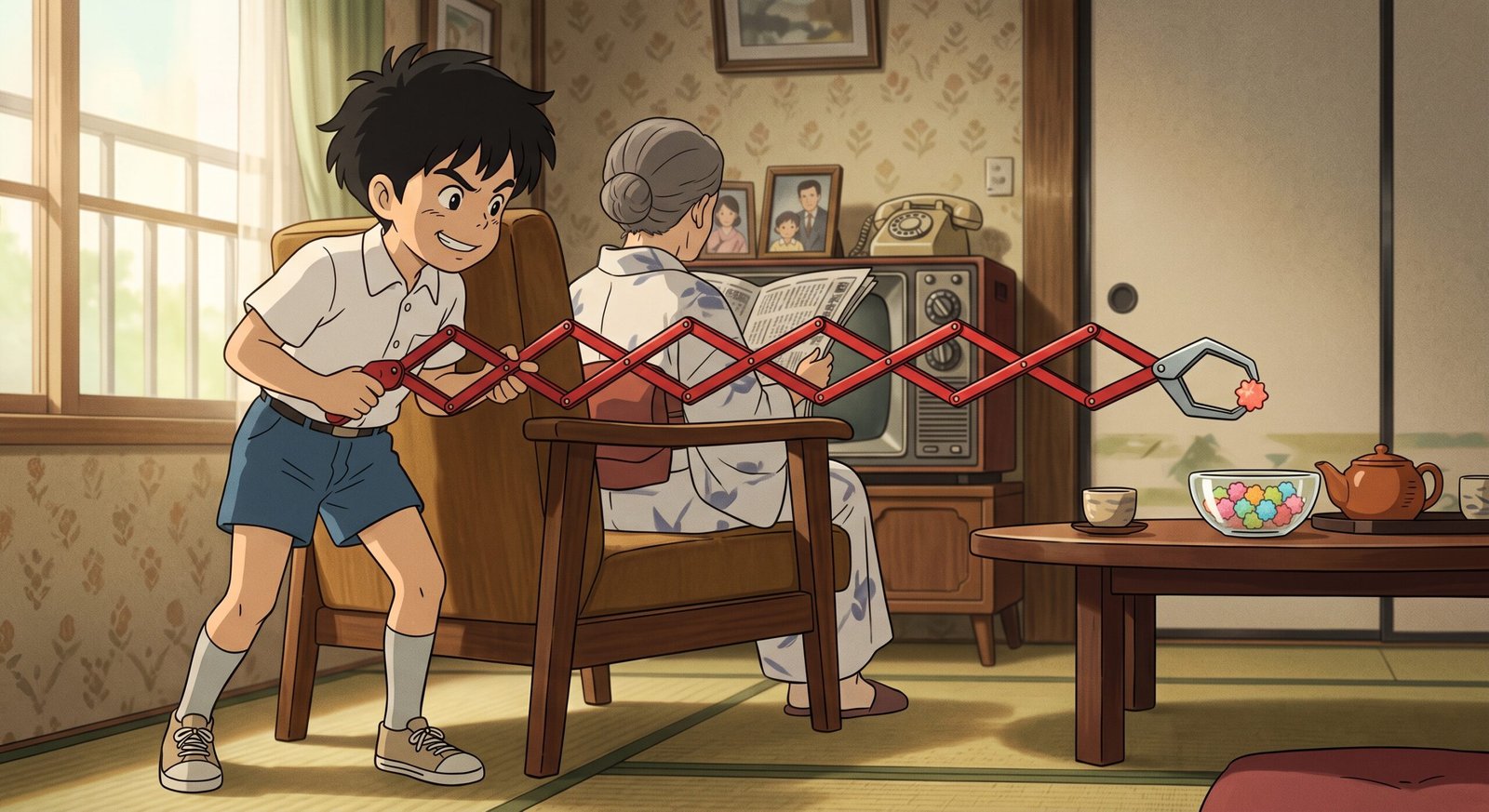
That willingness to gamble on unrelated ventures paid off in 1966, in an unglamorous way. During a factory inspection, Hiroshi spotted an extendable wooden claw that a maintenance engineer named Gunpei Yokoi (横井軍平) had built purely to amuse himself. Rather than telling him to get back to work, Hiroshi ordered it developed for mass production. Released for the 1966 holiday season as the Ultra Hand, it sold more than a million units, giving Nintendo its first real hit outside of cards.
Yokoi was pulled off maintenance duty and put in charge of a new toy development team, later formalised as Research & Development 1, or R&D1. He followed the Ultra Hand with the Ultra Machine, an indoor batting toy, and the Love Tester, a mildly gimmicky electronic novelty that measured "romantic compatibility" by having two people hold hands and grip a sensor. None of it was cutting-edge. That, it turned out, was rather the point.
Lateral Thinking with Withered technology
Yokoi's toys shared an underlying design philosophy he later put into words as kareta gijutsu no suihei shikō (枯れた技術の水平思考), usually translated as "lateral thinking with withered technology." It rested on two principles working together. "Withered technology" meant using components that were old, cheap, and thoroughly understood: parts whose manufacturing had been refined for years, so they were reliable and inexpensive rather than cutting-edge. "Lateral thinking" meant taking those unglamorous parts and finding a surprising new use for them, prioritising how a product felt to use over how impressive its specifications looked on paper.
It sounds almost too simple to matter, and yet it shaped nearly everything Nintendo built for the next three decades, hardware and software alike. A company with deep pockets can chase the newest chip on the market. A company that keeps nearly going bankrupt learns to get inventive with parts everyone else considers boring.
Learning to see in the dark
To push its electronics further, Nintendo recruited a solar-cell engineer named Masayuki Uemura (上村雅之) from Sharp Corporation in 1971. Working alongside Yokoi, Uemura adapted cadmium sulfide photocells, originally built for industrial light sensing and with nothing to do with toys, into a line of light-based novelty guns marketed as the Nintendo Beam Gun. It was a modest, faintly nerdy shift on paper: optoelectronics rather than pure mechanics. In practice it was exactly the technical groundwork Nintendo would need a couple of years later, when Hiroshi decided to bet the company on something considerably bigger than a toy gun.
Everything, On Fire, All at Once
That bigger bet was the Laser Clay Shooting System, launched in January 1973. Conceived by Hiroshi and engineered by Yokoi, it repurposed Japan's many bowling alleys, closed as the country's postwar bowling boom faded, into indoor skeet-shooting venues. Overhead projectors displayed moving clay-pigeon targets on large screens; players fired light-emitting rifles at them, and photocell sensors registered hits. Each venue installation cost around ¥4 to ¥4.5 million (roughly $110,000 to $120,000 today). Demand was strong enough that Nintendo spun up a dedicated subsidiary, Nintendo Leisure System Co., Ltd., in February 1973 just to keep pace with venue conversions.
Then, in October 1973, OPEC imposed an oil embargo. Japan imported almost all of its petroleum, and the shock hit the economy hard. Commercial operators cancelled their Laser Clay orders within months, and Nintendo, heavily leveraged in venue equipment and inventory, was left roughly ¥5 billion in debt (in the ballpark of $130 million today) and close to insolvency.
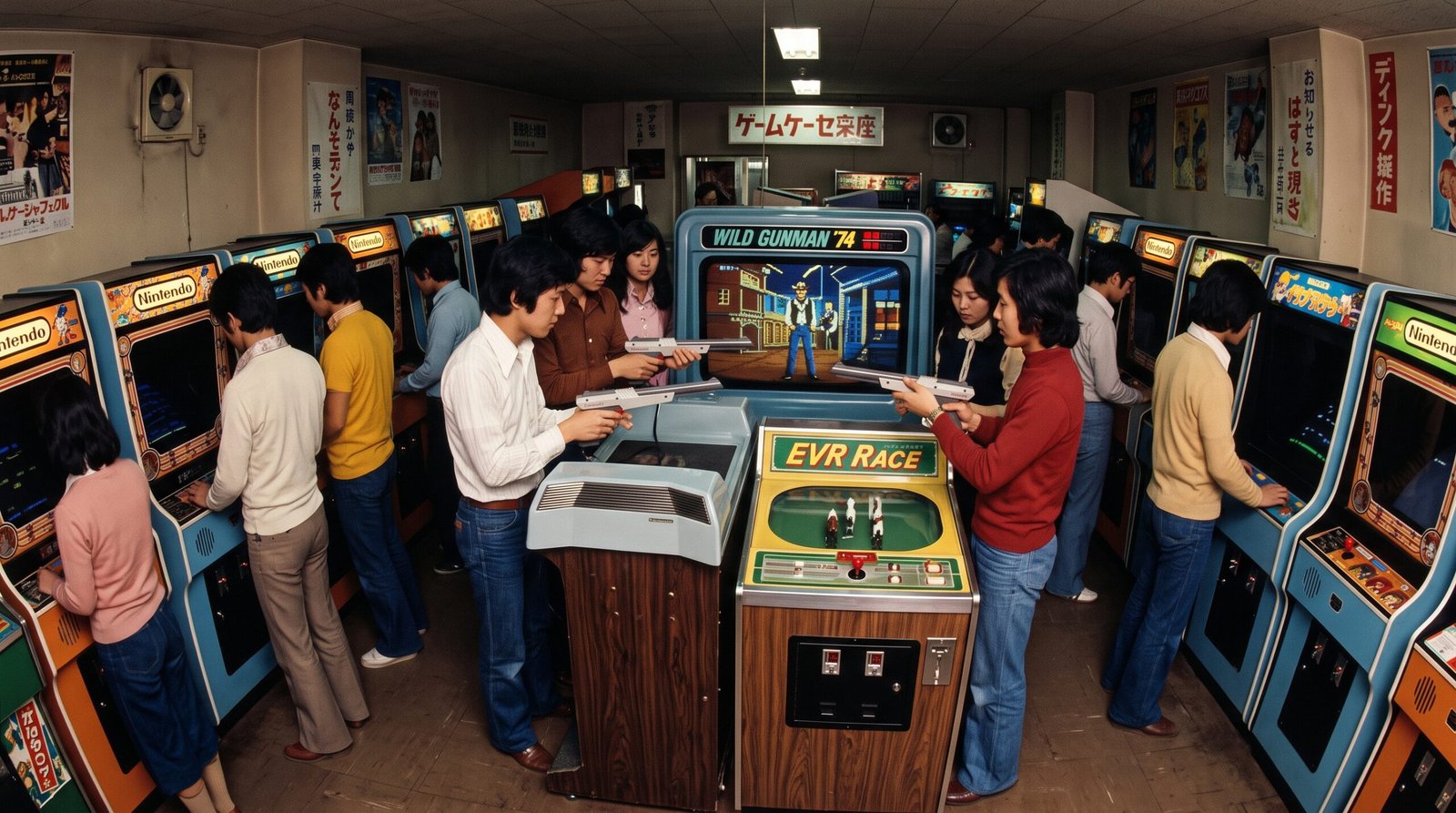
Hiroshi shut down Nintendo Leisure System and redirected the engineering team toward something smaller and cheaper: compact arcade cabinets built on the same optoelectronic base. Mini Laser Clay and Wild Gunman, released in 1974, combined 16mm film projection with light-sensitive targets to deliver interactive shooting games that could sit in an arcade rather than a bowling alley. Neither was spectacular, but both were steady, and they generated enough export revenue across North America and Europe to pay down Nintendo's debt over roughly seven years. Its status as a listed company on the Osaka Stock Exchange helped it hold onto credit and shareholder patience while it did.


The Lucky Break
Nintendo's route into home video games ran, somewhat improbably, through another company's failure. In 1974, Nintendo picked up Japanese distribution rights to the Magnavox Odyssey, the first commercial home video game console, which sold reasonably well but was limited by its price and its black-and-white display. Hiroshi took the lesson that home hardware needed to be Nintendo's own rather than someone else's import. The problem was that Nintendo had no chip manufacturing of its own.
The opening arrived through Mitsubishi Electric Corporation, with whom Nintendo had already collaborated on an arcade system called EVR Race in 1975. Mitsubishi had been developing a home-video-game chip with a calculator maker called Systec. When Systec went bankrupt before the project shipped, Mitsubishi was left holding a finished large-scale integration chip capable of producing colour video on an ordinary television, with nowhere to put it. Mitsubishi brought the chip to Nintendo, and Uemura took the idea to Hiroshi.
Hiroshi approved the project on one non-negotiable condition: the finished console had to retail for under ¥10,000 (roughly $200 today), well below anything comparable on the market. That price point made a single, well-specified console impossible without losing money on every unit, so Uemura's team built two instead.

Ten thousand yen or bust
The Color TV-Game 6 launched on 1st July 1977 at ¥9,800 (roughly $195 today), offering six variations of a Pong-style game called Light Tennis, with control dials embedded directly into the plastic housing to save on manufacturing. Alongside it, the same day, came the Color TV-Game 15 at ¥15,000 (roughly $300 today), running a fuller version of the same chip with fifteen game variations and detachable wired controllers.
The pricing was showmanship as much as engineering. The cheap CTG-6 pulled shoppers into stores; sales staff then steered them toward the pricier, higher-margin CTG-15. It worked about as well as a strategy like that can: the CTG-15 sold roughly 900,000 units and the CTG-6 around 500,000, giving Nintendo its first genuine home-electronics hit and a foothold in an industry it had only stumbled into a few years earlier. For a company that had spent the previous four years paying off debt from a shooting range business nobody wanted anymore, that was a remarkable turnaround, and it came from applying the exact same instinct that had built the toy division: take a cheap, well-understood chip and find a use for it that a bigger, better-funded rival hadn't bothered with.
Nintendo followed up with the Color TV-Game Racing 112 in 1978, priced at ¥12,000 (roughly $280 today) and built with an integrated steering wheel and gear shift. Its housing was designed by a young industrial-design graduate named Shigeru Miyamoto, hired the year before, in one of his first projects at the company: a detail that meant nothing in particular at the time and a great deal in hindsight. In 1979, the Color TV-Game Block Kuzushi, priced at ¥13,500 (roughly $275 today), adapted Atari's Breakout and, more significantly, was the first Nintendo gaming device engineered entirely in-house, without Mitsubishi's help on the hardware side. Eight years after nearly going under, Nintendo had gone from importing somebody else's console to building its own from scratch.


What the crises taught the company
None of this reads like a plan. It reads like a company that kept getting knocked over and kept getting back up slightly differently shaped each time: a legal loophole turned into a card business, a card business turned into licensed toys, a failed leisure venture turned into arcade cabinets, and a bankrupt rival's leftover chip turned into a home console. What held it together wasn't foresight so much as a consistent set of instincts: use the distribution network you already have, don't chase technology you can't afford, and treat a crisis as a redirection rather than an ending.
It also helped that the same handful of people kept turning up at each turn. Yokoi, promoted out of factory maintenance to build a toy that saved the company once, was still there designing the shooting galleries that nearly sank it, and still there again engineering the cheap arcade cabinets that dug it back out. Uemura, hired to work on solar cells, ended up the engineer who took a dead rival's leftover chip and turned it into Nintendo's first real video game hardware. Continuity of people, as much as continuity of philosophy, is easy to miss in a company history told through products and dates rather than the individuals who kept showing up to solve the next problem.
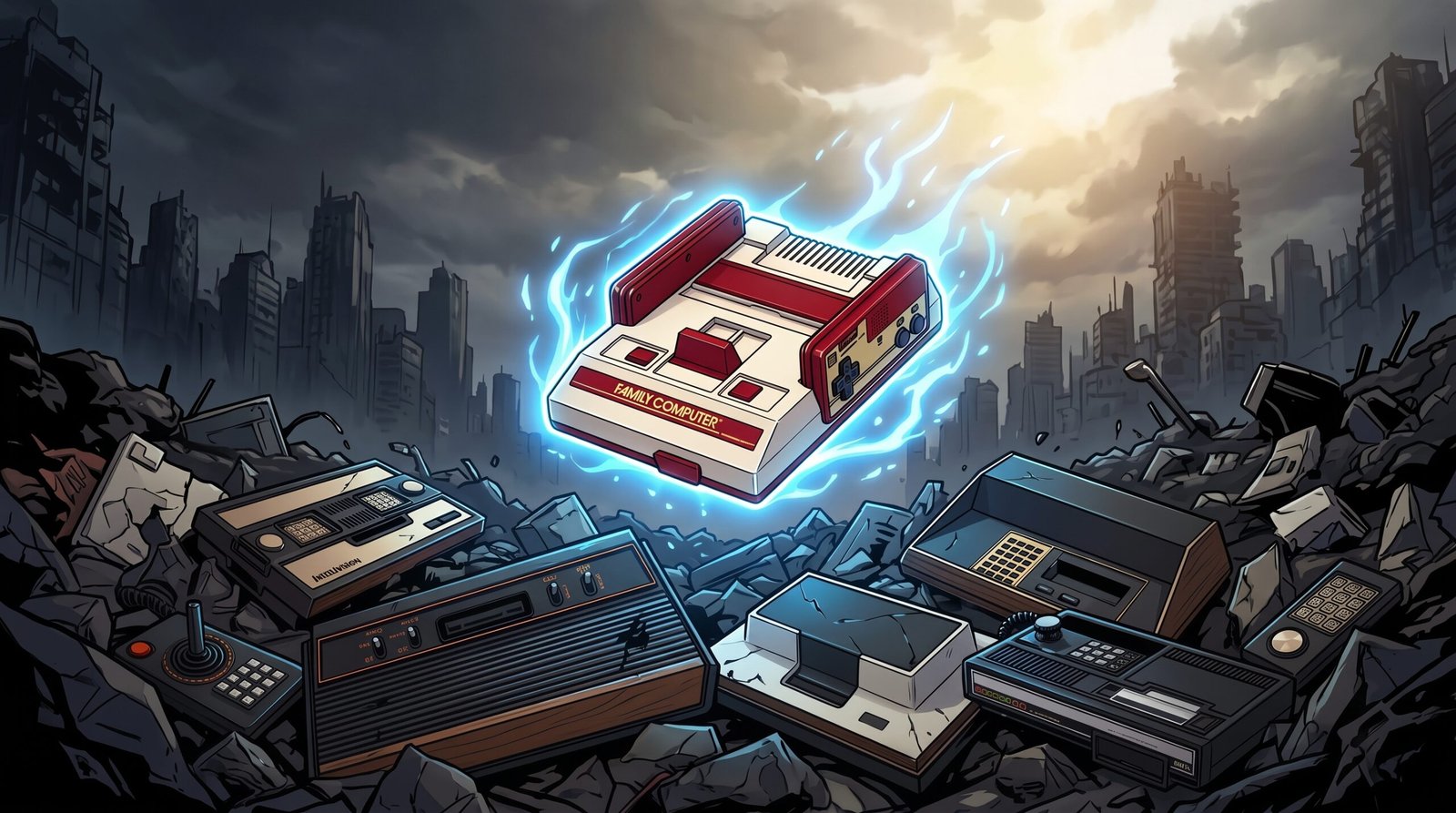
Those instincts, formalised in Yokoi's "withered technology" philosophy and hardened by two near-bankruptcies inside a single decade, became the design logic behind Nintendo's actual entry into video games proper: the Game & Watch handhelds of 1980 and the Family Computer of 1983, better known outside Japan as the NES. Getting there took another decade of the same restless, improvised engineering, and it's a story worth telling on its own terms.

Sources and further reading
Fusajiro Yamauchi – Wikipedia
History of Nintendo – Wikipedia
Hiroshi Yamauchi – Wikipedia
Sekiryo Kaneda – Wikipedia
Masayuki Uemura – Wikipedia
Laser Clay Shooting System – Wikipedia
Ultra Hand – Wikipedia
Marcus Richert, "Nintendo might be younger than it claims to be – or much older," TechRadar
Yen figures are converted at each period's prevailing exchange rate and then adjusted for US inflation to give a rough present-day equivalent; treat them as ballpark figures rather than precise conversions. Translated or paraphrased material from Japanese-language sources reflects standard secondary-source English renderings rather than original Nintendo documentation.


Pingback: Before Sonic: The Birth of Sega and the SG-1000