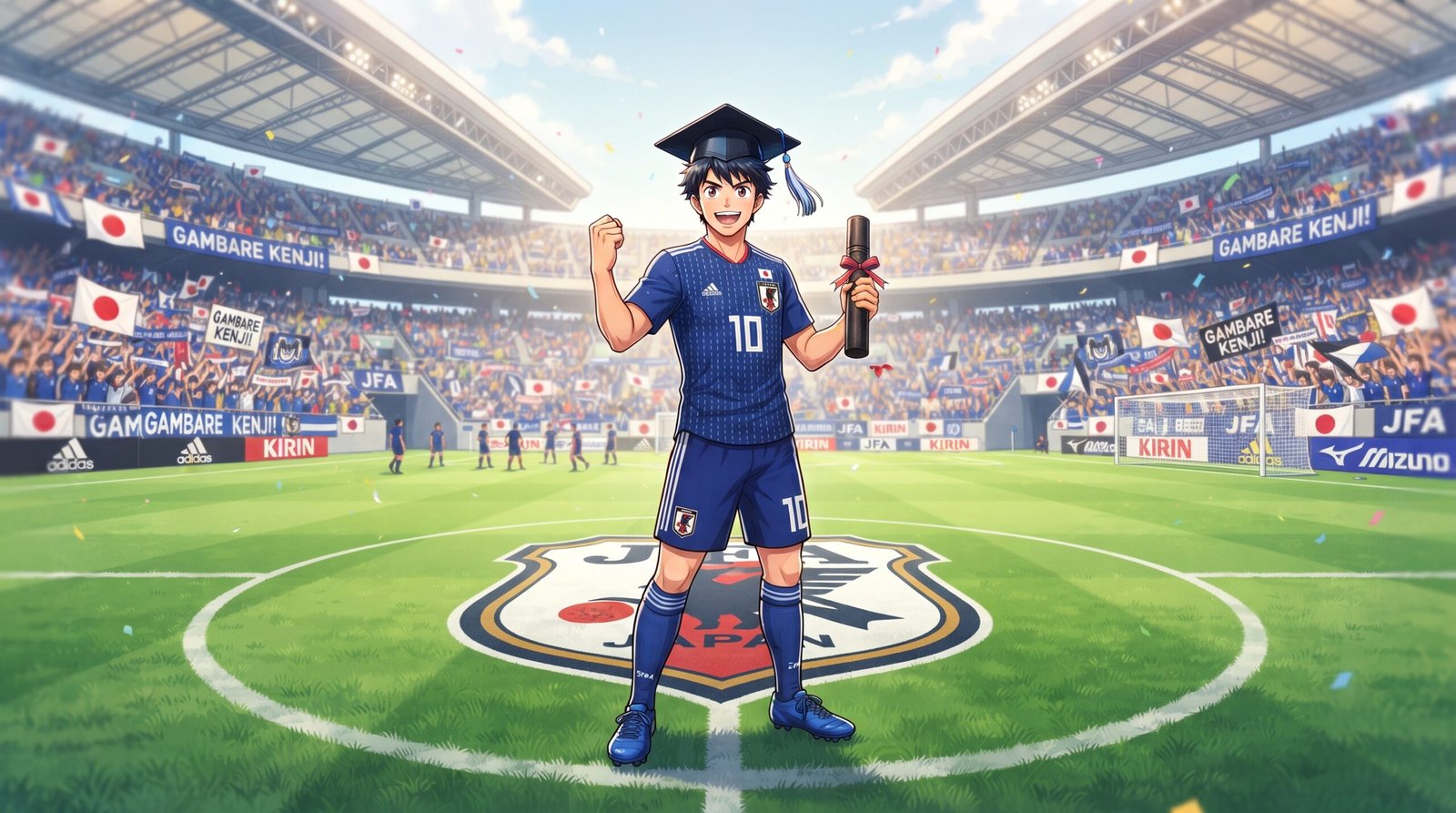
In 2016, Kawasaki Frontale offered an eighteen-year-old academy graduate a professional contract. Most players wait years for that phone call and never get it. Kaoru Mitoma (三笘薫, Mitoma Kaoru) got it early and turned it down.
He didn't quit football. He enrolled at the University of Tsukuba to study physical education, and for the next four years he spent almost as much time working out how a body should move as he did practicing his first touch. It's the kind of decision that sounds like a screenwriter's invention: promising winger walks away from a pro contract to write a thesis on dribbling. But when Mitoma finally did sign with Kawasaki Frontale in 2020, he arrived as a finished player rather than a raw one, and he tied the J1 League's rookie scoring record in his first season with thirteen goals, adding twelve assists to become the first rookie to lead the league in that category too. Two years later he was starting Premier League matches for Brighton & Hove Albion.
From a European vantage point, Mitoma's choice looks eccentric. Eighteen is the age at which the continent's academy system tends to decide a player's fate, for better or worse. In Japan, taking the university route is closer to routine. Roughly a third of all professional players in the J.League came up through university football instead of a club academy, and by the time Japan reached the round of sixteen at the 2022 World Cup in Qatar, close to a third of the squad had spent four years on a college pitch before turning pro. Understanding why requires looking at what Japan built as an alternative to the European model, and why that alternative has lasted long enough to become a genuine rival to it rather than a quirky side door.
The Bottleneck at Eighteen
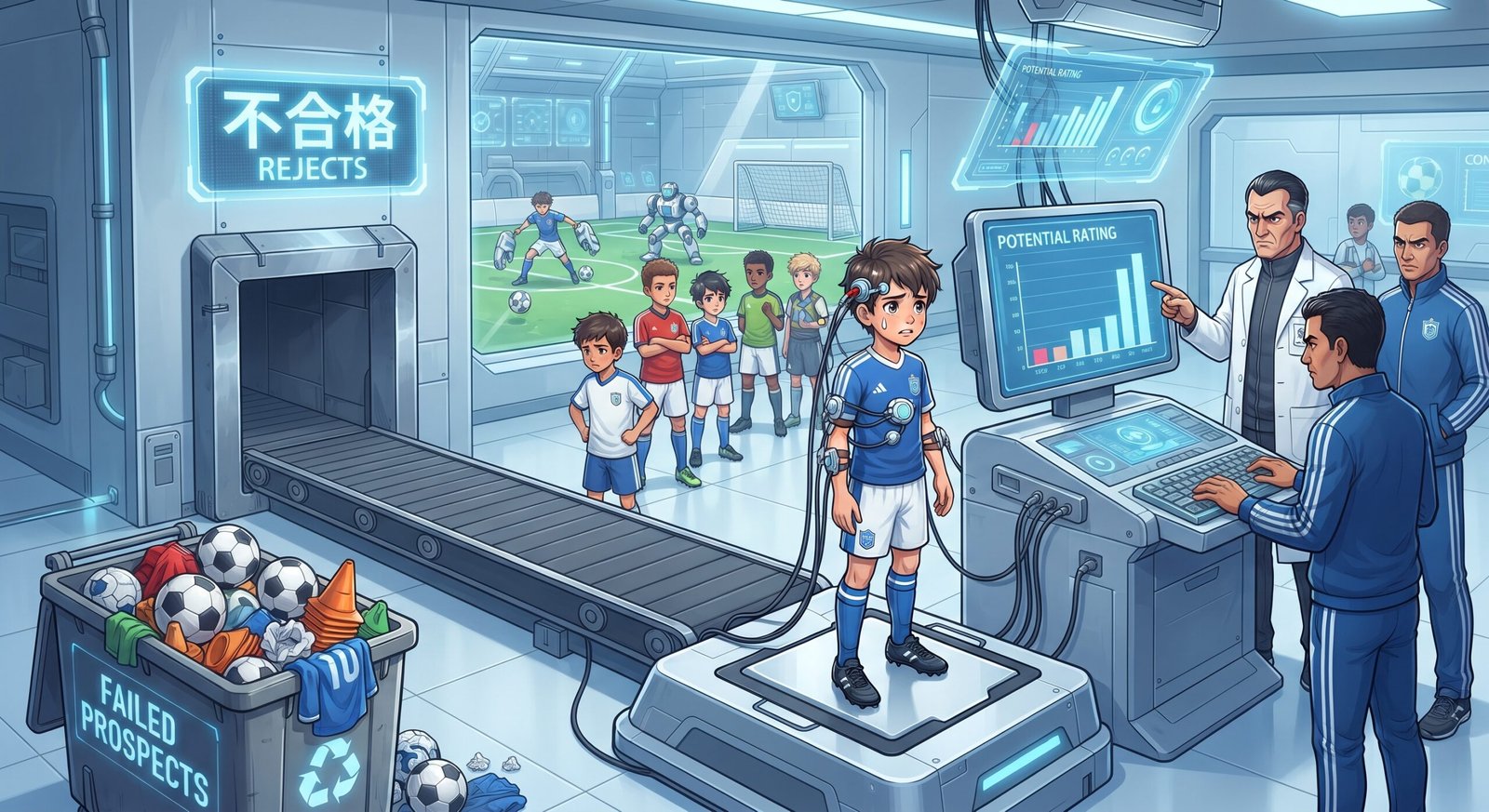
The European academy system runs on a simple bet: get to a player early, control every year of his technical development, and by eighteen you'll know whether he's worth keeping. Prospects join club structures at primary-school age and climb through single-year cohorts, competing every season just to survive into the next one. It's an efficient way to produce a handful of excellent players. It is a rough way to treat everyone else.
The eighteenth birthday is where the system narrows sharply. Graduates of Under-18 and Under-19 squads either force their way into a first team immediately, get parked in a reserve or Under-21 league of wildly uneven quality, or get shipped out on loan and hope somebody notices them. Industry estimates put the failure rate at well over ninety-five percent. The overwhelming majority of academy graduates never build a sustainable senior career, and plenty leave the game at twenty or twenty-one with no formal qualifications and no obvious next move. Clubs treat this as an acceptable cost of doing business, since the players who do make it are worth the wager many times over. Nobody asks the released nineteen-year-old how the math felt from the inside.
Japan's Second Track
Japan splits its young players at the same age, eighteen, without treating the split as final. At that point, prospects divide into two conduits: J.League club youth academies on one side, and high school teams governed by the All Japan High School Athletic Federation (高体連, Kōtairen) on the other. Players who aren't offered a professional contract when they finish high school, along with a smaller number who are offered one and turn it down, can spend four more years at university without giving up on turning pro. This isn't a consolation bracket. University football runs under its own national body, the Japan University Football Association (全日本大学サッカー連盟, JUFA), and its top programs are treated by professional scouts as a legitimate finishing school rather than a fallback.
Regional competitions, the Kanto University Soccer League (関東大学サッカーリーグ) chief among them, run with multiple tiers of promotion and relegation, which keeps every fixture meaningful and replicates the pressure of a professional table rather than a friendly kickabout. To make sure players who aren't starting still get real minutes, JUFA also runs the Independence League, a competition built for university reserve squads, so a four-year student career doesn't quietly stall out on the bench. On top of the league schedule, university teams compete in national knockout tournaments including the Prime Minister's Cup (総理大臣杯) and the All Japan University Football Championship (全日本大学サッカー選手権大会), known nationally as the Intercollegiate (インカレ). Leading programs rack up thirty-five to forty competitive matches a year across these competitions, more high-stakes football than most European teenagers see in the same age bracket.
The clearest sign that this is a genuine parallel path rather than a lesser one is that university teams also qualify for the Emperor's Cup (天皇杯), Japan's oldest and most prestigious knockout competition, where they're drawn against J1, J2, and J3 clubs in an open, unseeded bracket. Nobody is protecting the professionals from an awkward result.


Map of the regional leagues - WiJG?, Public domain, via Wikimedia Commons
The Bridge Between the Two Worlds
The mechanism connecting university football to the professional game is the JFA/J.League Special Designated Player System (JFA・Jリーグ特別指定選手制度), and its history explains a lot about how deliberately Japan built this pathway. The system began in 1998 under the name "reinforcement-designated player," open only to high schoolers. Very few of the players nominated in those early years actually got onto a pitch, so in 2003 the JFA overhauled it: it was renamed to its current form, opened up to university students, and shortened from a year-long designation to just a few months at a time, later trimmed further to month-by-month renewals. A 2018 revision tightened things again, generally restricting eligibility to amateur players whose host club has already confirmed a post-graduation professional contract (内定, kanyū naitei), unless the JFA's own technical committee makes a direct recommendation. The point of that change was to stop clubs from speculatively hoarding talent and to make sure a designated player is actually being built into the first team's plans.
Under the current rules, J1 and J2 clubs can register up to three special designated players at a time, and J3 clubs up to two. Crucially, these slots sit outside the J.League's ordinary twenty-five-man professional roster cap. While registered, the players stay strictly amateur, drawing reimbursement for transport, accommodation, meals, and insurance rather than a salary, but the senior minutes they log count toward the appearance thresholds required for a professional contract once they graduate. It's a neat piece of institutional design: a player can train and play with a J.League club's first team while still representing his university, without either side losing anything and without blurring who's actually paying whom.
Giant-Killers in Blazers
Scouts have long rated the leading university programs, Meiji University among them, as roughly comparable to a mid-table J2 side, and the Emperor's Cup keeps proving the comparison isn't flattery.
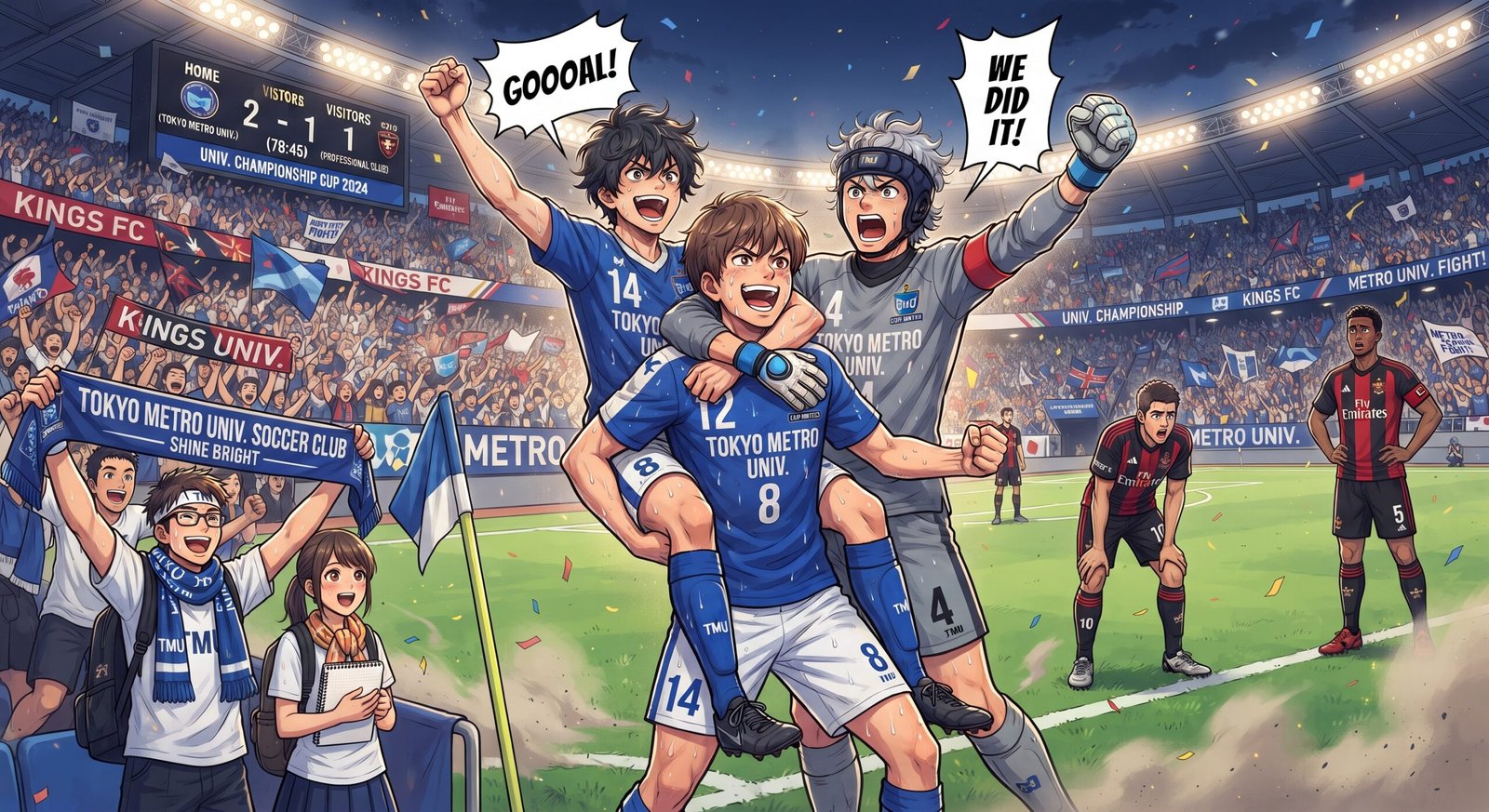
The 2019 tournament produced one of the tournament's most talked-about results when the National Institute of Fitness and Sports in Kanoya, representing a regional university league in Kagoshima, beat a reserve-heavy Nagoya Grampus side 3–0. That same year, Hosei University eliminated Tokyo Verdy 2–0 in the third round. In June 2024, the University of Tsukuba met Machida Zelvia, then leading the J1 table in the club's first-ever top-flight season, and beat them on penalties after a 1–1 draw through extra time. A year later, Toyo University went further still, beating Kashiwa Reysol 2–0 and then Albirex Niigata 2–1 to reach the round of sixteen, where they eventually fell to Vissel Kobe. These aren't upsets built on luck or a bad refereeing decision. They come from twenty-one- and twenty-two-year-old university players who are physically finished products running down heavily rotated professional lineups over ninety or a hundred and twenty minutes.
The Making of a Winger
Mitoma's four years at Tsukuba are worth dwelling on, because they show what the university system is actually built to do rather than what it merely allows.
He arrived unconvinced he was ready for the professional game, and he spent his time at university closing that gap deliberately. Working with Satoshi Tanigawa, a sports science academic and former Olympic hurdler, he rebuilt his running posture and acceleration mechanics to lengthen his stride and generate more power off the ground. He also overhauled his diet and conditioning to add functional muscle without losing the low center of gravity that made his dribbling so hard to read. For his graduation thesis, titled "Research on Information Processing of Attackers in 1-on-1 Soccer Scenarios" (サッカーの1対1場面における攻撃側の情報処理に関する研究), he strapped a head-mounted camera to himself and his teammates and gathered footage to study how elite dribblers actually process what's in front of them. His conclusion, since borne out on some very expensive Premier League pitches, was that the best dribblers keep their eyes on a defender's torso and center of gravity rather than glancing down at the ball, which lets them exploit a shift in weight the instant it happens.
His coach at Tsukuba, Masaaki Koido (小井土正亮, Koido Masaaki), describes his role less as instructing players than getting out of their way. "I did not 'raise' or 'make' Mitoma," he has said. "During collegiate matches, I often did not issue a single tactical command to him from the bench. He possessed a rare capacity to look at himself objectively, formulate an action plan, and execute it." Koido runs his program around personal development plans in which players map out where they want to end up, where they currently stand, and what specific steps close the gap, a structure meant to give them a wider view of their own careers rather than just their next training session.
The One Nobody Recruited
If Mitoma's story shows the system sharpening an obviously gifted player, Hidemasa Morita's (守田英正, Morita Hidemasa) shows it finding one nobody else had noticed. He went through Konko Osaka High School with no professional offers attached to his name, then enrolled at Ryutsu Keizai University, where he spent four years turning himself from a fairly anonymous utility player into a genuinely dominant defensive midfielder, sharpening his positioning, his pressing triggers, and his distribution against consistently high-level competition. Kawasaki Frontale signed him straight out of university in 2018. He won the J1 League title in his first season, later moved to Portugal's Santa Clara, and from there to Sporting CP, where he became a first-choice midfielder and a fixture for the Japanese national team.
Neither Mitoma nor Morita is really an exception inside this system, which is the point. The 2022 World Cup squad included several other university-developed players in similar molds: Junya Ito, out of Kanagawa University, went on to KRC Genk and Stade de Reims; Shogo Taniguchi came through Tsukuba on his way to spells in Qatar and Belgium; Miki Yamane moved from Toin University of Yokohama to Shonan Bellmare and eventually the LA Galaxy. None of them fit the profile of a player the European system would have flagged as a can't-miss prospect at sixteen. That's the argument for the system that produced them.
What It Costs
None of this comes free, and the trade-off is the same one Mitoma accepted when he turned down Kawasaki Frontale in the first place: time. Graduating at twenty-two, a Japanese collegiate prospect enters the professional game at an age when European or South American peers of similar ability may already have a hundred senior appearances and a full cap collection behind them. European recruitment leans heavily on models that price a player against his age and remaining upside, and clubs are understandably reluctant to pay a premium transfer fee for a twenty-two-year-old making his J.League debut, however talented he looks on video.
The practical result is that collegiate graduates chasing a European career tend to take a longer, more circuitous route than their academy-trained counterparts: a season or two establishing themselves domestically, a move to an intermediary league such as Belgium's Pro League, the Scottish Premiership, or Portugal's Primeira Liga, and only then, in their mid-to-late twenties, a shot at one of Europe's biggest leagues. Morita's path through Santa Clara to Sporting is a fairly typical version of that route, not an unusual one. Years spent almost entirely inside amateur structures can also slow a player's adjustment to the sharper edges of the professional game: locker-room politics, abrupt managerial sackings, and the kind of public scrutiny that follows a bad result. It's a real cost. Japan's football establishment has simply decided it's a cost worth paying for what the system gets in return.
What the System Is Trying to Build
Ask the people who run university programs why they do it this way, and the answer tends to circle back to something other than football.
Daisuke Kurita (栗田大輔, Kurita Daisuke), who has managed Meiji University through a stretch that has sent dozens of players into the J.League, including one especially productive year that alone yielded around a dozen professional signings, argues that on-field competence follows from character and the ability to solve problems independently, not the other way around. "Meiji University Football Club is not a professional training ground; it is a place for human development," he has said. "University is the final educational institution. Some become professionals, but others will enter society and work in corporate environments. If you strip football away from your résumé, what is left of you? What remains is how you will function in society." He connects that philosophy directly to results on the pitch: players who handle ordinary, unglamorous responsibilities without being told, he argues, are the ones who learn to read a game calmly and correct their own mistakes in real time. Meiji's non-negotiables under his management are built around three simple ideas: work rate (運動量, undōryō), intensity in contested duels (球際, kyūgiwa), and speed of transition (切り替え, kirikae).
At the national level, this thinking has the backing of Japan's football establishment. National team manager Hajime Moriyasu (森保一, Moriyasu Hajime) has spoken about the national side as the top of a much larger structure rather than something that exists on its own. "The national team is at the apex, but it only exists because the baton is passed up through various categories and sectors across the country," he has said. "We must always conduct our activities with deep gratitude for that developmental chain." Former JFA technical director Koji Sorimachi has made a related point about the danger of judging talent too early: looking at Olympic and senior squads, he's noted, only a small fraction of those players were flagged as national-team prospects at Under-15 level, since children and young adults simply develop on unpredictable timelines that a rigid selection system tends to punish rather than accommodate.
The Safety Net
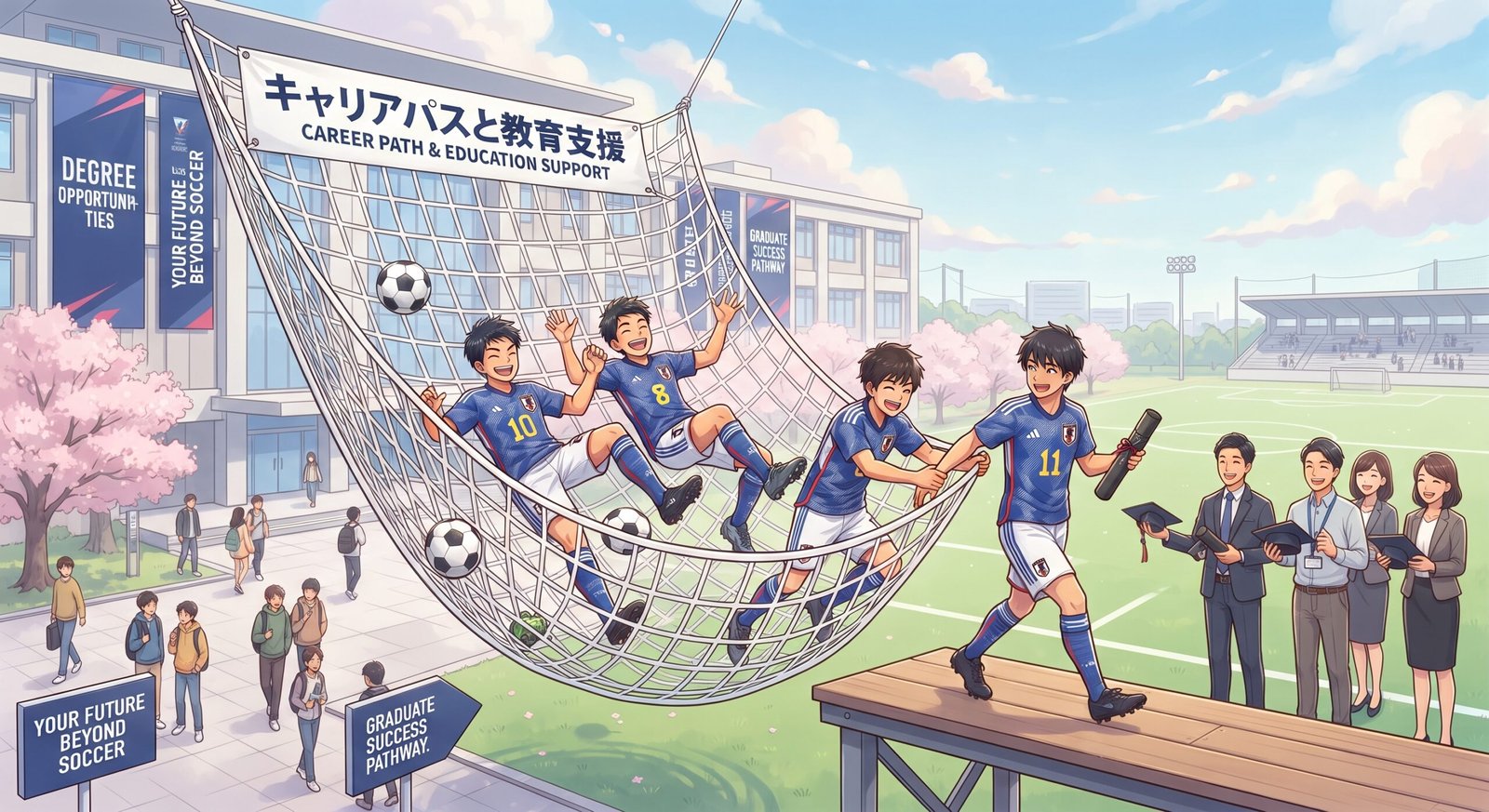
There's a more practical case for the university system too, and it has less to do with dribbling technique than with what happens after a career ends, which for most players is sooner than they'd like. The average professional career in the J.League runs about four to five years, and plenty of players are out of the top divisions before they turn twenty-six. In the European academy model, players released in their early twenties frequently run into serious difficulty precisely because they have limited formal education and a narrow professional identity built entirely around a sport that just told them no.
The Japanese university pathway heads that problem off directly by pairing high-level athletic training with an accredited bachelor's degree. Collegiate athletes have full access to Japan's formal corporate recruitment cycle (就活, shūkatsu), and university athletic departments maintain alumni networks that help non-drafted players move into corporate roles across finance, construction, education, and marketing. At programs like Tsukuba, a meaningful share of varsity players complete teacher certification alongside their sports science coursework, which gives them an immediate professional credential the day their playing career ends, whenever that turns out to be.
That security seems to pay off even for the players who do turn pro. Entering the J.League with a completed degree already in hand takes some of the sting out of the existential question that quietly follows every young athlete around: what happens if this doesn't work out? Players who've already answered that question tend to approach their careers with less fear and more focus, which shows up over time in career longevity, steadier financial decisions, and smoother transitions into coaching or sports administration once the playing days are actually done.
The Long Way Round Isn't the Slow Way
None of this makes the Japanese model better than the European one, and nobody serious is arguing Japan should abandon its club academies. What the university pathway does is give the system a second route for players who need more time, whether that's a late growth spurt, a tactical education that hasn't clicked yet, or simply the wrong body for professional football at eighteen and the right one at twenty-two. Mitoma is the version of this story people remember, mostly because Brighton's TV deal is bigger than Meiji University's. Morita is the more common version: a player good enough to succeed, who simply wasn't visible yet at the age European academies insist on making up their minds.
Four extra years is a long time to ask a talented teenager to wait. Japan's bet is that a fully developed twenty-two-year-old, with a degree, a support network, and no illusions about what happens if football doesn't work out, is worth more than a rushed eighteen-year-old with neither.
A Note on Quotes
Quotations from Japanese-language sources have been translated into English for this piece and may not represent word-for-word official translations. Direct quotes originally given in English are presented as spoken.
Sources
Japan Football Association: Special License Player System
Wikipedia: J.League Designated Special Players
Wikipedia: Kaoru Mitoma
Wikipedia: Hidemasa Morita
Premier League: The story of Mitoma's rise to Brighton superstar
ANA Group: ANA Teams Up with Kaoru Mitoma
The Japan Times: Nagoya Grampus suffer big upset in Emperor's Cup second round (2019)
J.League: Emperor's Cup 3rd Round Recap (2025), Toyo University upset
ESPN: The Machida Zelvia miracle (2024)
Wikipedia: 2024 FC Machida Zelvia season
Nikkei: 独自布陣で3冠 明大サッカー部監督・栗田大輔 (Daisuke Kurita, Meiji University)
Wikipedia: 全日本大学サッカー連盟 (Japan University Football Association)