
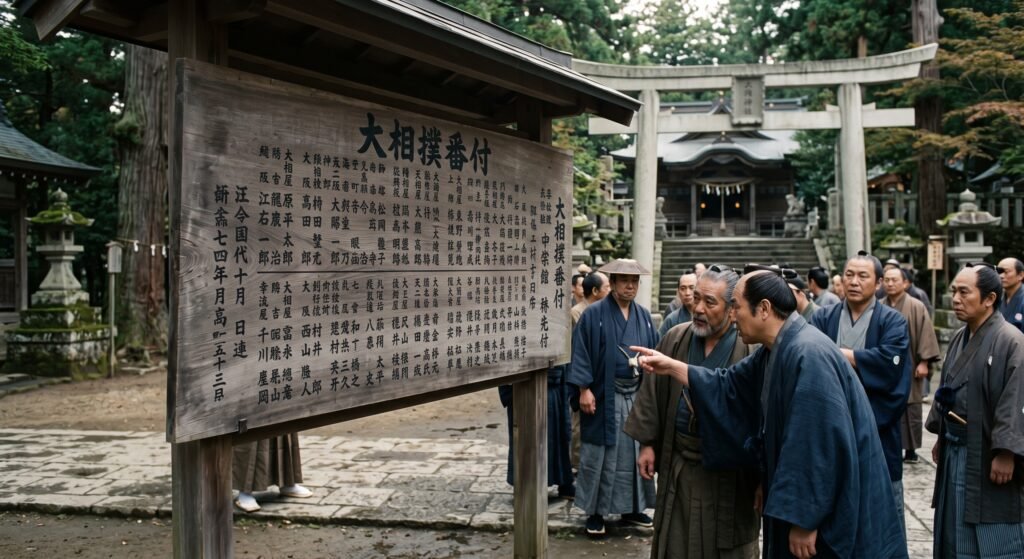
Six times a year, the Japan Sumo Association (Nihon Sumo Kyokai, 日本相撲協会) prints a single sheet of paper, and that sheet decides who eats first, who sleeps in a private room, and who spends the next two months on kitchen duty. It is called the banzuke (番付), and it behaves less like a scoreboard than a legal document: a pay slip and a caste system rolled into one, hand-lettered in dense black ink by a referee who disappears from public life for two weeks to write it.
There is no algorithm behind it. A committee of sumo elders draws up the rankings from a decades-old internal rulebook, a scribe copies the result out by hand in a script barely changed since the eighteenth century, and the whole document is kept a state secret until the morning it is released. Move half a rank the wrong way and you can lose your salary, your belt, and your bedroom, all at once.
Here is how it works today, and then how it got so wonderfully strange.
Six Divisions and a Very Hard Floor
Professional sumo runs on six ranked divisions holding roughly six hundred wrestlers, split by one line that matters more than any other. Above it, in Makuuchi (幕内) and Juryo (十両), wrestlers are legally recognised as sekitori (関取): salaried professionals with their own room and a personal attendant. Below it, wrestlers are officially classed as rikishi yoseinai (力士養成員, wrestlers in training), sharing a dormitory and cooking and cleaning for the wrestlers above them in exchange for a small allowance rather than a wage.
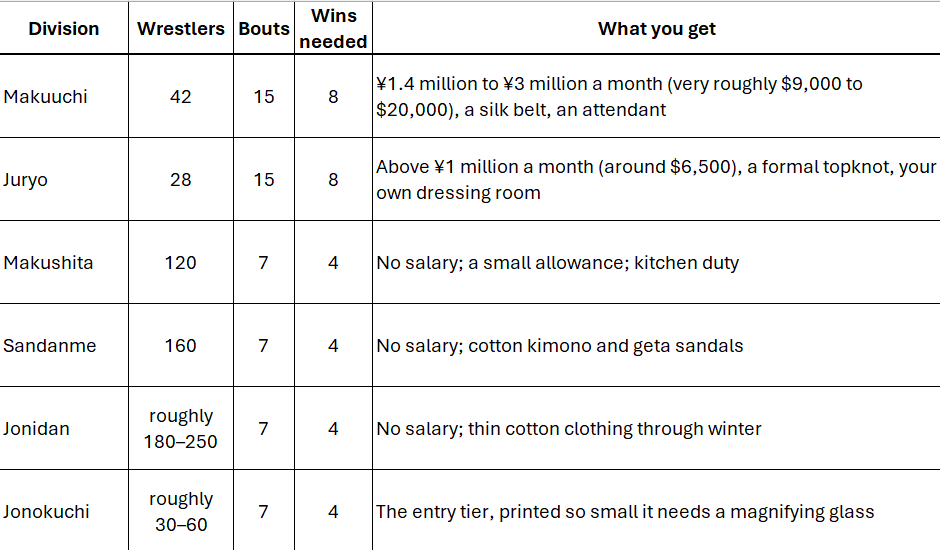
Slip from the bottom of Juryo to the top of Makushita and you lose the wage, the silk, and the private room in one move, returning to a shared dormitory to do chores for wrestlers who, a fortnight earlier, were your equals. To manage that boundary, the association leans on precedent rather than formula: a wrestler ranked in Makushita's top fifteen who goes 7-0 gets priority promotion into Juryo, while the same unbeaten run from rank sixteen or lower earns only a jump within Makushita. A wrestler at East Makushita 1 needs just four wins from seven to be almost guaranteed a step up, provided Juryo clears a seat above him.
The Wednesday Morning Committee
No stablemaster, and certainly no computer, compiles the banzuke. That job belongs exclusively to the Judging Department (Shimpan-bu, 審判部), under the association's internal rulebook, the Banzuke Hensei Yōryō (番付編成要領, Guidelines for Compiling the Banzuke). Article 2 compels the department to convene the Banzuke Hensei Kaigi (番付編成会議, Ranking Organisation Meeting) within three business days of a tournament's end, which in practice means the following Wednesday morning. Around twenty voting elders sit on it, chaired by the Judging Department Director (Shimpan-buchō, 審判部長), while three referees record every decision by hand.
Article 6 sets the legal standard in a single line: promotions and demotions follow a wrestler's win-loss record. What the rule deliberately avoids is turning that record into a formula, and the reason is baked into the association's own working philosophy: banzuke wa ikimono (番付は生き物), "the banzuke is a living thing." Because every division has a fixed headcount, promotion is zero-sum, and how far anyone travels depends on who else had a good tournament. An 8-7 record might earn a wrestler a full rank if the ranks above him cleared out through losses, or only half a rank, shuffling from the West side of a number to the East, if those same ranks are held by fellow winners. East outranks West at every equivalent position on the sheet, and that distinction decides ties for the same open slot.
The Ozeki's Safety Net and the Long Climb to Yokozuna
The top two ranks carry their own special rules, written into Chapter 1 of the association's guidelines. An Ozeki with a losing record enters the next tournament under kadoban (角番) status, needing eight wins simply to keep his rank. Miss that mark and he drops, but only as far as Sekiwake, even coming off a tournament missed entirely through injury; ten wins or more in that very next tournament restores him to Ozeki, while nine or fewer means starting the long climb again from scratch.
Yokozuna cannot be demoted at all, which means nobody can simply promote a wrestler into it the way they promote an Ozeki. Elevation runs through five checkpoints instead: the Judging Department Director asks the Chairman of the Board (Rijichō, 理事長) to consider a candidate, usually after back-to-back tournament championships; the Chairman puts the question to the Yokozuna Deliberation Council (Yokozuna Shingi Iinkai, 横綱審議委員会), an outside body of cultural and legal figures, which needs a two-thirds vote to recommend him; the Ranking Organisation Meeting writes him into the draft; and the Board of Directors must approve unanimously before messengers reach his stable. Nobody puts a candidate forward without already knowing the answer, so in practice the process rarely stalls, but every one of those five steps is a genuine hurdle rather than a formality.
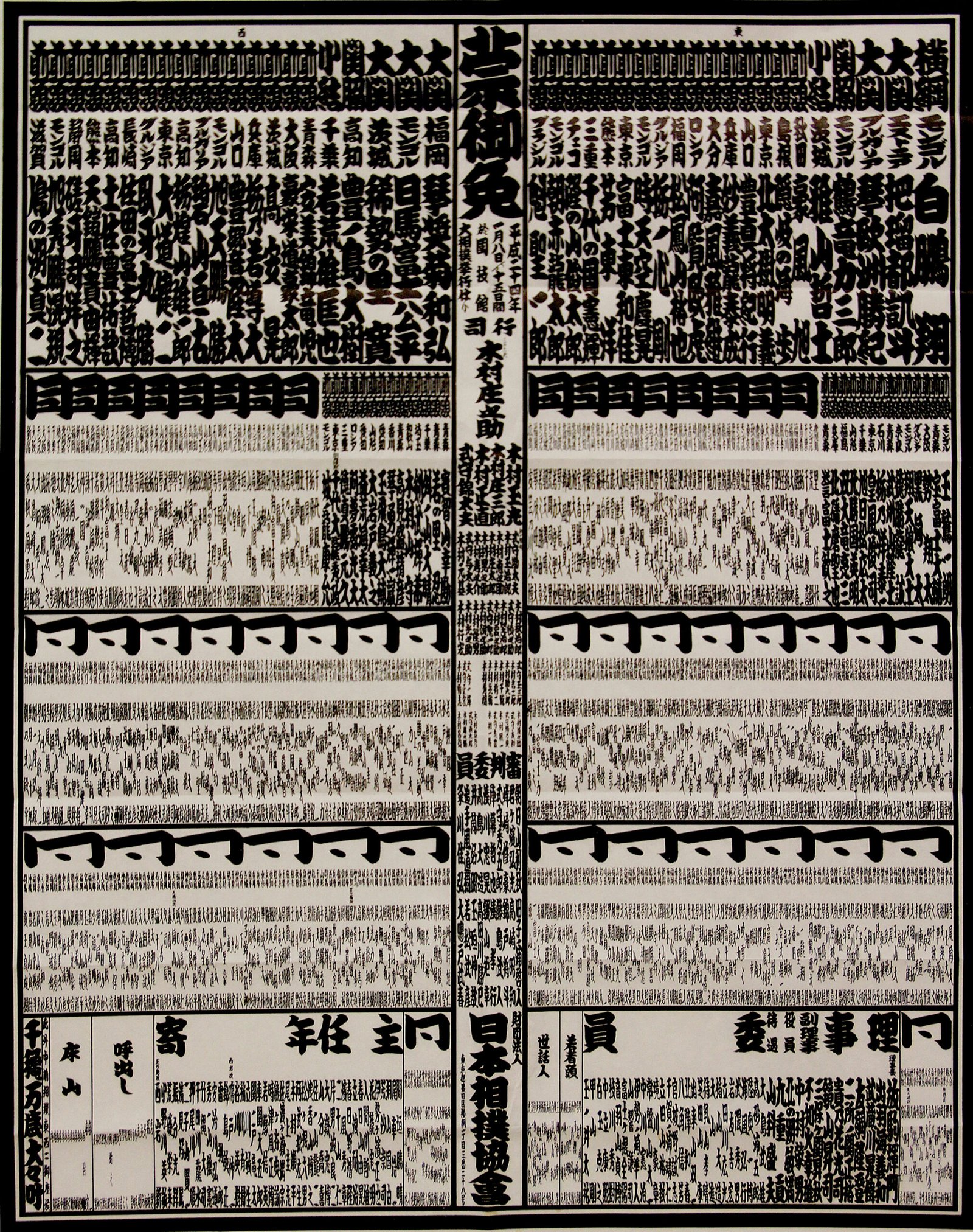
The official Banzuke for the January 2012 Grand Sumo Tournament - Hatsu Basho
Two Weeks in Silence: How the Banzuke Gets Written
Once the committee decides, the document still has to be made, and this is where sumo stops resembling modern sports administration. The banzuke has been hand-lettered since the Edo period in a script called Negishi-ryū (根岸流), dense enough to leave almost no white paper showing, on the theory that a sheet packed with "no room to insert an awl" will be matched by a packed arena on the day.
Three referees do the work: a chief scribe (kaki-te, 書き手) and two assistants, excused from regional tours to focus on nothing else. The current chief scribe, the second man to hold the name Kimura Yonosuke (木村要之助), took over in March 2023 from the third Kimura Yodo (木村容堂), who had held the post since November 2007, just over fifteen years. In the two days after a tournament, the team gathers retirements and name changes; the assistants then rule a blank sheet of Kent paper, 110 by 80 centimetres, into five tiers, calculating column widths down to fractions of a millimetre so every division's wrestlers get an equal share of the row regardless of headcount.
Then, over ten to fourteen days, working roughly eight until five, the chief scribe produces the motogaki (元書き), the master manuscript, moving left to right so the wet ink of one column never smudges under his hand as he reaches the next. A single sheet wears through three brushes. A Yokozuna's name sweeps large across the top; recruits at the bottom, in Jonokuchi, are squeezed into script two millimetres wide, known fittingly as mushimegane (虫眼鏡, "magnifying-glass writing"). After a proofing pass, the sheet is reduced to roughly a quarter size and sent to press.
Alongside it, referees keep a more private document, the Maki (巻), a scroll recording every bout of the tournament by stamping a seal beside the loser's name. Before the senior Yokozuna's name is even written at its head, the referee writes a single character, Kagami (鏡, "mirror"), on the understanding that the wrestler is being reflected onto the page. Stepping over the scroll is, by tradition, close to unthinkable.
Secrets, Whispers and Release Day
Article 11 classifies the finished banzuke as gokuhi (極秘), strictly confidential, for roughly four weeks after the Wednesday meeting. The chief scribe deliberately limits outside contact while he writes, partly because an early leak could disrupt sponsorship deals and stable negotiations meant to wait for the official announcement.
Two exceptions are allowed. New Yokozuna and Ozeki are told within hours and formally invested at a ceremony (shōshin dentatsu-shiki, 昇進伝達式), since the rank carries duties that need weeks of preparation. Wrestlers newly promoted, or returning, to Juryo are also told that same afternoon, since a new sekitori needs to commission an apron and kimono that cannot be arranged at short notice; officially this remains only an informal notice (naiji, 内示), and he keeps trainee pay and status until the physical sheet appears. Everyone else, including every top-division debut, stays sealed until release day: a Monday, thirteen days before the tournament's opening Sunday, when the association distributes roughly six hundred thousand copies from the Ryōgoku Kokugikan at six o'clock in the morning.
From Shrine Placards to a Government Loophole
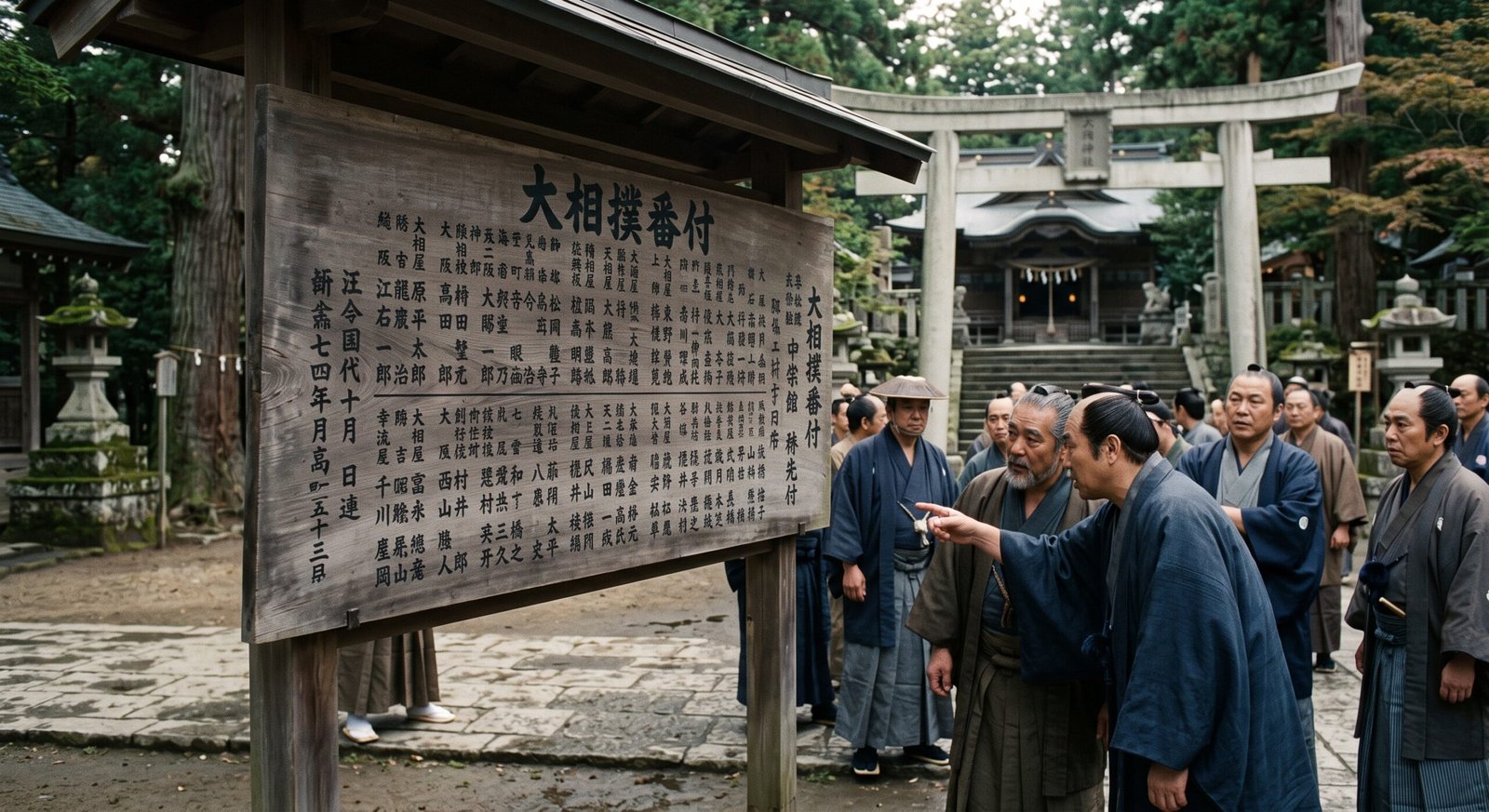
The oldest confirmed ranking document in sumo is not a printed sheet but a wooden placard, an ita-banzuke (板番付), raised outside a shrine to advertise a charity tournament. The earliest surviving example dates to 1699, from a tournament at the Okazaki Tenno-sha shrine in Kyoto, and already used the term Sanyaku, the name still given to sumo's senior ranks. The document went portable in 1717, with the first woodblock-printed rosters circulating around the Kyoto-Osaka region, and in the winter of 1757 the Edo Sumo Association issued the first single vertical broadsheet, establishing the five-tier layout still recognisable today.
Carved across its top centre were three characters, Gomen Koumuru (蒙御免), "by your honourable permission granted." Commercial prize-fighting was technically illegal under the Tokugawa shogunate, so promoters held tournaments as sanctioned religious fundraisers instead, and that loophole, rendered in beautiful calligraphy, is still printed on the banzuke today, more than a century after the shogunate itself disappeared.

A Rope Becomes a Rank
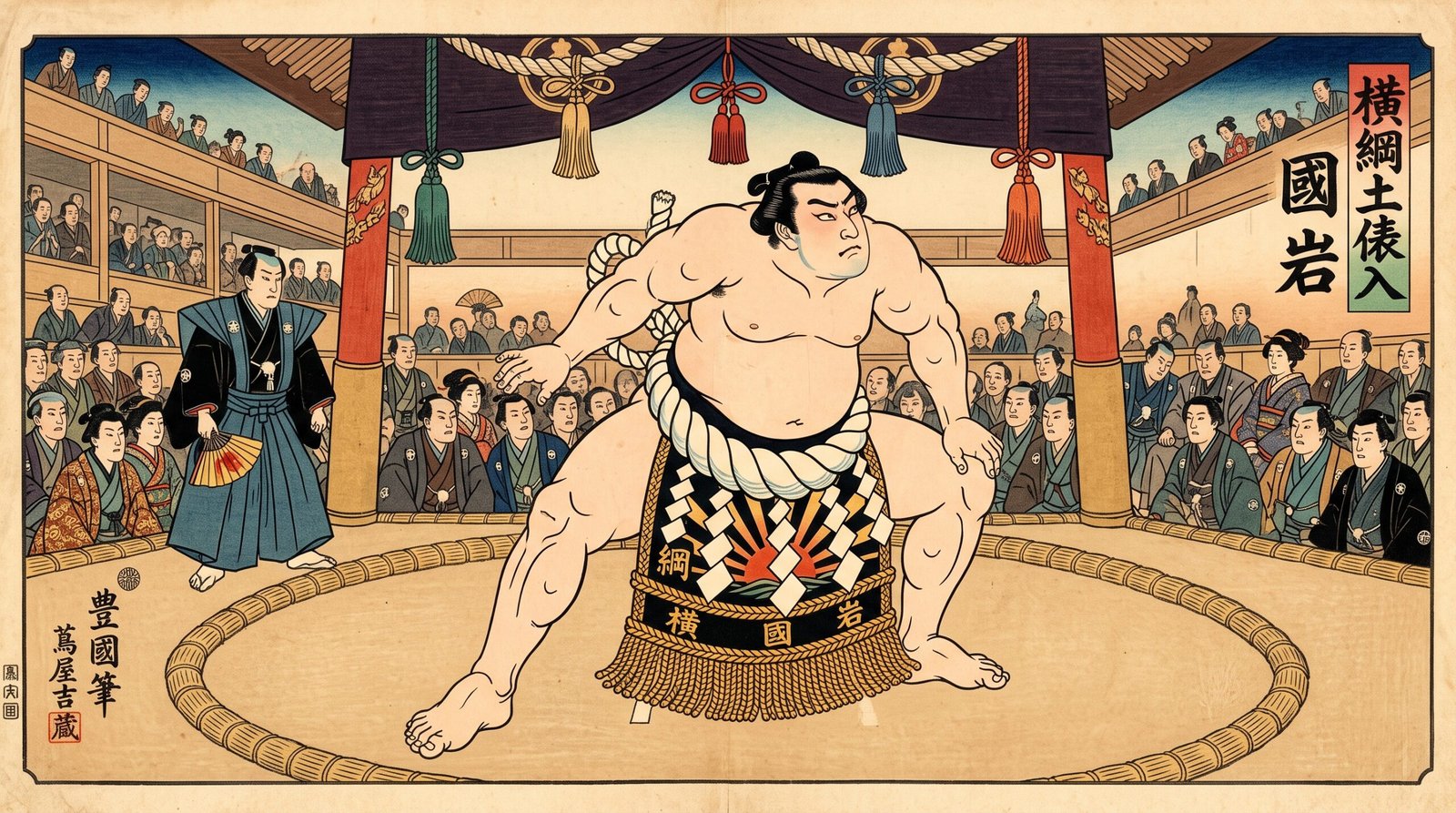
For most of sumo's history, the banzuke recognised only three senior ranks: Ozeki, Sekiwake, and Komusubi. Yokozuna was not a rank at all but an honorary licence, granted since 1789, permitting an especially accomplished Ozeki to wear a sacred rope belt and perform a solo ring-entering ceremony. On paper, a licence holder was still listed simply as Ozeki.
That changed almost by accident in May 1890, when a wrestler named Nishinomi Kajiro I (西ノ海嘉治郎), licensed but placed in an overhang column (haridashi, 張出) below a rival, took visible offence at the demotion in status. The association's fix was to write "Yokozuna" directly above his name in the margin: the first time the word had ever appeared on a banzuke. That improvised compromise hardened into law in February 1909 when, alongside the opening of the original Ryōgoku Kokugikan, the association formally made Yokozuna sumo's official top rank rather than a mere honorific.
The quieter but no less consequential shift of this era came in 1888, when the association introduced a formal salary for the top ten wrestlers just below Makuuchi, creating the division we now call Juryo, "ten ryo," after the wage those early salaries roughly matched. It is now the single most important boundary on the entire sheet.
The Referees Inherit the Brush
For close to two centuries, the banzuke's calligraphy was a commercial trade, controlled by a publishing house founded by Mikawaya Negishi Ji'emon, whose family lettering style gave the script its name. That arrangement ended in November 1944, when the printing house surrendered its rights and the association handed the job to its own referees instead. Every scribe since has been an active gyōji, and the craft has passed hand to hand within the association ever since, a technique once guarded as a trade secret and now taught openly to anyone qualified to hold the brush.

Safety Nets, Overcrowding, and Shrinking Numbers
Sumo spent the twentieth century adding protective rules, then removing them. Until May 1971, any wrestler in the top five of Maegashira or Juryo was protected from relegation no matter how badly he lost, which let underperforming wrestlers clog the top of a division while better ones queued below; from July that year, the immunity was scrapped entirely. The following January brought the opposite kind of reform, the Public Injury System (Kosho-seido, 公傷制度), letting a wrestler hurt in an official bout sit out the next tournament without demotion. Over three decades, stablemasters increasingly complained that healthy wrestlers were gaming it with trivial knocks and convenient diagnoses, and the association scrapped the whole system at the end of 2003.
By the early 1990s, a recruitment boom had pushed the lower divisions to record sizes; in May 1994 alone, Jonidan swelled to 420 wrestlers, the largest it has ever been. There was no longer room on the sheet for the haridashi system, those overhanging columns used since the Edo period whenever more than two wrestlers held a senior rank, and from July 1994 extra Yokozuna, Ozeki, Sekiwake, and Komusubi were folded straight into the main grid instead.
Release day itself had already moved once, for reasons that had nothing to do with wrestlers: in 1970 the association shifted the announcement from a Saturday eight days out to a Monday thirteen days out, calculating that a quieter sports page on Mondays meant bigger newspaper coverage. It has stayed there ever since. More recently, the pressure has reversed. Japan's shrinking youth population has left the lower divisions struggling to fill their old headcounts, and the Sandanme division, fixed at two hundred wrestlers since 1984, was trimmed to 180 in 2022 and to 160 in 2025.
What is remarkable about the banzuke is not any single rule on it. It is that a document born as a wooden shrine sign, printed under a loophole in shogunate law, still decides a professional athlete's pay, sleeping arrangements, and standing today, and that at every turn where a shortcut was available, the people responsible for it chose the harder, slower, more human way instead. A committee could rank wrestlers by formula. It doesn't. A printer could typeset the names. It doesn't do that either. Somewhere in Tokyo, six times a year, one man is still bent over a sheet of paper the size of a small tablecloth, wearing out brushes one at a time, making sure there is no room left to insert an awl.
A note on translation: Quotations from Japanese-language sources in this piece have been translated into English by the author. Quotations originally given in English are indicated as such.
Sources
Japan Sumo Association: Yokozuna glossary entry — official confirmation of the 1890 first appearance of "Yokozuna" on the banzuke and its formal codification in February 1909.
Japan Sumo Association Quiz Archive: the 1890 Nishinomi Kajiro banzuke dispute — first-hand account of the haridashi dispute that led to "Yokozuna" first appearing on the printed sheet.
Japanese Wikipedia: Juryo (十両) — establishment of the Juryo division and salary system in spring 1888.
Japanese Wikipedia: Haridashi (張出) — history and July 1994 abolition of the haridashi overhang system, including the record 1994 Jonidan headcount.
Japanese Wikipedia: Banzuke (番付表) — the 1970 shift of the release date to a Monday thirteen days before the opening tournament day.
Japanese Wikipedia: Sandanme (三段目) — division headcount history, including the 2022 and 2025 reductions.
Japanese Wikipedia: Kosho-seido (公傷制度) — introduction of the Public Injury System from January 1972 and its abolition at the end of 2003.
Japanese Wikipedia: Kimura Yodo III (木村容堂 (3代)) — tenure as chief banzuke scribe, November 2007 to January 2023.
Japanese Wikipedia: Kimura Yonosuke II (木村要之助 (2代)) — succession as chief scribe from March 2023.
Osumo3: interview with Kimura Yonosuke on becoming the eighth post-war banzuke scribe — first-hand account of the handover and the technical work of ruling out the sheet.
Pingback: After the Cut: Life After Sumo for Retired Wrestlers