Two enormous men crouch nose to nose in a clay circle, slap their thighs, and then, on some invisible signal, crash into each other hard enough to rattle the rafters. Somewhere nearby, a man dressed like a medieval court official is watching for a foot to touch the ground outside a rope boundary. Before any of this happened, a priest buried salt, chestnuts, and dried squid under the ring and asked the gods for a good harvest.
That's sumo (相撲): part wrestling match, part Shinto ceremony, part 1,300-year-old political survival story. It looks ancient and unchanging, and the sumo world likes to say so, but the sport you'd see in Tokyo today is really the product of constant reinvention. Every time Japan's rulers changed, sumo changed with them, while insisting the whole time that nothing had changed at all. Here's how a village harvest ritual turned into one of the world's more peculiar national institutions, and who along the way decided it should look the way it does.
Gods, Grain, and a Very Bad Day for Taima no Kehaya
Wrestling shows up early in Japanese writing. The Kojiki (712 CE) and Nihon Shoki (720 CE), Japan's oldest chronicles, both describe grappling contests among gods and men. In one myth, two deities settle a dispute over who gets to rule the land with a wrestling match on a beach in Izumo. One combatant's arm turns into an icicle and then a blade mid-bout, which is one way to win an argument.
The Nihon Shoki also records an earlier, more mortal bout, traditionally dated to 23 BCE, though most historians treat that date as legend rather than fact. A local strongman named Taima no Kehaya, said to be able to snap horns with his bare hands, was matched against a potter named Nomi no Sukune. It did not go well for Kehaya: the account says Sukune broke his ribs and stamped him to death, then inherited his land. Brutal as it sounds, Sukune was later honoured as the mythical ancestor of Japanese wrestling, and the whole episode set a pattern that would repeat for centuries: win on the ground, gain land, status, or both.
Long before any of this reached the imperial court, village communities across Japan were already staging wrestling matches at harvest festivals, using the outcome to predict whether the crops would be good that year. Sumo, in other words, started life less as a sport and more as a weather forecast with a body count.
The Emperor's Wrestling Party
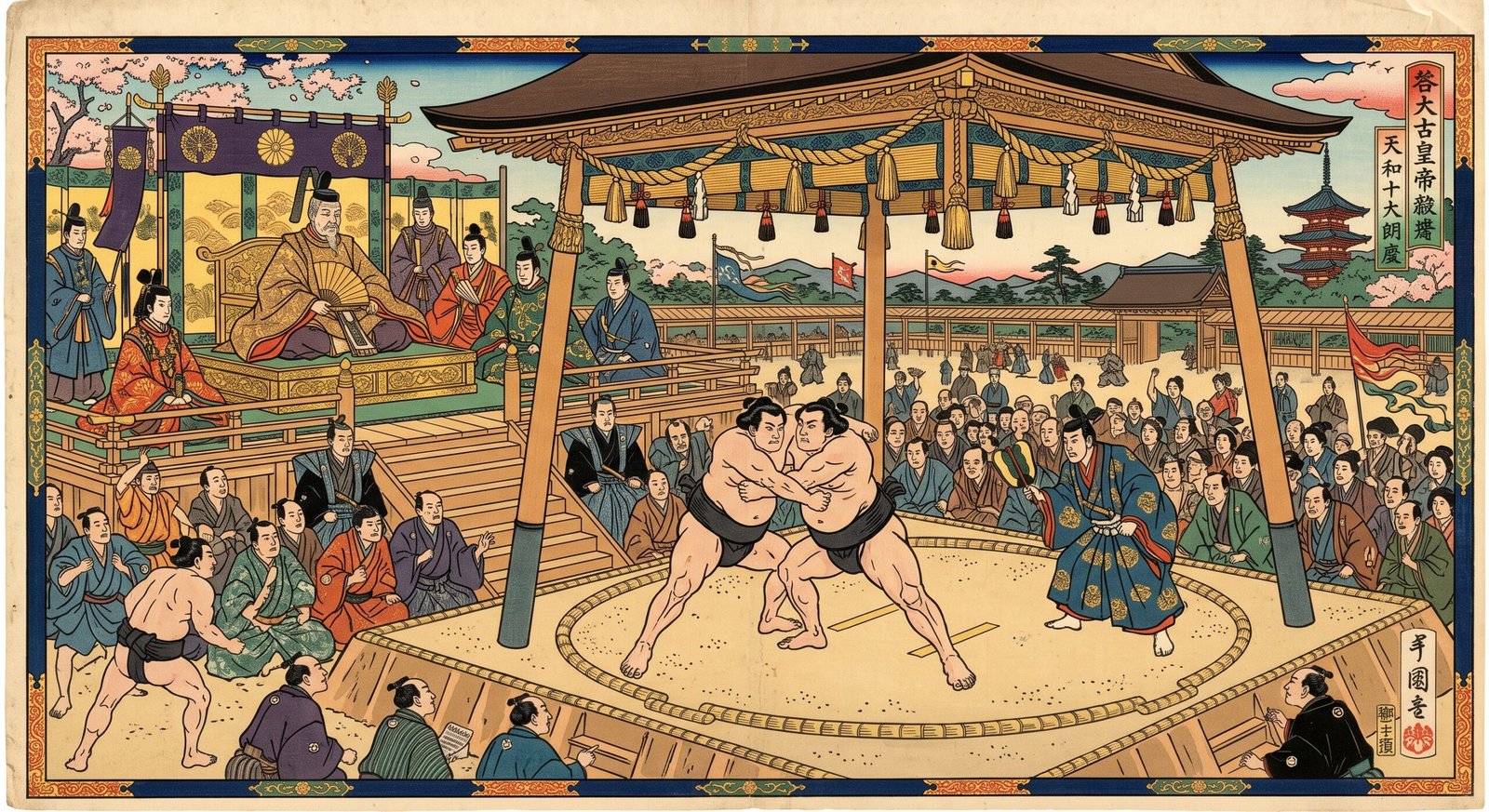
By the eighth century, the Yamato court had noticed a good spectacle when it saw one. In 734, Emperor Shōmu formalised annual court wrestling, known as sechie-zumo, timed to coincide with the Tanabata festival. For roughly four centuries afterward, provincial governors sent their strongest men to the capital to compete in front of the emperor. Kicking, striking, and gouging, all perfectly acceptable in the mythical version, were banned. What had been closer to a street fight became a stage-managed display of imperial order, with the outcome mattering rather less than the ceremony surrounding it.
That's a theme worth holding onto, because it recurs throughout sumo's history: whoever is in charge of Japan at any given moment tends to want the sport tamed, formalised, and put to work in service of something bigger than itself.
From Court Ceremony to Battlefield Drill
The court's grip on sumo loosened once actual soldiers took over the country. When the Kamakura shogunate rose to power under Minamoto no Yoritomo at the end of the twelfth century, wrestling was repurposed as combat training, called buke-zumo, teaching samurai to throw and disarm an armoured opponent using nothing but their hands. Yoritomo personally sponsored tournaments at Kamakura's Tsurugaoka Hachimangū shrine, which tells you roughly how seriously the ruling class was taking this by now.
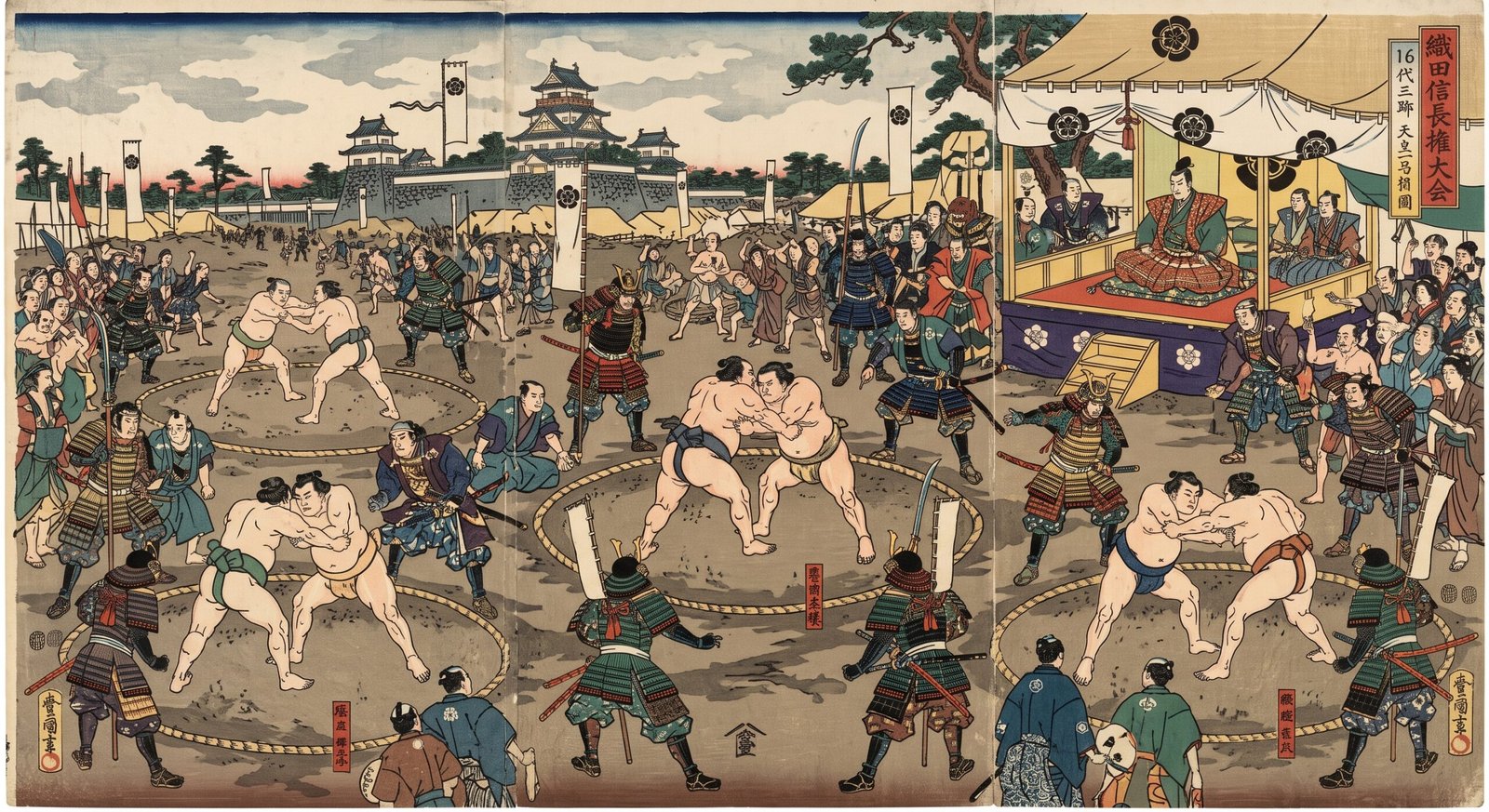
During the Sengoku period, when rival warlords spent a century trying to out-manoeuvre each other, sumo became a scouting exercise as much as entertainment. Oda Nobunaga, one of the era's most powerful and most theatrical warlords, staged huge invitational tournaments at Azuchi Castle, gathering hundreds of wrestlers from across the country. Impress him on the sand and you might walk away with swords, a place in his personal retinue, and a job title. To manage so many bouts at once, Nobunaga's organisers began marking out temporary rings on the ground to keep order among the crowds and combatants alike, an early, unglamorous ancestor of today's sacred dohyō (土俵), the ring itself.
The Edo Deal: Charity Wrestling and the Birth of the Yokozuna
Sumo's modern shape was forged, somewhat improbably, out of a crackdown. Once the Tokugawa shogunate had pacified the country in the early 1600s, plenty of unemployed samurai and street toughs still fancied a fight, and impromptu wrestling matches in Edo, Kyoto, and Osaka kept sparking riots. The authorities banned the street version outright. Wrestlers got around this by reviving kanjin-zumo, tournaments held under the cover of raising money for shrine and temple repairs. Charity, it turned out, was an excellent loophole.
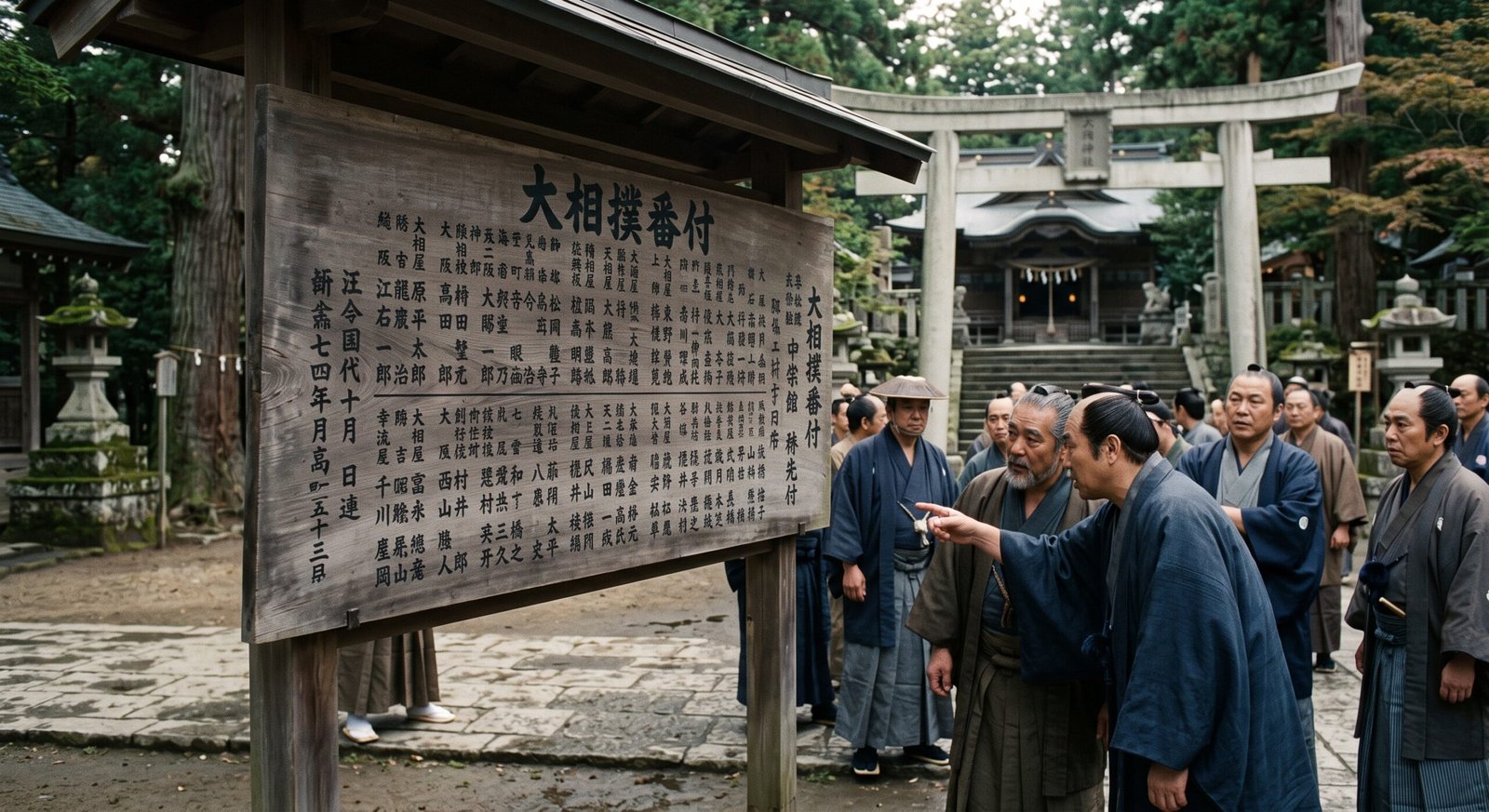
By 1684, the shogunate had formally allowed regular kanjin-zumo in Edo, and this is generally reckoned as the true starting point of professional sumo. Wrestlers organised themselves into a guild, the forerunner of today's Japan Sumo Association, and set up the stable system, or heya (部屋), in which a licensed master, the oyakata, houses, feeds, and trains his own wrestlers under one roof. Rankings were published on a printed sheet called the banzuke (番付), a tradition that continues today and is still, charmingly, hand-brushed in a dense calligraphic style designed to leave no white space on the page.
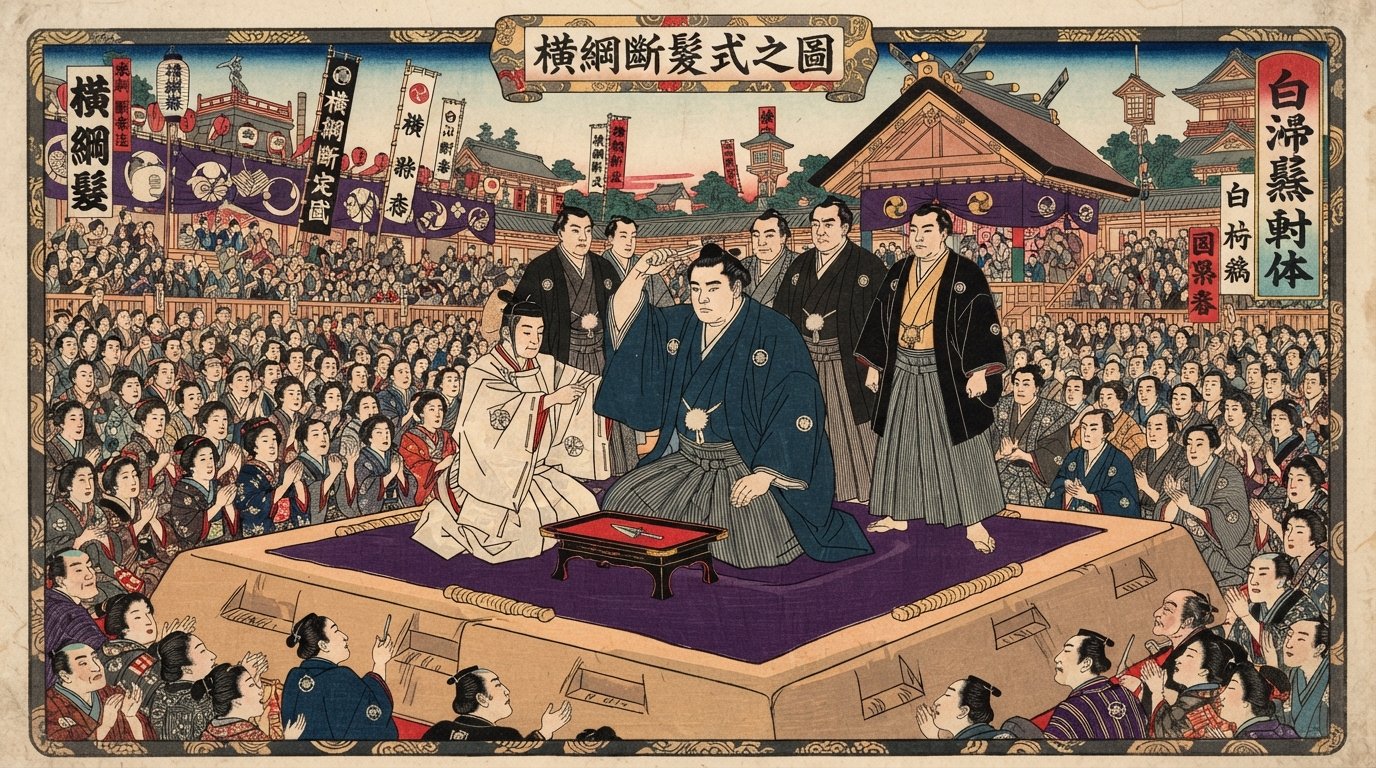
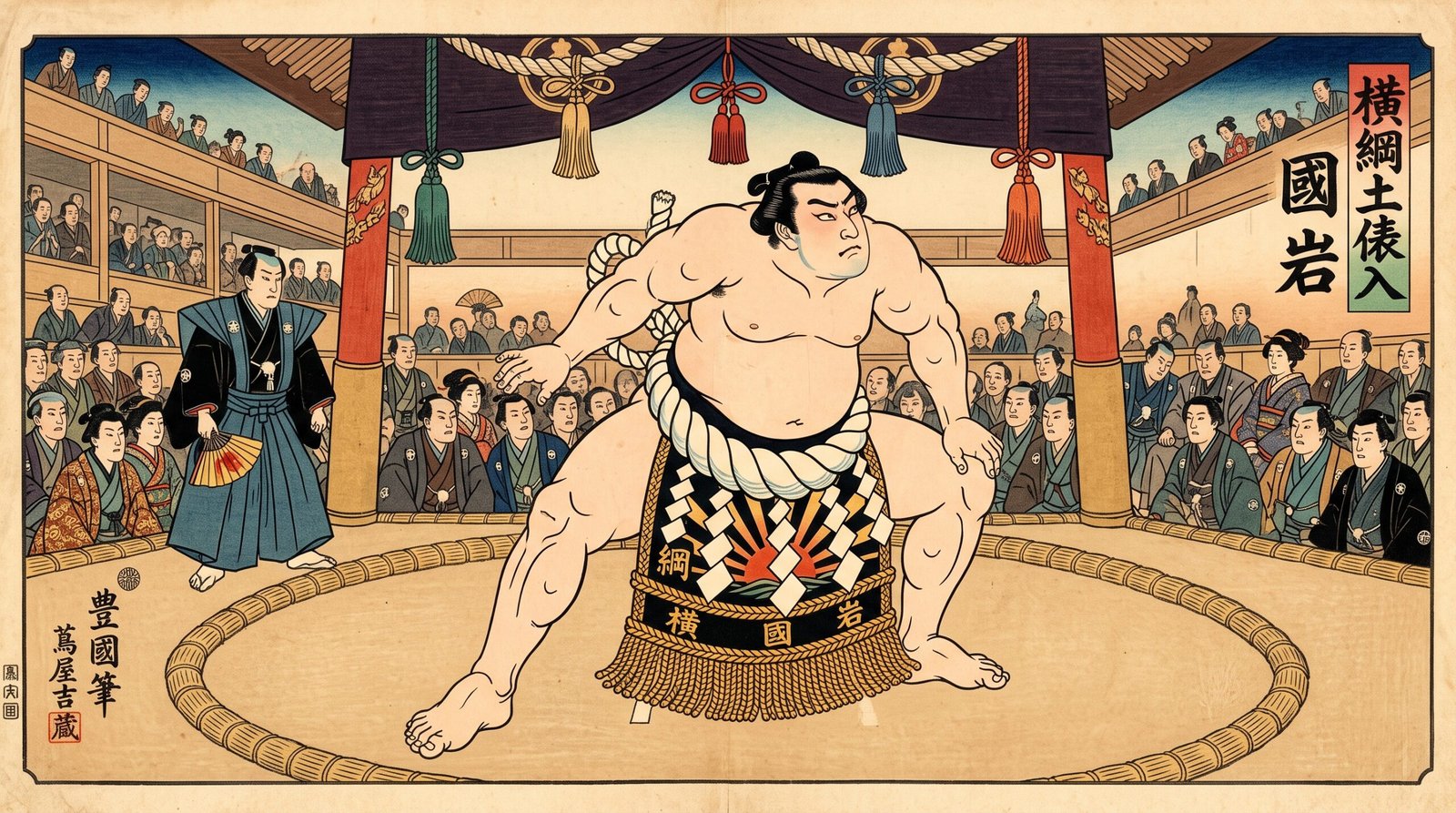
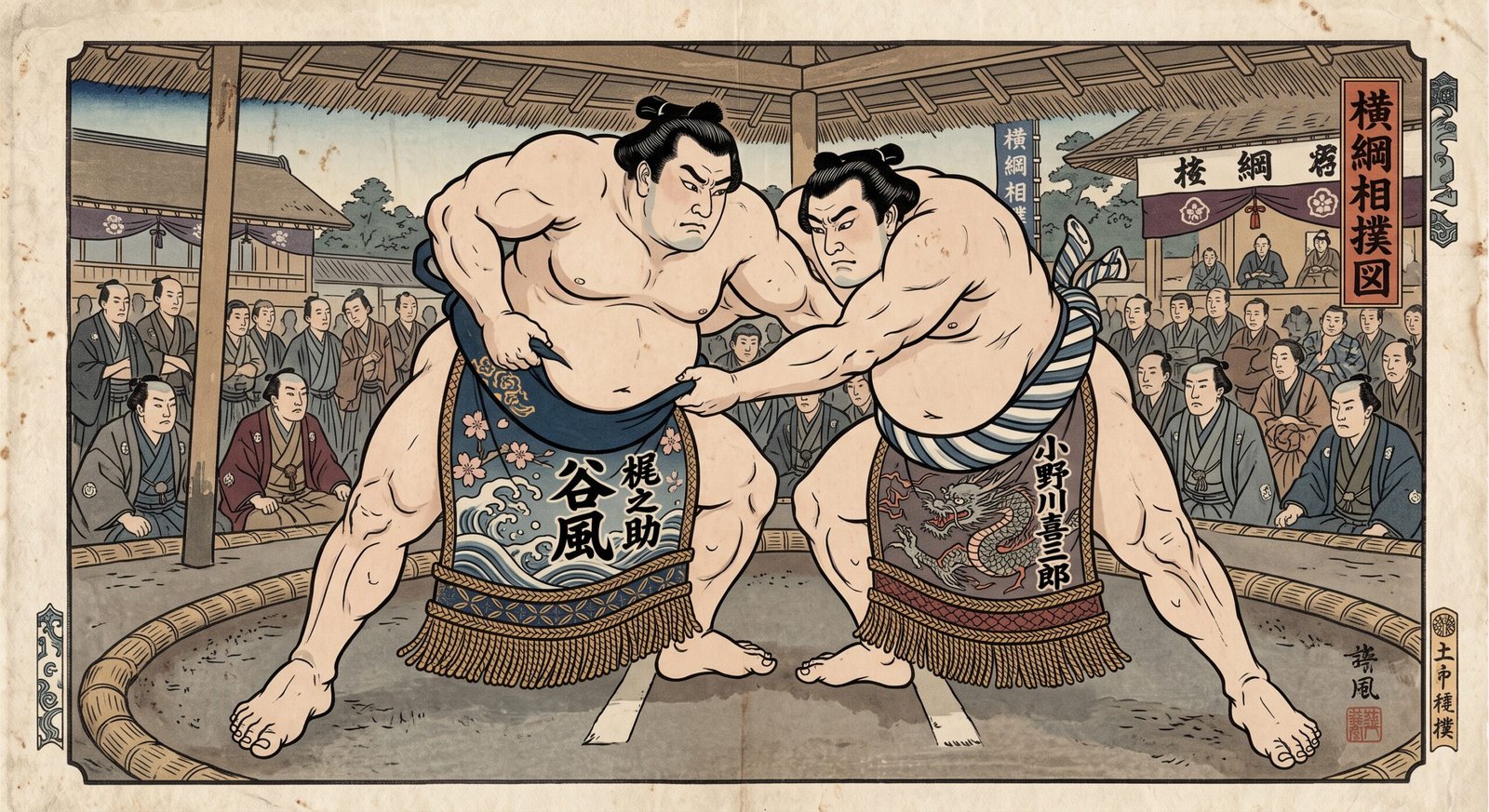
Sumo's Edo-era golden age arrived during the Kansei era, driven by the rivalry between three wrestlers: Tanikaze, Onogawa, and Raiden. In 1789, the Yoshida family, hereditary arbiters of sumo ceremony, issued the very first yokozuna (横綱) licences to Tanikaze and Onogawa. This wasn't originally a competitive rank at all; it was a ceremonial honour that let a wrestler wear a thick braided rope and perform a solo ring-entering ceremony. Raiden, meanwhile, was busy putting together one of the most absurd records in sporting history: 254 wins against just 10 losses, a winning percentage over 96 percent, and he never received the yokozuna licence at all. His sponsoring clan simply backed the wrong political horse. Even in an ancient sport built on strength, connections mattered rather more than the record book suggested they should.
Reinvented for a Modern Empire
The fall of the shogunate in 1867 nearly finished sumo off. The new Meiji government was chasing Western approval and found half-naked wrestling matches an embarrassment; a ban on the samurai topknot and new anti-nudity ordinances threatened the sport's very existence. Sumo survived by attaching itself to the one institution nobody in the new government could touch: the emperor. In 1884, officials arranged an imperial command tournament in front of the Meiji Emperor himself, and sumo was reborn as an ancient pillar of the imperial state rather than a leftover from the old regime, regardless of how recently the paperwork had been signed.
The sport then leaned into its new prestige. In 1909, the Tokyo Sumo Association built Japan's first permanent indoor sumo arena at Ryōgoku (両国), which needed a suitably grand name. Officials landed on Kokugikan (国技館), or "national sports hall," language lifted directly from the dedication written for the opening ceremony describing sumo as Japan's kokugi (国技), its national sport. It is worth pausing on that word choice, because the Japanese legal historian Nitta Ichirō has pointed out, dryly, that sumo only officially became the "national sport" in 1909, and the people who decided that were, more or less, the sumo world itself. So next time someone tells you sumo has been Japan's national sport since time immemorial, you now know the actual filing date.
In 1925, the once-rival Tokyo and Osaka sumo associations merged, helped along by a donation from the Prince Regent who would later become Emperor Shōwa, forming the body now known as the Japan Sumo Association. The Emperor's Cup was established as the sport's ultimate prize, and the modern structure of grand sumo, six tournaments a year contested for a trophy bearing the emperor's name, was essentially locked into place.

Legends, Streaks, and the World Turning Up
The twentieth century gave sumo its household names. Futabayama Sadaji strung together an almost unbelievable 69 consecutive wins between 1936 and 1939, drawing on a Zen-inflected idea of the "wooden gamecock," a bird so calm that rivals flee at the sight of it, mistaking it for a carving. When his streak finally ended on 15th January 1939, he reportedly sent his mentor a one-line telegram admitting he still had some way to go before reaching that state of calm.
Postwar television turned sumo into a national fixture, and Taihō Kōki became its defining figure of the 1960s, eventually racking up 32 tournament championships, a record that stood for over four decades. Taihō was as famous for his composure as his strength; after one controversial officiating decision ended a long winning streak, he reportedly shrugged it off by saying it was the champion's own fault for wrestling a bout close enough to be disputed in the first place. In the 1980s, Chiyonofuji Mitsugu, nicknamed "The Wolf," took a different route to greatness. Lighter and leaner than most of his rivals, he rewrote what a champion's body was supposed to look like, won 31 championships, and became the first wrestler in history to reach 1,000 career victories.
Sumo's most significant shift in recent decades, though, has been geographic. Hawaiian-born Takamiyama broke into the top ranks in the late 1960s, and by 1992 another Hawaiian, Konishiki, was being denied promotion despite strong results, sparking an uncomfortable public debate about whether a foreign wrestler could ever have the right "dignity" for sumo's highest ranks. That ceiling broke in January 1993, when Akebono, born Chad Rowan in Hawaii, became the 64th yokozuna, the first foreign-born wrestler ever to reach the top. The door he opened led, within a decade, to an era of Mongolian dominance, culminating in Hakuhō Shō, who finished his career with a scarcely believable 45 tournament championships and 1,187 career wins, records that make the rest of sumo history look almost sedate by comparison.
The same decades brought institutional headaches. In 2011, a match-fixing scandal, uncovered through leaked text messages, forced the cancellation of the spring tournament in Osaka, sumo's first cancelled tournament since 1946, and led to roughly two dozen wrestlers and stablemasters losing their positions. In response to concerns about foreign dominance, the association has also, since 1992, limited each stable to a single foreign-born wrestler, and requires any foreign wrestler who wants to become a permanent stablemaster after retirement to take Japanese citizenship first. The talent, in other words, is welcome on the clay; running the institution is still meant to stay in Japanese hands.

Still a Ritual, Still an Argument
Walk into a tournament today and the sacred and the modern sit right on top of each other. The ring is still rebuilt from scratch before every tournament and consecrated the day before with rice, salt, and sake in a ceremony performed by the referees, who dress like medieval court officials and, in a nod to an older and blunter era of accountability, still carry a short sword symbolising their willingness to answer for a bad call with their life. Nobody actually does that anymore, thankfully, but a referee whose decision is overturned is still expected to submit a formal letter of resignation.
Not every old rule has aged as gracefully. Women are still barred from entering the ring itself, a policy the association frames as ancient religious tradition, even though the strict version of the ban is largely a Meiji-era invention. It has caused real friction: female officials have been blocked from presenting trophies, and in 2018 a referee, in the confusion of a medical emergency, was recorded asking women who had rushed in to perform CPR on a collapsed local mayor to leave the ring. The episode drew widespread criticism and a public apology from the association's chairman, and the underlying debate hasn't gone away.
That tension is, in its own way, the whole story of sumo in miniature. A sport that presents itself as an unbroken sacred tradition has, in practice, rebuilt itself every time Japan itself changed, court ceremony giving way to samurai drill, samurai drill to street entertainment, street entertainment to imperial showpiece, imperial showpiece to global spectacle. The clay circle looks the same as it always has. Almost everything happening around it has been renegotiated at least once. Given the sport's track record, it probably will be again.
Further reading
World History Encyclopedia: Sumo
Wikipedia: Japan Sumo Association
Nippon.com: "Yokozuna" Hakuhō — An Intimate Tale of a Sumō Grand Champion
Wikipedia: Taihō Kōki
Wikipedia: Chiyonofuji Mitsugu
Wikipedia: Match-fixing in professional sumo