
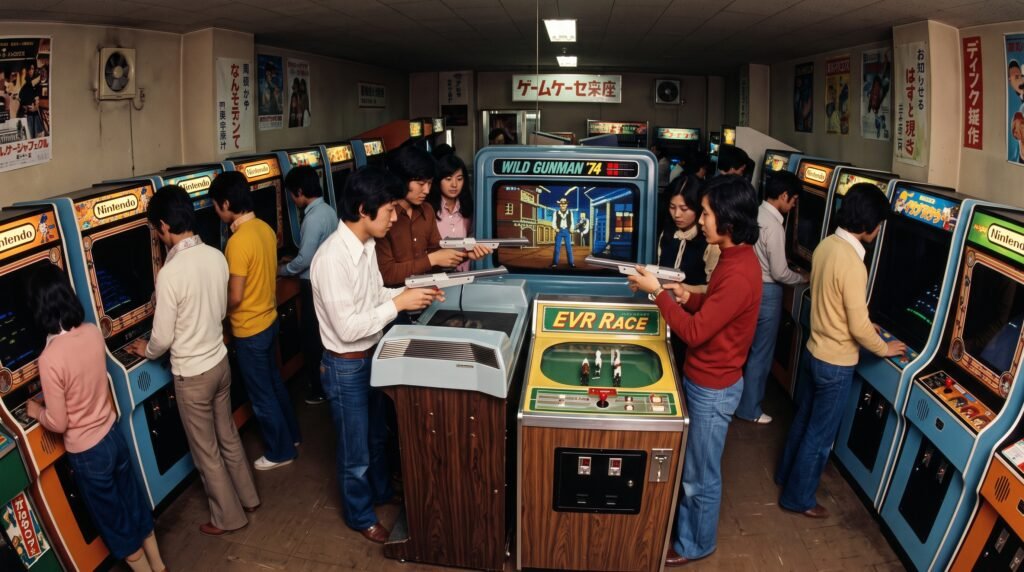
By the time most people think of Nintendo, they think of a company that makes consoles: the Famicom, the NES, the Switch, whatever comes next. For a decade before any of that, though, Nintendo was something narrower and much less certain of itself: an arcade manufacturer, scrapping for floor space in Japanese game centres and North American bars against companies with better games and deeper pockets. It lost money on some of its earliest video machines. It nearly sank its fledgling American subsidiary on a title nobody remembers. And in trying to recover from that failure, it built the game, the hardware philosophy, and eventually the console decision that would define the company for the next forty years.
This is the story of that time: 1975 to 2002, from a horse-betting cabinet built on secondhand film technology to a joint venture with two of its former rivals. Along the way, Nintendo changed strategy more than once, and one of those changes is the reason it makes home consoles at all.
A Betting Machine That Wouldn't Behave
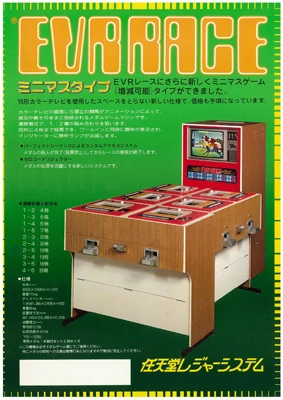
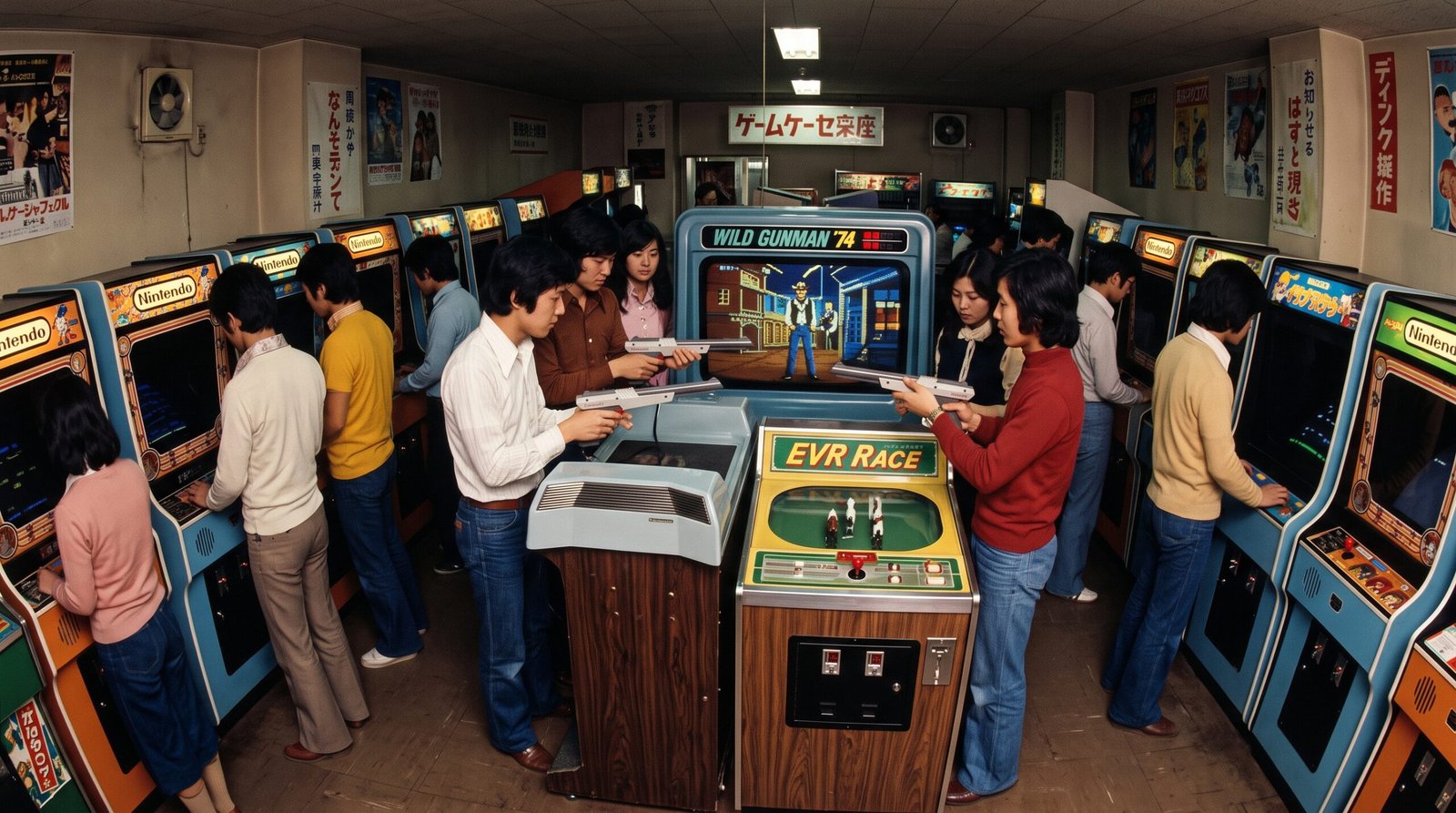
Nintendo's first video game wasn't really trying to be a video game. EVR Race, built in 1975 by a young engineer named Gen'yō Takeda (竹田玄洋), used Electronic Video Recording technology to play back pre-recorded film loops of horse races on a large multiplayer cabinet, letting bettors pick a winner as the reels spun. Nintendo already had a foothold in amusement centres through electro-mechanical novelties like the Laser Clay Shooting System, and EVR Race was meant to extend that business into something closer to a proper video game.
It didn't behave. Running dual film projectors inside a public arcade turned out to be a maintenance nightmare, and breakdowns were constant. The game taught Nintendo a blunt lesson: whatever came next needed to run on solid-state electronics, not film and mechanical parts.
Nintendo took that lesson seriously, but slowly, and largely by copying. Computer Othello, a microprocessor-driven take on Reversi, arrived in June 1978 in a cocktail-cabinet format. Block Fever, a Breakout clone built on discrete logic circuitry, came the same year. Neither was ambitious. Both were the company finding its feet in a market it didn't yet understand.
Playing Catch-Up
Taito's Space Invaders changed the calculation for every arcade manufacturer in Japan, Nintendo included. In 1979 the company released Space Fever, a fixed shooter engineered by Masayuki Uemura (上村雅之) with graphics by a young staffer named Shigeru Miyamoto (宮本茂), in what became his first formal credit on a video game. Space Fever wasn't a pure clone. It offered three separate play modes, one of which split the alien formation into two groups moving in opposite directions, and a variant released the same year, SF-HiSplitter, added enemies that split apart when hit.
The more interesting title came a few months later. Sheriff, released in late 1979 and designed by Takeda with art from Miyamoto, gave players an eight-way rotary dial for aiming alongside a separate joystick for movement, an unusually elaborate dual-control scheme for the period. It had destructible cover, a defend-the-perimeter structure, and small animated cutscenes between stages, predating the intervening storytelling that Pac-Man would later become known for. Exidy licensed it for North America under the name Bandido.
None of this made Nintendo a serious player yet. It was still following the market rather than shaping it, and the games that did well were, at best, clever variations on somebody else's idea. That was about to change, but not before things got considerably worse first.

Flyer for Color Space Fever by Nintendo, sourced via Wikipedia. Used under Fair Use.
The Warehouse Problem
In October 1980, Nintendo Research & Development 2, under Uemura, released Radar Scope, an angled, pseudo-3D fixed shooter developed in partnership with the subcontractor Ikegami Tsūshinki (池上通信機), with sound by Hirokazu Tanaka and cabinet art by Miyamoto. It did moderately well in Japan. Minoru Arakawa (荒川実), the newly installed president of Nintendo of America, was confident enough to order 3,000 units for the North American market, committing most of the young subsidiary's operating budget to the bet.
The bet went wrong for reasons that had nothing to do with the game itself. Shipping from Japan to New York took four months, and by the time the cabinets landed in late December 1980, the American arcade scene had moved on. Space shooters were oversaturated, maze games like Pac-Man were the new draw, and operators complained that Radar Scope's sound effects were grating. Only 1,000 of the 3,000 units sold. The other 2,000 sat in a Seattle warehouse, and Nintendo of America was staring at insolvency.
Arakawa did two things in response. He relocated the subsidiary's operational base to the Seattle area, shortening the shipping times that had helped sink Radar Scope in the first place, a logistical fix that would matter enormously five years later when the NES needed to scale fast in North America. And he asked Nintendo's president, Hiroshi Yamauchi (山内溥), for a way to salvage the unsold cabinets.

An Ape, Not a Sailor
Yamauchi handed the problem to Miyamoto, working under the supervision of chief engineer Gunpei Yokoi (横井軍平), with a development budget of roughly $267,000, or somewhere near $950,000 today once inflation is accounted for. Miyamoto's original plan was to license Popeye, Olive Oyl, and Bluto from King Features Syndicate and build a game around them. When those negotiations collapsed, he kept the underlying structure and swapped in original characters: a carpenter named Jumpman, later renamed Mario; a woman named Pauline; and an escaped gorilla called Donkey Kong.
That substitution mattered more than it might sound. It pushed Nintendo, for the first time, toward original characters and an original narrative structure rather than a genre exercise or a licensed property. Donkey Kong abandoned the single-screen shooting conventions Nintendo had been imitating for years in favour of four distinct, multi-tiered stages built around construction scaffolding, which made it one of the earliest true platformers. It ran on Radar Scope's existing Z80 hardware. Nintendo of America staff manually retrofitted the 2,000 unsold cabinets in the Seattle warehouse, swapping ROM chips and repainting them from blue to red, and after prototype tests in Seattle taverns brought in a promising $30 a day, Nintendo released Donkey Kong in July 1981.
It sold out immediately. By October, Nintendo of America was moving 4,000 units a month, and by June 1982 it had sold roughly 60,000 cabinets in the United States alone, generating around $180 million in coin-drop revenue.* A second year of sales pushed cumulative US cabinet revenue past $280 million by 1983, a figure worth somewhere in the region of $1 billion in today's money. Nintendo also licensed the game for home consoles: Coleco paid an upfront fee plus royalties per cartridge and shipped Donkey Kong as a pack-in title with the ColecoVision in August 1982, eventually moving six million cartridges and roughly doubling Coleco's annual sales. Atari picked up the home computer rights.
Success brought a legal fight, too. Universal City Studios sued in 1982, arguing that Donkey Kong infringed its trademark in the 1933 film King Kong. Nintendo's counsel, Howard Lincoln and John Kirby, pointed out that Universal itself had already established in an earlier case that the original King Kong characters and story sat in the public domain, an argument that could hardly be more directly self-defeating for the plaintiff. Judge Robert W. Sweet ruled for Nintendo on the twenty-second of December, 1983, finding no likelihood that consumers would confuse the two properties and that Universal had acted in bad faith by threatening Nintendo's licensees. Nintendo, barely two years removed from a Seattle warehouse full of dead stock, had just won a fight against a Hollywood studio, and the legal division built to run that defence would go on protecting the company's intellectual property for decades.

A Console of Their Own
Donkey Kong's success left Nintendo with cash, credibility, and a licensing arrangement that handed most of the home market's profit to Coleco and Atari. Yamauchi decided he didn't want to keep renting out his own hit game to other people's hardware. Sometime in 1982, he instructed Uemura to design a home console of Nintendo's own, one capable of running a faithful conversion of Donkey Kong while staying cheap enough for a mass market. This is the moment arcade strategy and home strategy stopped being separate questions for Nintendo. From here on, the two businesses would share components, share engineering staff, and in some cases share the exact same circuit boards.
Uemura's team brought a Donkey Kong arcade cabinet to the chip manufacturer Ricoh and asked them to build integrated circuits capable of replicating its performance at consumer prices. Uemura had initially wanted a 16-bit machine with a keyboard and floppy drive; Yamauchi rejected that as needlessly expensive and intimidating to non-technical buyers, and the team settled on an 8-bit CPU built around the inexpensive MOS Technology 6502 core, paired with a custom graphics chip. Yamauchi's original target was a retail price near ¥9,800, in the region of $40 at the exchange rates of the day, or something like $125 in today's money.* "It amazed us to see such a product," Uemura later said of an Atari console the team studied during development, before conceding that matching it within Nintendo's budget looked close to impossible at first.
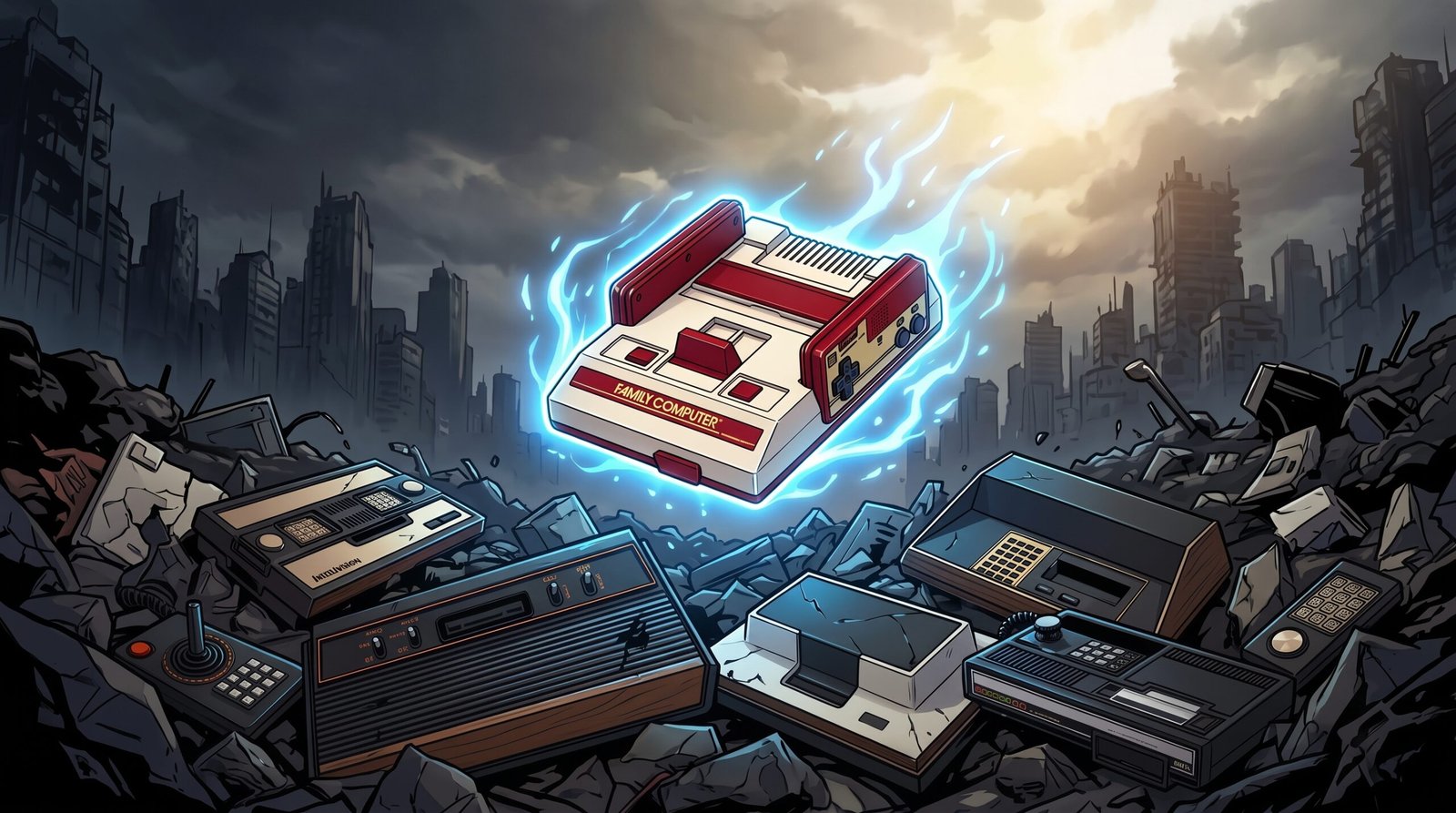
The console shipped a little later than planned and a little more expensive than hoped. Nintendo released the Family Computer, or Famicom, on the fifteenth of July, 1983, at a retail price of ¥14,800, roughly $60 at the time and somewhere near $190 today, launching alongside home ports of Donkey Kong, Donkey Kong Jr., and Popeye. It hit its central technical goal even if it missed its price target: the Famicom really could run a recognisable version of the arcade game that had saved the company two years earlier. Nintendo was now, deliberately, in the business of building both the machines that took quarters in arcades and the machines that sat in living rooms, and increasingly the same underlying engineering fed both.

Whose Code Is It, Anyway
The rapid scaling of Donkey Kong also exposed a structural problem Nintendo had been carrying since the late 1970s. Much of its early arcade software, including Space Fever, Sheriff, Radar Scope, and Donkey Kong itself, had been engineered in partnership with Ikegami Tsūshinki, a broadcast-equipment manufacturer that handled hardware assembly and low-level programming under contract. Ikegami's original agreement for Donkey Kong gave it exclusive rights to manufacture the printed circuit boards, at a fixed cost of ¥70,000 per unit, roughly $320 at the time and around $1,000 today, for an initial run capped at 8,000 boards.*
American demand blew past that cap almost immediately, and when Ikegami couldn't scale production fast enough, Nintendo produced an estimated 80,000 additional boards independently, without Ikegami's authorisation. Ikegami, unsurprisingly, refused to work on the sequel. Nintendo hired a separate firm, Iwasaki Engineering, to reverse-engineer Donkey Kong's existing Z80 code so it could build Donkey Kong Jr. without Ikegami's involvement, and Ikegami went on to partner with Sega instead, working on titles including Zaxxon and Congo Bongo.
In 1983, Ikegami filed suit in the Tokyo District Court, seeking ¥580 million in damages, somewhere around $2.4 million at the exchange rates of the time and closer to $7 or $8 million adjusted for inflation, arguing that Nintendo had both breached the manufacturing contract and infringed Ikegami's copyright by reverse-engineering the game's code. The case sat unresolved for years while Japanese courts worked out whether compiled, machine-readable code even qualified for copyright protection at all. In 1989, the Tokyo High Court found that it did, and that Ikegami held the copyright in the assembly code it had authored. The two companies settled out of court in 1990 on undisclosed terms.
The fallout reshaped how Nintendo built games. To avoid ever being caught in that position again, the company expanded its internal engineering divisions, formalising R&D1 under Yokoi and R&D2 under Uemura, and kept core software compilation in-house from that point forward. It also meant Nintendo avoided re-releasing the original arcade ROM of Donkey Kong for decades, since its legal claim to that specific code had never been fully settled; home conversions, including the NES version, were written from scratch by internal teams rather than adapted from Ikegami's original work. When a playable recreation of the arcade game later turned up as a hidden feature inside Rare's Donkey Kong 64 in 1999, it existed as an independent re-creation rather than a direct use of the code at the centre of the old dispute.
Two Screens Are Better Than One
Nintendo's post-Donkey Kong success had left it with an odd surplus: a stockpile of extra video monitors. Tasked with finding a use for them, Takeda's team at what was now Nintendo R&D3 landed on a boxing game. Punch-Out!!, released in February 1984 with character art by Miyamoto and a debut arcade score from Kōji Kondō, stacked two monitors vertically inside a single cabinet. The top screen carried round timers, scores, and animated portraits of the opponent; the bottom carried the fight itself. To solve the obvious visibility problem of a behind-the-player boxing game, the team rendered the player's own boxer, Little Mac, as a translucent green wireframe, so incoming punches stayed visible through his own body. It became the top-earning arcade game in the United States that year, and the dual-monitor format it introduced became a direct ancestor of later Nintendo hardware, including the Nintendo DS.
The more consequential hardware move came the same year, and it made the Famicom's new role explicit. Rather than continuing to design bespoke circuit boards for every new arcade title, Nintendo built the VS. System around the same Ricoh 2A03 processor already sitting inside the Famicom, an 8-bit chip derived from the MOS 6502 core with built-in audio channels. The board came in three cabinet configurations: the single-screen VS. UniSystem, a two-screen VS. DualSystem upright, and a steel-framed cocktail cabinet nicknamed the "Red Tent" that let up to four players compete on opposing monitors in titles like VS. Tennis. To stop operators from bootlegging ROM chips, Nintendo scrambled the colour-palette tables in the VS. System's custom graphics chips, so an unauthorised ROM would render as an unplayable mess of wrong colours on the wrong board.
Nintendo also used the arcade side of the business to tune difficulty and monetisation in ways it would never have applied to the home game. VS. Super Mario Bros. borrowed harder stages that would later surface in Japan as Super Mario Bros. 2 on the Famicom Disk System, tightened enemy hitboxes, and could be configured by operators to demand well over a hundred coins for a bonus life. The arcade and console lines were no longer parallel businesses that happened to share an owner. They were, increasingly, the same hardware wearing two different costumes.

Selling the Living Room from Inside the Arcade
By 1986, the NES had revived the North American home console market, and Nintendo's arcade strategy shifted again, this time from extracting coin-drop revenue toward using arcades as a storefront for the console itself. The PlayChoice-10 let operators offer up to ten selectable NES titles in a single cabinet, running unmodified NES game code on a Ricoh 2A03 paired with an RGB graphics chip, while a separate Zilog Z80 processor ran the menu system, tracked coin input, and pulled hint text from an auxiliary ROM on each game cartridge.
The economics were the real shift. Rather than charging per life, as almost every prior arcade game had, PlayChoice-10 sold a fixed block of play time per coin, letting players freely switch between any of the ten loaded titles until the clock ran out. The goal wasn't maximum coin-drop per cabinet anymore; it was getting people comfortable enough with NES games in public that they'd go buy the console and cartridges for home. The arcade business had become, in part, a marketing channel for the console business it had originally spun off from.
One Last Lap
Nintendo repeated the preview-cabinet idea in 1991 with the Nintendo Super System, built around the 16-bit SNES architecture: a Ricoh 5A22 processor, the SNES's dual graphics chips, and a Sony audio processor, offering time-limited previews of titles like Super Mario World and F-Zero. But the strategy had a shrinking window. As home hardware caught up to arcade capability through the early 1990s, dedicated preview boards lost ground to high-end 3D arcade systems that home consoles simply couldn't match, and Nintendo's standalone arcade ambitions faded for most of the decade.
They resurfaced once more in 2002, in an unlikely partnership. Nintendo joined Sega and Namco, former rivals turned occasional collaborators, to build the Triforce arcade board around GameCube architecture: an IBM "Gekko" PowerPC processor running at 485 megahertz, an ATI "Flipper" graphics processor, and double the GameCube's usual memory to handle networked, multi-monitor arcade setups. Sega's Amusement Vision studio used the board to build F-Zero AX, released in arcades in 2003 alongside the GameCube's own F-Zero GX, and the two versions could exchange custom vehicle data through a memory card, a direct if smaller-scale echo of the hardware convergence the VS. System had pioneered nearly twenty years earlier.

The Shape It Left Behind
None of Nintendo's later console decisions happened in isolation from this period. The Famicom's central processor and graphics chip were built by taking the Donkey Kong arcade board apart and re-engineering it for consumer prices, which means the machine that made Nintendo a household name was, quite literally, a miniaturised arcade cabinet. The Ikegami dispute forced the company to build the in-house engineering culture that would go on to define its software for the next four decades. The Radar Scope shipping crisis relocated Nintendo of America to the Pacific Northwest years before that same geography became essential to scaling the NES. And the legal team assembled to fight off Universal City Studios stayed in place to defend Nintendo's intellectual property through everything that followed.
Nintendo's decade in the arcades reads, in hindsight, like an apprenticeship it didn't choose and nearly failed. It came out the other side with a mascot, an engineering philosophy, a legal department, and a console strategy it would never really abandon. The next instalment in this series picks up a thread left dangling here: the handheld line that grew out of these same years, and the home machine that made the arcade lessons permanent, in the Game & Watch and Famicom era.
Quotations translated from Japanese-language interviews are rendered here in the English translations published by the cited secondary source; no quotations in this piece were originally given in English.
Sources
Radar Scope — Wikipedia
Donkey Kong (arcade game) — Wikipedia
Universal City Studios, Inc. v. Nintendo Co., Ltd. — Wikipedia
Ikegami Tsushinki — Super Mario Wiki
Masayuki Uemura interview — Shmuplations
Punch-Out!! (1984 video game) — Wikipedia
Ricoh 2A03 — Wikipedia
F-Zero GX — Wikipedia
Nintendo Didn't Create Donkey Kong — Nostalgia Nerd
40 Years Ago: 'Donkey Kong' Saves Nintendo From Failure — Ultimate Classic Rock
Pingback: How Nintendo’s Famicom Rebuilt Gaming From the 1983 Crash