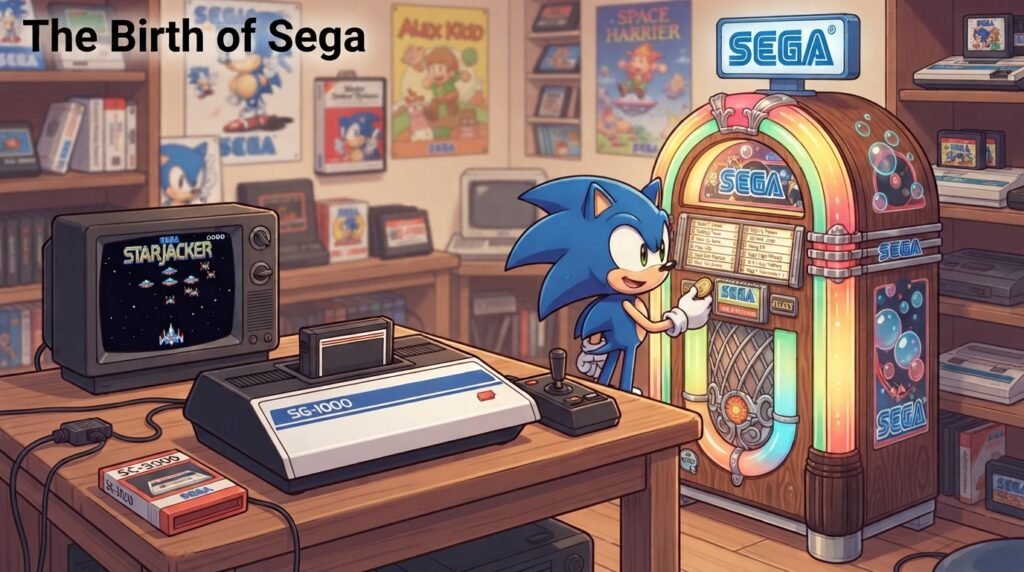
In 1951, Tokyo was still a city under occupation, and two American entrepreneurs named Raymond Lemaire and Richard Stewart noticed something that Japan had in short supply: entertainment for the thousands of US servicemen stationed there. They started importing coin-operated phonographs, slot machines, and mechanical games, refurbishing them, and placing them on American military bases across the Asia-Pacific. It was a modest, unglamorous trade. Nobody involved was thinking about video games, because video games did not exist yet. But the company Lemaire and Stewart founded, restructured in 1954 under the name Service Games, would eventually become Sega. And the console it built in a matter of months to avoid being crushed by Nintendo, the SG-1000, would be the first step on a road that led to the Genesis, the Saturn, and Sonic the Hedgehog.
Getting there took three decades, two continents, a submarine periscope, a merger with a Hollywood conglomerate, and a rushed engineering scramble that nobody at the company actually wanted to run. This is the story of how it happened.
Two companies, one instinct
By the late 1950s, Japan's customs rules and foreign exchange restrictions were making it increasingly difficult to keep importing assembled coin-operated machines from the United States, so in June 1960 Service Games split into two Japanese entities. Nihon Goraku Bussan (日本娯楽物産), run by Stewart, handled sales, leasing, and distribution. Nihon Kikai Seizo (日本機械製造), run by Lemaire, handled manufacturing. Locked out of importing finished American jukeboxes, Nihon Kikai Seizo simply reverse-engineered them and built its own. In 1962, the company released Japan's first domestically manufactured jukebox, and gave it a name that would outlive everything else it ever made: the SEGA 1000, a contraction of "SErvice" and "GAmes."
While the Lemaire and Stewart side of the business was busy reinventing the jukebox, a second American was building a parallel operation across town that would eventually merge with it. David Rosen had served in the US Air Force during the Korean War, stationed in Japan and the Far East, and something about the country stuck with him. In 1954, at 24, he returned to Tokyo and started Rosen Enterprises, which began by selling Japanese art to American buyers and running Photorama, a chain of automated photo booths that took the identification photographs that post-war Japanese bureaucracy demanded constantly. Within a few years Rosen had noticed the same thing Lemaire and Stewart had: a growing appetite for coin-operated leisure. He switched to importing American arcade machines and placing them in dedicated amusement corners inside department stores, the beginning of a Japanese institution that still exists on the top floor of nearly every major department store in the country.
By the mid-1960s, Rosen's arcades needed a steady stream of new machines, and Nihon Goraku Bussan wanted to grow beyond the military bases that had sustained it for a decade. In June 1964, Nihon Goraku Bussan absorbed its manufacturing partner, Nihon Kikai Seizo, and a year later, in July 1965, it merged outright with Rosen Enterprises. The new company was called Sega Enterprises, Inc. (株式会社セガ・エンタープライゼス), and David Rosen became its president. It brought together Rosen's arcade network with the manufacturing capacity, technical staff, and hard-won "Sega" brand of the old jukebox business. For the first time, the company had everything it needed to stop reconditioning other people's machines and start building its own.
A note on dates: an earlier telling of this history dated the SEGA 1000 jukebox to July 1960, the same month the company split into its manufacturing and sales arms. Sega's own corporate anniversary materials and multiple independent Japanese-language histories place the jukebox's release in 1962, and that is the date used here.

A simple game, and a quarter
Sega's first real engineering achievement after the merger arrived in late 1966, and it was a game about submarines. Periscope put the player in front of a large cabinet and had them peer through an actual periscope sight at miniature warships drifting across a painted ocean. Pull the trigger, and a chain of amber and blue lights raced across the cabinet floor to simulate a torpedo run, accompanied by the clank and whir of spring-loaded strikers standing in for engine noise and explosions. It was engineered under Sega's Shikanosuke Ochi, with the cabinet's look supervised personally by Rosen, who had sketched out the original design himself.
Periscope was a hit in Japan, filling department store game corners and Sega's own arcades, and in 1967 Sega began exporting it to North America and Europe, the first Japanese-made arcade game to succeed commercially in the West. It arrived at an inconvenient moment for the American operators who had to sell it: the machine was expensive to ship across the Pacific and carried steep import duties, at a time when the entire US coin-op industry ran on the dime. Rosen made a decision that would outlast the game itself. He told American route operators to charge a quarter.
"It was a simple game," Rosen said of it years later, but its scale and novelty were enough to make players pay two and a half times the going rate without blinking. The gamble worked, and it worked so completely that a quarter became the industry standard for the rest of the arcade era, an economic norm that survived the transition into video games and lasted decades. Rosen later called the whole episode a turning point that launched Sega into the export business in earnest.
That kind of visibility gets noticed. In 1969, the American conglomerate Gulf+Western, which was busy assembling a leisure and entertainment portfolio around Paramount Pictures, bought Sega Enterprises outright. Rosen stayed on as chief executive, now with a much deeper pool of capital behind him to expand factories, fund engineering, and grow the arcade business across Japan.
Learning to build video games
Through the early 1970s, Sega kept building electromechanical machines: driving games, shooting galleries, and in 1971 the country's first domestically designed pinball table, released the same year a young engineer named Hideki Sato (佐藤秀樹) joined the company. Sato would spend the next three decades shaping nearly every piece of hardware Sega ever released, and his fingerprints are all over the story that follows.
The ground shifted again in 1972, when Atari released Pong and the amusement industry began its move from switches and relays to solid-state electronics. Sega followed a year later with Pong Tron, released in July 1973 and, alongside Taito's Elepong, one of the first two commercial video games made in Japan. It ran on discrete transistor logic feeding a cathode-ray tube, not a microprocessor, but it pointed the whole company toward a future built on chips rather than springs.
Getting there required outside help. In 1978, Sega bought Gremlin Industries, a San Diego arcade manufacturer, mainly to get its hands on people who actually understood microprocessors. Sato and a handful of colleagues were sent to California for weeks of intensive training in Zilog Z80 architecture and solid-state design, a practice of shipping Japanese engineers to Gremlin for a crash course that Sega would repeat for years. The following year brought a second, equally important hire when Sega acquired Esco Boeki, a coin-op distribution company, and installed its head, Hayao Nakayama (中山隼雄), as Executive Vice President under Rosen. Nakayama moved fast: he wound down Sega's pinball manufacturing in 1979, judging correctly that electromechanical hardware could no longer compete with video games on revenue or reliability, and pushed the company's engineering effort almost entirely into microprocessor-driven arcade cabinets.
The results came quickly. Head-On, released in April 1979, put a car on a dot-covered maze and became one of the games that directly inspired Namco's Pac-Man. Monaco GP followed later that year, built from discrete logic rather than a microprocessor and remaining one of the most reliable earners in arcades for years. By February 1982, Sega was ranked among the world's top arcade manufacturers and released Zaxxon, whose axonometric perspective and shadow-tracking altitude gauge gave a flat screen a real sense of height for the first time. Early the following year came Astron Belt, Japan's first laserdisc arcade game. Sega, by any measure, was an arcade company operating at the peak of its craft.

A falling sky
None of that prepared Sega for what happened next, and it happened on two continents at once.
In North America, the coin-operated amusement business was contracting as street locations lost money and the home console market drowned in a flood of poorly made cartridge software, a collapse that came to be known as the Atari Shock. Then, in early 1983, Gulf+Western founder Charles Bluhdorn died suddenly, and the conglomerate's new leadership began looking to simplify its holdings, including Sega's manufacturing arms.
At home in Japan, something more constructive was happening. Semiconductor fabrication had matured enough that 8-bit processors, dynamic RAM, and video display chips had all become genuinely affordable, and for the first time it looked possible to build a consumer computer for the living room at a price ordinary families might pay.
Sega's leadership, watching the American console market implode in real time, wanted nothing to do with dedicated game machines. As Sato later put it, plainly, video game consoles looked like an unstable toy business. So the research and development effort he led went instead into something more respectable: the SC-3000, an 8-bit home computer with a built-in membrane keyboard, priced at 29,800 yen (roughly US$200 today) and pitched as a "game computer" that could run BASIC programs as easily as it played arcade ports. It was a computer for parents who wanted to tell themselves they were buying something educational.
That plan lasted until early 1983, when word reached Sega's sales and engineering staff that Nintendo, a toy and playing-card company out of Kyoto, was finishing a dedicated home console called the Family Computer. Nintendo was aiming for an aggressive 15,000 yen price point, built on its retail experience with the handheld Game & Watch line. Nakayama did the arithmetic and did not like the answer: at 29,800 yen, the SC-3000 would never compete for space under a television. He told Sato to build a cheaper, dedicated console out of the SC-3000's own guts, and to do it fast.
The machine nobody had time to want
What followed was less a design process than a demolition. Sato's team stripped the keyboard, the cassette interface, and the auxiliary circuitry out of the SC-3000, remounted the core processing and video chips onto a cheap single-sided circuit board, and called the result the SG-1000. It went on sale at 15,000 yen (roughly US$100 today), matching the Family Computer exactly, with an external keyboard sold separately for anyone who still wanted the computer experience underneath.
"We learned that Nintendo planned to release their own console system at the same time," Sato recalled, "so we removed the keyboard from the SC-3000 and marketed it as a new home console, the SG-1000." He was characteristically blunt about how little anyone at Sega understood what they were building. "While we knew how to make arcade games, we didn't really know anything about console development," he said. "In fact, the very idea of a 'consumer' market for video games was unheard of then: back then it was just a 'new business' idea."
The console division felt that indifference from every level of the company. Arcade development was Sega's identity and its biggest budget line, staffed with elite engineering graduates building custom boards that could push 256 colors and hundreds of sprites onto a screen. The home console team, by contrast, was treated as an unproven side project, thrown together from a handful of engineers and whoever else could be spared. When arcade programmers were asked to write games for the new hardware, several turned the work down, unimpressed by a machine limited to sixteen colors and one hue per sprite. Sega ended up leaning on outside studios like Compile and Coreland to fill out a launch catalog, while its own consumer software largely fell to junior programmers tasked with squeezing arcade code into small ROM cartridges.
Sato's team, meanwhile, was discovering that consumer hardware runs on a completely different kind of math than arcade hardware does. An arcade board might sell five thousand units in its lifetime, so a component costing ten yen less barely moved the needle. A console selling hundreds of thousands of units turned that same ten yen into millions. "We really agonized over the exact choice of components," Sato said. "We estimated that in a single year, the average user would use our consoles for about 500 hours, and we based our choice of chips and their durability on that estimate. Using low quality parts is obviously a bad idea, but using parts that are too high quality also isn't good." It was an entirely new discipline, learned under a deadline that Nintendo had set without knowing it.

Two consoles, one morning
On 15th July 1983, Sega released the SC-3000 and the SG-1000 across Japan. By coincidence rather than design, Nintendo launched the Family Computer on the exact same day, opening a rivalry between the two companies that would run for the next two decades.
Under the plastic, the SG-1000 was built almost entirely from off-the-shelf parts: a Zilog Z80A processor clocked at 3.58 megahertz, manufactured under licence by NEC or Sharp, paired with a single kilobyte of main RAM and a Texas Instruments-derived video chip driving 16 kilobytes of video memory. The result was a 256-by-192 pixel display with 15 colours plus transparency, up to 32 monochrome sprites on screen with a hard limit of four per scanline, and three-channel square-wave audio from a Texas Instruments-derived sound chip. It shared its basic architecture with early MSX computers and Coleco's ColecoVision, and it came with a detachable joystick and a distinctive "Hold" button that paused the CPU mid-game, an unusual feature for a machine this early. To broaden its retail footprint, Sega also licensed the design to the toy company Tsukuda Original, which sold a compatible clone called the Othello Multivision, bundled with a built-in copy of the board game Othello.
The launch line-up leaned heavily on Sega's arcade back catalogue. Star Jacker, a vertically scrolling space shooter, led the charge alongside Congo Bongo, an isometric take on the arcade game Tip Top; N-Sub, a submarine title built under contract by Compile; a Mahjong game; a naval shooter called Yamato; and a shogi puzzle title, Serizawa Hachidan no Tsumeshogi. Packaged in silver boxes priced between 3,800 and 4,500 yen (roughly US$25 to US$30 today), these six cartridges were what Sega had to offer against a rival that launched, by most counts, with only three games of its own.
Stars in their eyes
Nobody at Sega expected what happened next. The SG-1000 sold around 160,000 units in its first year on shelves, helped along by early stock shortages and motherboard reliability problems that dogged Nintendo's launch. Set against the arcade business Sato and his team actually understood, where a strong machine might sell a few thousand units over its whole lifetime, the number was staggering.
"No one predicted how big of a hit the SG-1000 would be," Sato said. "The first year alone, we sold 160,000 units. They sold so well, we started to get stars in our eyes, thinking we might sell half a million! It was a scale completely incomparable with our arcade board sales. And that is how our entire company caught Console Fever, and threw ourselves into that side of game development."
The excitement did not erase the machine's problems. Its graphics chip could not match the custom silicon Nintendo had built into the Famicom, and once the Family Computer's early shortages cleared, its superior colour palette and cheaper sourcing let it pull decisively ahead. Sato, with the benefit of hindsight, was unsentimental about the SG-1000's design, joking that its oversized cartridges made the console look like "some big tombstone" whenever one was slotted home, a complaint he cared about enough to fix in the console's first redesign the following year.
None of that undoes what the SG-1000 actually achieved. It proved, against the company's own instincts, that home hardware could be a real business rather than an "unstable toy" sideline, and it did it in under a year, using a computer nobody had originally intended to turn into a console. The manufacturing pipelines, the retail relationships, and the outside developers Sega brought in to hit that July deadline became the foundation the company built on for the Mark III, the Mega Drive, and everything after. Sega had spent thirty years drifting from occupation-era jukeboxes to submarine simulators to solid-state arcade cabinets, absorbing whatever business it needed to survive along the way. The SG-1000 was the moment all of that experience got pointed, almost by accident, at the living room.
A note on translation
Quotations from Hideki Sato are drawn from a 1998 Famitsu DC interview, translated into English by shmuplations.com. All other Japanese-language quotations and paraphrased remarks are cited from English translations published by the outlets listed below. Quotations from David Rosen were originally given in English and are reproduced as recorded by the American trade press.
Sources
Sega Corporation Corporate History Timeline
Sega Hard Encyclopedia: SG-1000 Hardware Specifications
Sega Hard Encyclopedia: SC-3000 Hardware Specifications
The History of Sega Console Hardware (Hideki Sato, trans. shmuplations.com)
Time Extension: Celebrating the SG-1000, Sega's First Console
SEGAbits: SEGA Retrospective — The Life of Hideki Sato
The History of How We Play: David Rosen of Sega and His Vision for Arcade Games
Japan Today: David Rosen Helps Launch Sega in Japan
Wikipedia: David Rosen (businessman)
Wikipedia: Periscope (arcade game)
Wikipedia: SG-1000
Wikipedia: Hayao Nakayama
Wikipedia: Gremlin Industries
Sega Retro: Shikanosuke Ochi
Weblio: Sega corporate history