In the autumn of 1986, most of Furukawa Electric's championship footballers were still showing up to the office on Monday mornings. They filed paperwork, sat through meetings, and did the ordinary work of a wire and cable manufacturer. Then, in the evenings and on weekends, they became the best football team in Japan. Nobody at the company seemed entirely sure which version of them was supposed to matter more, and for a while in December of that year, that confusion nearly cost Japanese football one of its most important victories.
"Go For It"
Furukawa Electric Soccer Club had just won the 1985 Japan Soccer League (日本サッカーリーグ) title under manager Eijun Kiyokumo (清雲栄純), which meant the company club had earned the right to represent Japan at the sixth Asian Club Championship (アジアクラブ選手権), the closest thing Asian football had to a continental crown. It should have been a moment of pure pride. Instead, it produced a crisis, because the Asian Football Confederation had scheduled the tournament's preliminary and final rounds across December 1986, and that calendar collided directly with the Emperor's Cup (天皇杯), the domestic competition that, at the time, mattered more to a Japanese company than almost anything else its team could win.
This was not a small tension to resolve. Japanese football in the mid-1980s still ran on corporate paternalism: teams were staffed by employees first and athletes second, and a company's standing was measured by how it performed in front of other companies, not how it fared against the rest of Asia. Inside Furukawa's own boardroom and within the wider Japan Soccer League, plenty of voices argued for the sensible option: withdraw from the continental tournament, protect the domestic campaign, and treat international competition as the expensive, faintly reckless distraction it was widely assumed to be.
Kiyokumo and coach Osamu Kawamoto did something that wasn't especially common for the era. They asked the players what they wanted. The answer came back unanimous: they wanted to test themselves against Asia's best, whatever the cost to their standing at home. That left the decision in the hands of one man, company president Etsuji Kusakabe, and he settled it with three words that have outlived almost everything else about that season. Bypassing the conservative counsel around him, Kusakabe told his football club: "Go for it" (「行ってこい」).
Furukawa formally withdrew from the Emperor's Cup. It was, by the standards of the day, close to unthinkable: a Japanese company choosing continental ambition over domestic prestige, and doing it in public. The decision came at the worst possible moment to test anyone's nerve. In the six league matches before the mid-season break, Furukawa had gone one win, one draw, and four defeats, a run of form that would make most executives tighten their grip rather than loosen it. Instead, the squad flew out to Southeast Asia carrying a losing streak, an executive mandate nobody had asked for, and the uncomfortable sense that they now had something to prove twice over.
The New Arrival
The team that made that decision wasn't quite the same team that had struggled through the first half of the season. In late 1986, Yasuhiko Okudera (奥寺康彦) came home to Furukawa after nine seasons in the German Bundesliga with 1. FC Köln, Hertha BSC and SV Werder Bremen. The Japan Soccer League had actually created a new category of registration, the "Special License" player, specifically to bring men like him back into the domestic game without pretending they were still amateurs. Okudera became one of the first two players ever to hold it. He arrived home with well over two hundred Bundesliga appearances behind him, and a standard of game-reading and technical execution nobody else in the Japan Soccer League had been exposed to at close range.
It did not click straight away. Okada, the team's captain, later admitted that Okudera's return created its own kind of pressure:
"When Okudera returned from West Germany in the autumn of 1986, his play was extraordinary, truly a class apart. But precisely because of that gap, there was an initial tactical disconnect, and we tended to hold back out of deference. Early on in league play, things did not click. But when it came to this Asian tournament, everyone shared the singular, desperate desire to win. That shared unity completely tore down the wall between Okudera and the rest of the squad."
Whatever had been missing in the league games dissolved somewhere between Kuala Lumpur and Riyadh, which turned out to be fortunate, because Furukawa was going to need every part of that partnership to hold under pressure. Around Okudera and lead striker Hiroshi Yoshida, veteran winger Yoshikazu Nagai supplied craft on the counter-attack, sweeper Takeshi Okada and marking back Hisashi Kaneko anchored the back line, and goalkeeper Yoshio Kato commanded his box with the calm of someone who had been doing the job for years. It wasn't a team assembled by a scouting department. It was a group of colleagues who had chosen, together, to find out how good they actually were.
Into the Heat
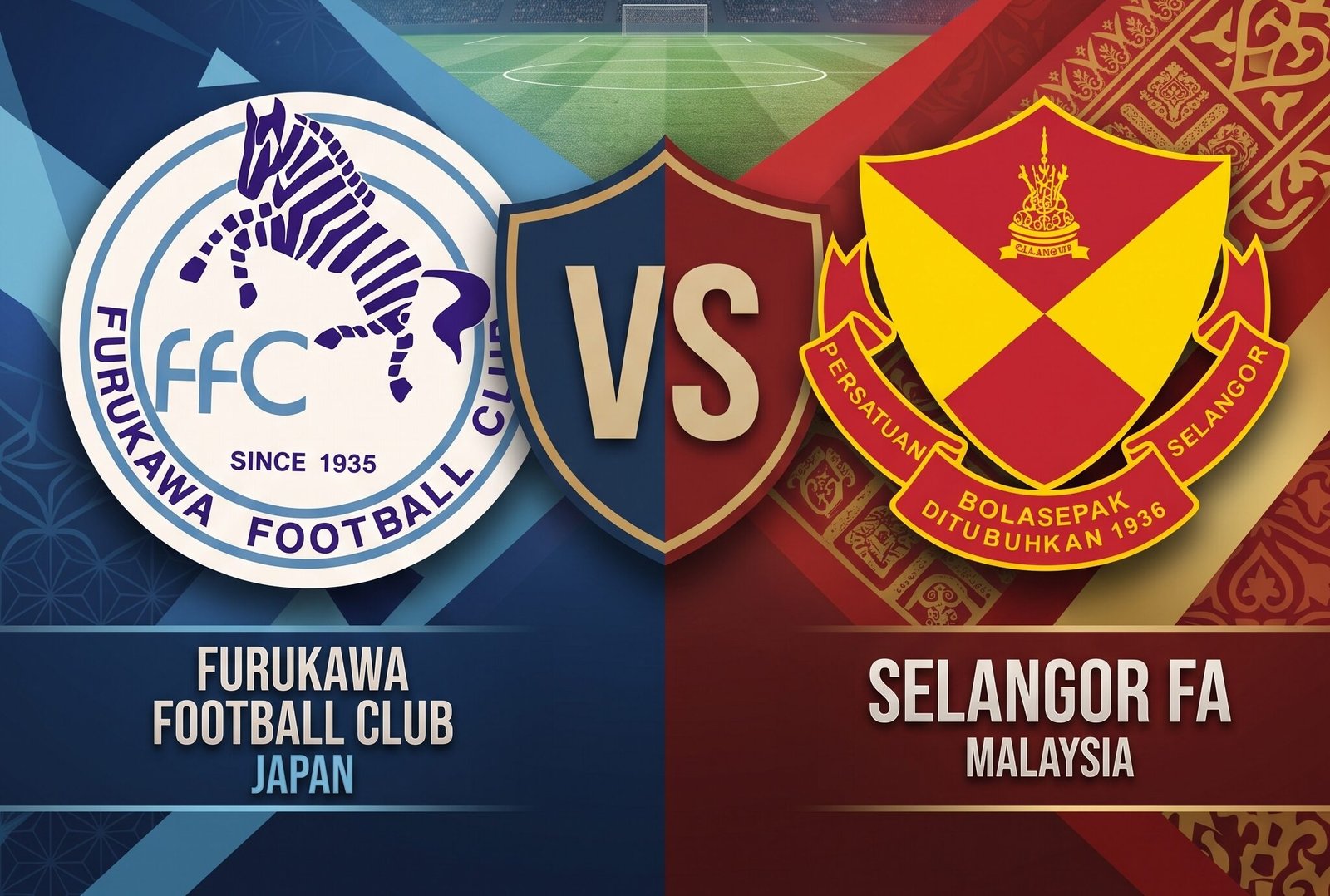
The qualifying route began gently enough. Furukawa received a bye through the first round and went straight into the centralised second-round group in Kuala Lumpur, drawn alongside Malaysian champions Selangor FA and Macau's Hap Kuan. Whichever side topped the group would take Southeast and East Asia's spot in the championship round; there was no margin for a stumble.
Adjusting to equatorial heat and heavy humidity, Furukawa leaned on compact, disciplined pressing rather than trying to outrun conditions they weren't built for. They opened against Selangor on 7th December 1986 and rode out an early spell of home pressure to win 2–1. Two days later they beat Hap Kuan 3–1, finishing the group unbeaten and booking their place in the final round. It was tidy, professional work, the kind that draws little attention at the time and matters enormously in hindsight, because it put them on a plane to Riyadh.
That was where the real test began.
A Different Kind of Away Match
The final round ran from 26th to 30th December 1986 at the Prince Faisal bin Fahd Stadium in Riyadh, Saudi Arabia, and it asked something of Furukawa that no domestic season ever had: three full international matches in five days, against opposition that had grown up playing a version of football the Japanese squad had barely encountered.
Getting there was its own ordeal. There was no direct commercial route between Tokyo and Saudi Arabia in 1986, which meant a long, multi-leg journey, on top of visa protocols that were far from straightforward. When the squad finally landed in Riyadh, they stepped into heat more than 20 degrees warmer than the winter they had left behind in Tokyo, with almost no time to adjust before kickoff.
The football itself was a step into unfamiliar territory too. Host club Al-Hilal fielded much of the Saudi Arabian national team that had won the 1984 AFC Asian Cup, backed by serious state resources, a physical style Furukawa's players had rarely faced, and crowds that made no secret of who they wanted to win. Iraqi champions Al-Talaba and Chinese powerhouse Liaoning FC brought their own versions of the same problem: bigger, stronger, and playing in front of officials who, as the tournament wore on, did not always seem inclined to see things Furukawa's way.
Three matches in five days against that kind of opposition would have tested any team. Furukawa had to do it jet-lagged, sun-scorched, and still not entirely sure whether the folks back at head office in Tokyo saw this trip as an act of courage or an expensive indulgence.
Down, Then Level, Then Ahead
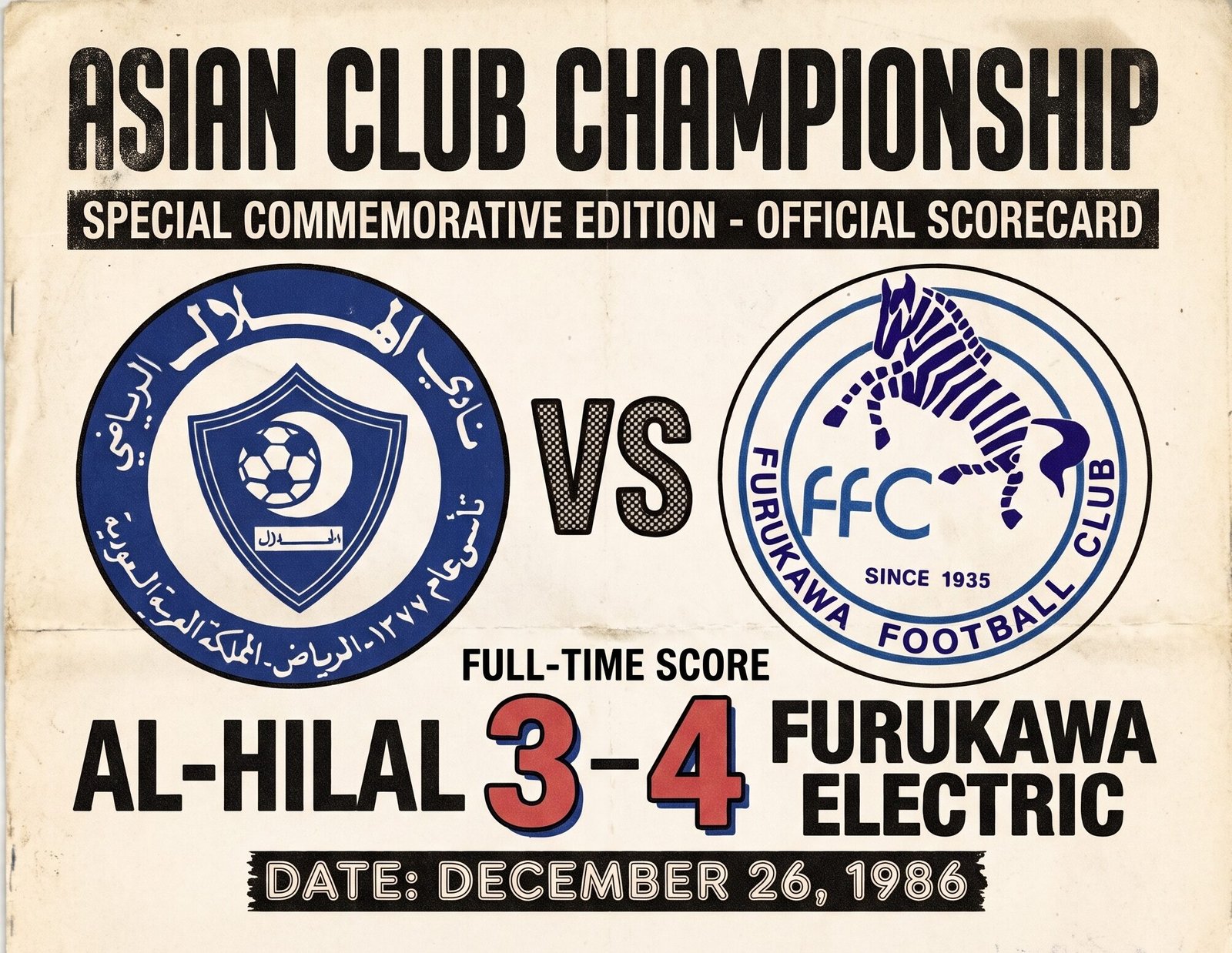
Furukawa opened the final round against the team everyone expected to win the whole thing. Al-Hilal dominated the early exchanges, and in the 31st minute they converted a corner to go 1–0 up, exactly the start the home crowd had come for.
Furukawa didn't panic. Sweeper Takeshi Okada (岡田武史) and defensive midfielder Satoshi Miyauchi held the defensive shape together through Al-Hilal's opening surge, and just before the break, a loose ball spilled past the Saudi centre-backs. Okudera reacted first, drove it home, and Furukawa went into halftime level at 1–1.
Whatever adjustments Kiyokumo made at the break worked immediately. Early in the second half, JSL top scorer Hiroshi Yoshida (吉田弘) broke the offside line and finished cleanly to put Furukawa 2–1 ahead. Then Okudera took the match by the throat. In the 50th minute he scored again. In the 57th, he scored a third. A team that had trailed 25 minutes into the game now led 4–1, and the returning Bundesliga veteran had a hat-trick to his name in his first real test back on Asian soil.
Al-Hilal clawed back two late goals amid disputed stoppages, and for a few uncomfortable minutes the lead looked shakier than the scoreline suggested it should. Furukawa held on. Final score: 4–3.
Digging In
Two days later, on 28th December, Furukawa faced Al-Talaba, the Iraqi champions, who had opened their own campaign with a 2–2 draw against Liaoning and brought a directness that was going to test a different set of muscles entirely. Reading the threat correctly, Kiyokumo had his backline sit five metres deeper than usual, taking away the space Al-Talaba wanted to attack behind, while using quick ground transitions to bypass the midfield battle rather than fight through it.
Hiroshi Yoshida ran the Iraqi defenders ragged with aggressive movement into the channels, and despite a stream of hard fouls and whistle decisions that didn't often go Furukawa's way, the Japanese side scored once in each half to win 2–0. It wasn't as dramatic as the Al-Hilal comeback, but in some ways it said more about the team: composed, disciplined, unwilling to be dragged into the kind of physical contest that had been designed to break them.
The Siege
The decider, on 30th December, was against Liaoning FC, who would go on to win the Asian Club Championship in 1990 and who carried the spine of the Chinese national team into that final match. This was, by every account, the strongest team left in the tournament.
Furukawa scored early through Hiroshi Yoshida on a breakaway, and then spent almost the entire rest of the match defending for their lives. Okada and Hisashi Kaneko led a defensive stand that had little to do with tactics and everything to do with will: winning header after header, clearing loose ball after loose ball, refusing to let a single one of Liaoning's chances turn into an equaliser. Decades later, Okada would still talk about that match with a mixture of pride and disbelief:
"Winning that final match against Liaoning FC, who we felt were overwhelmingly strong, was monumental. In terms of match play, we were pinned back in desperate defence the entire time. I am still in touch with one of the Chinese players from that match, and even today he insists to me: 'We were clearly the stronger side.'"
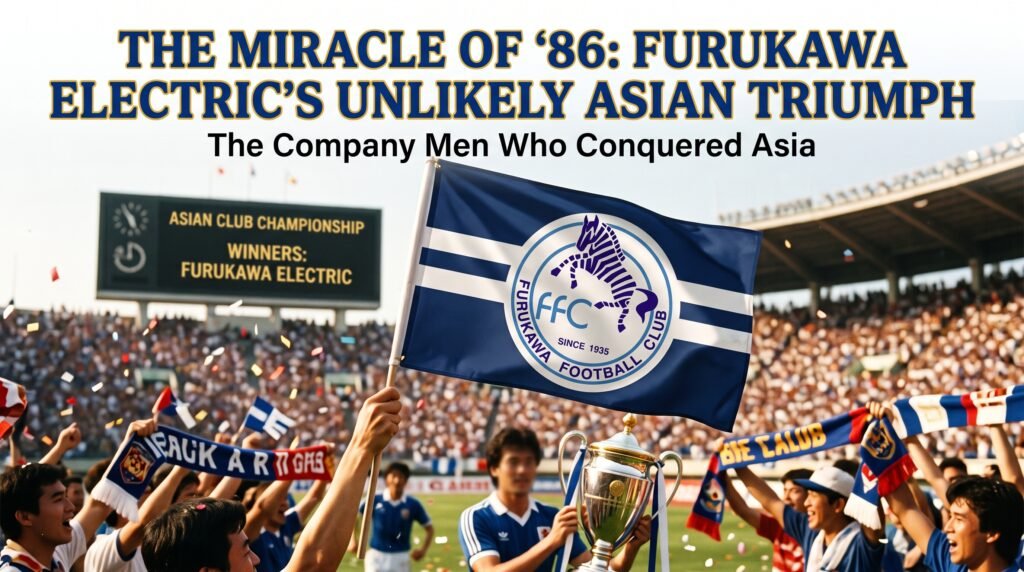
Furukawa held the 1–0 lead to the final whistle. Three matches, three wins: a Japanese club had won the Asian Club Championship for the first time in the competition's history.
Kiyokumo's own summary of the experience, given once the squad was safely home, captured something that the record books never quite manage to: the way a well-earned triumph can still leave a bitter aftertaste. "While I am delighted we won the championship, I simply cannot accept the sheer unfairness of the referees," he said. "It cut the joy in half." (「優勝したのはうれしいが、レフェリーの不公平さにはどうしても納得がいかない。うれしさも半減です」)
A Bottle of Whisky
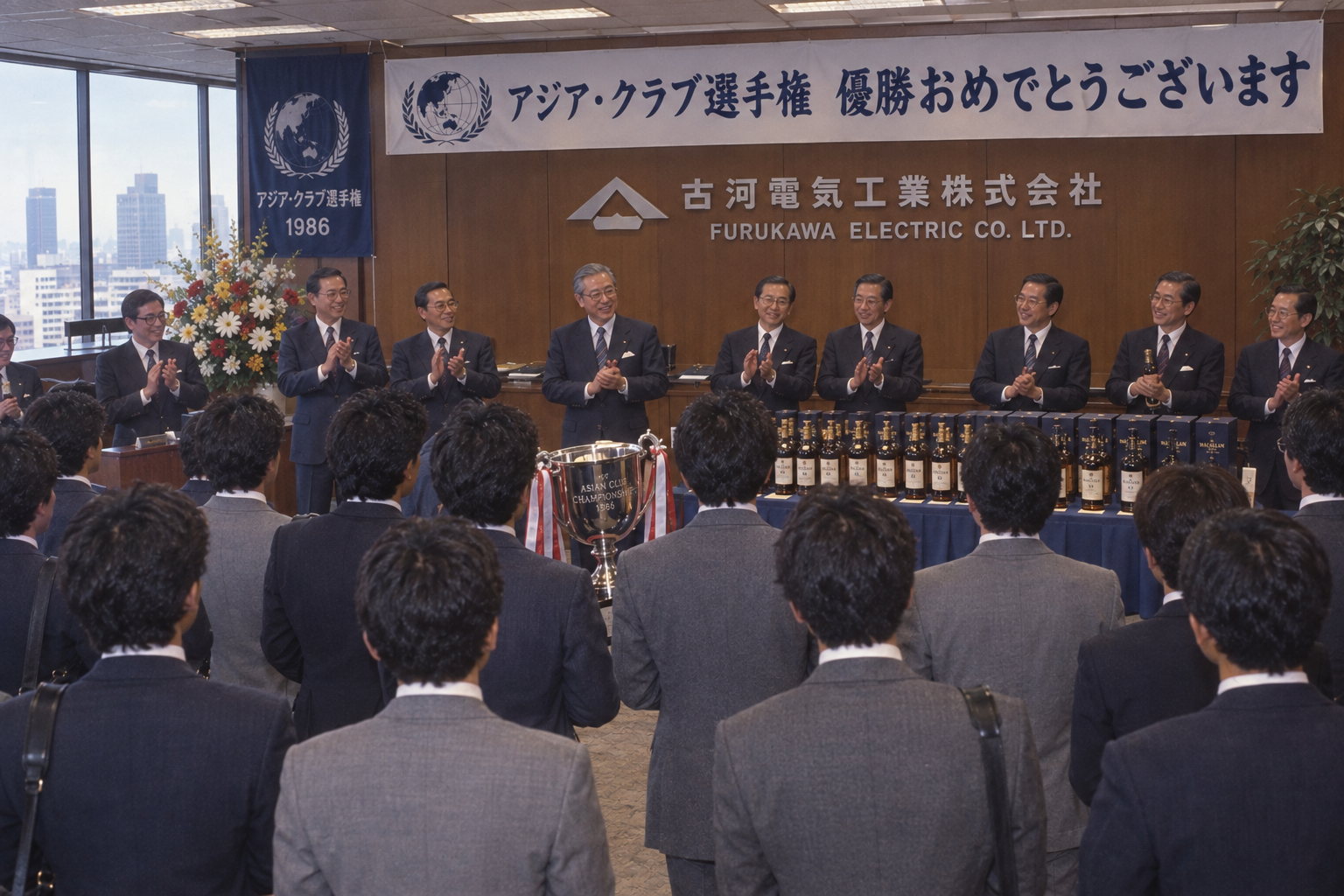
Furukawa's squad was, Okudera aside, a team of salaried company employees who split their time between an office and a training pitch. So when the newly crowned champions of Asia flew home to Tokyo, the company reward waiting for them was modest almost to the point of comedy: a single bottle of premium liquor, handed to each player.
At the time, nobody seemed to mind. Okada remembered the moment fondly, and with a self-awareness that only arrives with distance:
"To commemorate the championship, the company rewarded each player with a single bottle of premium liquor. At the time, we celebrated wildly, yelling 'We did it!' But looking back on it later, I realised we had been smoothly managed. After all, we were the champions of Asia, playing in Saudi Arabia; the prize money alone must have been substantial."
It's a small detail, but it says almost everything about the era those players were operating in, and Okada, again, put it best:
"Even as a company team, we claimed: 'We are pros.' But looking back objectively, we were truly naive amateurs. After practice, we went out drinking and passionately debated football. We simply loved the game. In an era when choosing football made little sense for your future career, we loved it, and we loved fighting as Furukawa Electric. That is why we played as hard as we could without worrying about what lay ahead."
That gap between what the players had just proven and what the company gave them for it wasn't lost on Japanese football's wider governing bodies. If a company squad of part-time footballers could win Asia, the argument for keeping the sport organised as a network of corporate hobby teams got considerably harder to make. It's not the only reason Japan eventually tore the whole structure down and rebuilt it as a professional league, but it's one of the harder ones to argue with.
Behind the scenes, one man had already spent the tournament thinking in exactly those terms. Junji Ogura, who had travelled to Riyadh from Furukawa's London office to help manage the trip, spent the following decades building the international relationships that would eventually make him president of the Japan Football Association and, later, one of the small number of Japanese officials ever to sit on the FIFA Executive Committee.
What Furukawa Started
The win didn't stay a novelty for long. The following year, Yomiuri Club followed Furukawa's example and won the 1987 Asian Club Championship as well, giving Japanese clubs back-to-back continental titles and giving the rest of the Japan Soccer League a very direct incentive to start taking international competition seriously. Furukawa's own reward for winning Asia was a trip to Cairo in early 1988, for a one-off Afro-Asian Club Championship match against African champions Zamalek in front of a crowd of 40,000. They lost 2–0, a reminder that the gap they had just closed against Asia's best hadn't closed everywhere at once.
The individuals who made the trip to Riyadh went on to shape Japanese football for decades afterward. Kiyokumo later joined the national team's coaching staff and lived through the "Agony of Doha" in 1993, before managing JEF United Ichihara himself. Okada carried the composure he'd found in that Liaoning siege into a management career that included Japan's first FIFA World Cup qualification in 1997 and its historic run to the Round of 16 at the 2010 World Cup in South Africa, arguably the two biggest nights in the national team's history up to that point. Okudera, whose hat-trick had turned the tournament, would later be inducted into the Japan Football Hall of Fame, recognition for a career that had already made the case for professionalism in Japan before most of the country was ready to hear it.
And when the J.League finally launched in 1993, Furukawa Electric's football club merged with JR East to form JEF United Ichihara, a founding member of the new professional era. Kiyokumo, half-jokingly, once suggested that a manager might not have even been necessary for the group of players he'd taken to Riyadh:
"Perhaps a manager wasn't even needed for that team." (「もしかしたら、監督は必要なかったかもしれません」)
He trusted Okada, Miyauchi, and Okudera to organise themselves on the pitch, and in Riyadh, under conditions none of them had trained for, that trust held. Furukawa Electric had gone looking for continental respect and come home with a trophy, some bruises, a few grievances about refereeing they never quite let go of, and a bottle of whisky each. It turned out to be enough to change the shape of Japanese football for good.
A note on translation:
Quotations in this piece were originally given in Japanese and have been translated into English; none were originally given in English.
Sources
Furukawa Electric Co., Ltd. — Platform Legend: Eijun Kiyokumo, "The Asian Title We Won Together"
Furukawa Electric Co., Ltd. — Platform Legend: Takeshi Okada, "Becoming a Professional Was an Obligation"
Furukawa Electric Co., Ltd. — Platform Legend: Yasuhiko Okudera, "Never Fear the Challenge, Go to the World"
Furukawa Electric Co., Ltd. — Platform Legend: Junji Ogura, "What I Brought Back From London"
Soccer Magazine Web — "Overcoming Hardship to Conquer Asia: Furukawa Electric"
Web Sportiva — "Japan's First ACL Title Came 40 Years Ago, Won by a Hat-Trick Legend on the Toughest of Away Trips"
Furukawa Electric Co., Ltd. — Soccer Club History
Furukawa Electric Co., Ltd. — Soccer Club Official: History and Tradition
Japan Football Association (JFA) — Japan Football Hall of Fame: Yasuhiko Okudera
KAKU Sports Office — "Yasuhiko Okudera: Japan's First Asian Conquest with Furukawa Electric"
FC-Forum — "1986 Soccer Digest: Japan Soccer League Retrospective"
Wikipedia (Japanese) — 1986 Asian Club Championship
Wikipedia (Japanese) — Hiroshi Yoshida (footballer)
RSSSF — Asian Club Competitions 1986/87
Wikipedia (English) — 1986 Asian Club Championship
Wikipedia (English) — Yasuhiko Okudera
Wikipedia (English) — 1987 Afro-Asian Club Championship